
24/7 Customer Support

Free returns

Same-day & Next-day Delivery

Quality Guaranteed

Unlock Your Welcome Offers: FREE Delivery | Up to 80% OFF | Free 30-day JoyPlus trial
Download the APP
Replacing a cooking appliance can look straightforward until installation day reveals an unsuitable cut-out, an overloaded circuit or cookware that will not heat. Built-in hobs vary considerably in fuel type, dimensions, control systems and safety features, so comparing the headline price alone can lead to extra costs.
The most common buying pitfalls are:
A typical 60cm hob may measure approximately 590mm wide, while its required cut-out could be 560mm by 490mm. However, dimensions differ between models. Check:
For example, some compact 29cm models require a cut-out of approximately 260mm by 490mm. This can suit a compact kitchen, studio flat or a worktop that cannot accommodate a full-width appliance.
Do not assume an existing opening can be reused without checking the new installation diagram. A professional installer should confirm the fit before cutting the worktop.
An induction hob heats a compatible magnetic pan directly. It generally offers responsive control, automatic pan detection and a cooler surrounding surface than radiant electric technologies, although the glass may remain hot from the pan. You will need magnetic cookware, such as suitable cast iron or magnetic stainless steel.
A ceramic hob uses radiant heating elements beneath a smooth glass-ceramic surface. It works with a broad range of flat-bottomed cookware, including aluminium and non-magnetic stainless steel, but the surface and pans can remain hot after switching off.
A traditional electric hob with solid plates is straightforward and may suit rental properties or households seeking rotary controls. It usually takes longer to heat and cool than induction.
A gas hob provides visible flame adjustment and works with most cookware. Look for a flame-failure device, which is designed to stop the gas supply if the flame goes out. A gas connection must be completed by a Gas Safe registered engineer.
The total rated power gives an indication of the electrical load, but it does not mean every zone continuously consumes the maximum figure. A four-zone induction model may have power management to distribute available electricity across zones.
For UK installations, check the listed rated fuse, supply requirements and whether the hob is supplied for hard-wiring. A 7,200W model and a 2,900W compact model may require different electrical arrangements. Never use an unsuitable extension lead for a built-in hob.
Useful everyday features include:
The following options suit different kitchen layouts, budgets and cooking patterns. Product specifications should be checked again before purchase and installation.
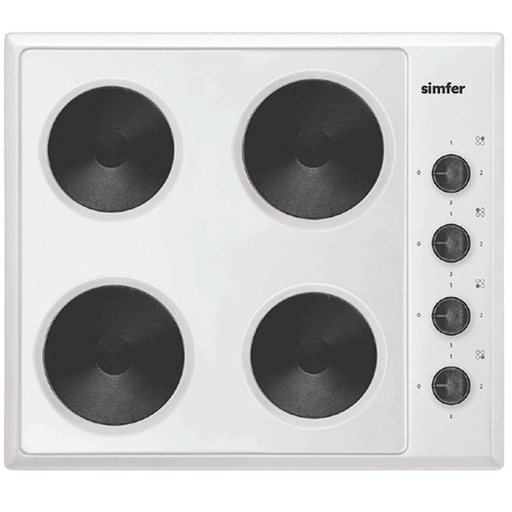
Why This Fits Their Persona: A practical choice for first kitchens, rental properties and households wanting four cooking areas with familiar side-mounted rotary controls.
Its listed 60cm format and approximately 590mm by 520mm dimensions make measurement straightforward, while the solid-plate design avoids induction cookware restrictions.
Four solid plates; two 1,000W plates and two 1,500W plates; white finish and manual controls.
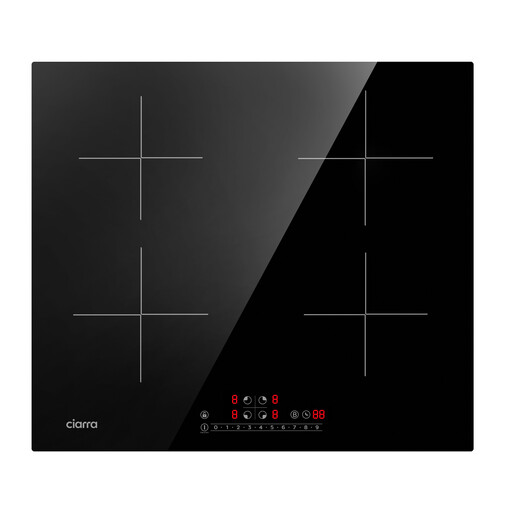
Why This Fits Their Persona: Suitable for regular family cooking where four pans, precise controls and a coordinated black glass finish are priorities.
The product page lists a 560mm by 490mm cut-out, nine power levels, automatic pan detection and a 32A rated fuse, giving installers important information in advance.
Four zones; booster function; individual 99-minute timers; child lock and residual heat indicator.

Why This Fits Their Persona: Designed for cooks who regularly use several pans, large cookware or a wok and prefer visible flame control.
The five-burner layout and listed 75cm width make its capacity clear. It also specifies flame-failure devices and a cast-iron support system.
Five burners including a double-ring wok burner; automatic ignition; rotary dials; LPG conversion option listed.

Why This Fits Their Persona: A flexible option for tenants, small kitchens, temporary accommodation or households needing an additional cooking zone without modifying the worktop.
Its portable format avoids incorrect built-in cut-outs. It still requires magnetic, flat-bottomed cookware and clear ventilation around the unit.
2,000W power; eight power levels; 60–270°C temperature range; three-hour timer and child lock.
We have compiled a complete, real-time list of products that fully satisfy these strict selection criteria and UK safety regulations.
Many built-in electric hobs are designed for a hard-wired connection to a suitable fused spur rather than a standard plug. Check the product specification, rated fuse and installation manual. A qualified electrician should assess the circuit and complete the connection in line with applicable UK requirements.
Lifespan depends on construction, frequency of use, cleaning and installation quality. Avoid abrasive cleaners, do not use a hob with cracked glass and keep ventilation openings clear. Rotary controls, solid plates, radiant elements and induction electronics can have different service requirements, so check the warranty and manufacturer guidance before buying.
Induction transfers heat directly to compatible cookware, which can reduce wasted heat during some cooking tasks. Running cost still depends on the electricity tariff, cooking time, pan size and selected power level. Compare the rated power and use residual heat or timers where appropriate rather than relying on efficiency labels alone.