
24/7 Customer Support

Free returns

Same-day & Next-day Delivery

Quality Guaranteed

Unlock Your Welcome Offers: FREE Delivery | Up to 80% OFF | Free 30-day JoyPlus trial
Download the APP
A built-in induction hob can give a kitchen a clean, modern appearance while providing responsive heat and straightforward cleaning. However, product listings often focus on power boosts, glossy glass and large warranty figures without explaining the details that affect installation and everyday use.
Before choosing a 60cm induction hob or another size, watch for three common buying traps:
A standard 60cm built-in induction hob usually has four cooking zones and is suitable for many UK kitchen layouts. Typical models in this category measure around 590–592mm wide and 520–522mm deep, with a cut-out close to 560 x 490mm. These dimensions are not universal, so always compare the appliance specification with your worktop and installation manual.
A four-zone induction hob works well for everyday family cooking, while a 29cm two-zone model may suit a small flat, annex or compact kitchen. Larger 77cm hobs provide more space but need a wider worktop cut-out and may not suit a standard replacement project.
A touch control induction hob can create a smooth, uncluttered surface without rotary dials. Look for clearly separated controls, readable power indicators and a suitable number of settings. Models range from nine power levels to 17 levels, with intermediate settings offering finer adjustment for simmering.
An induction hob with boost function can temporarily increase power for tasks such as boiling water. Check whether boost is available on all zones, whether power is shared between zones and whether it reduces automatically after a defined period.
An induction hob with timer can switch an individual zone off after the selected cooking period. This is useful for simmering, steaming and reducing the risk of leaving a pan heating unattended, although normal supervision is still required.
Many full-size induction hobs are hardwired induction hob appliances with a total connected load between approximately 7.2kW and 7.4kW. They should be installed and connected by a qualified electrician in accordance with the manufacturer’s instructions and applicable local requirements.
Check the following before ordering:
Useful safety features include a child-safe induction hob lock, residual heat indicators, automatic pan detection and safety switch-off. Induction glass may remain cooler than a ceramic cooking surface, but the area beneath a hot pan can still retain heat. Do not touch it until the indicator confirms it has cooled.
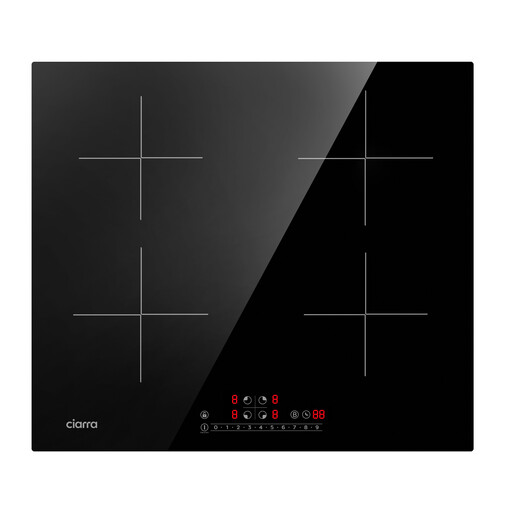
Why This Fits Their Persona: A practical four-zone layout for renters, first-time renovators and households moving from a traditional electric hob to induction cooking.
The specification states the 590 x 520mm appliance size, 560 x 490mm cut-out and 32A rating, helping buyers check installation compatibility before purchase.
Nine power levels, booster function, individual timer, pan detection and child lock are included.

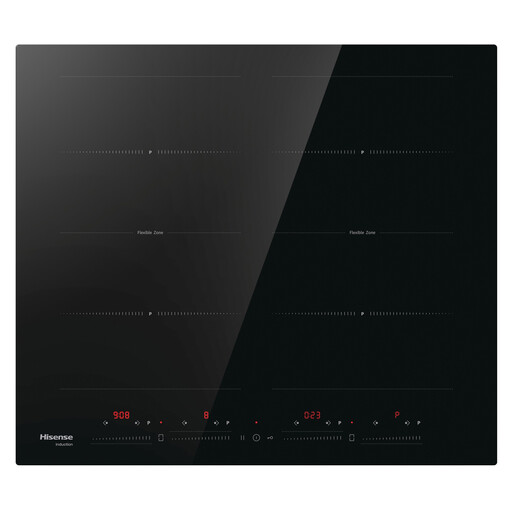
Why This Fits Their Persona: A suitable choice for a planned kitchen renovation where a frameless black-glass finish and detailed control are priorities.
The listing clearly identifies the 7.4kW hardwired connection and professional installation requirement rather than treating fitting as a minor detail.
It provides four zones, 17 power levels, PowerBoost, QuickStart, ReStart and an independent timer for each zone.
Why This Fits Their Persona: Useful for batch cooking, large pans and griddles in busy family kitchens without moving to a wider hob.
Area Flex addresses the limitation of fixed circular zones by combining two zones for larger cookware.
It includes four slider controls, Rapid Boil, Heat Shift, an integrated timer with automatic switch-off and child lock.
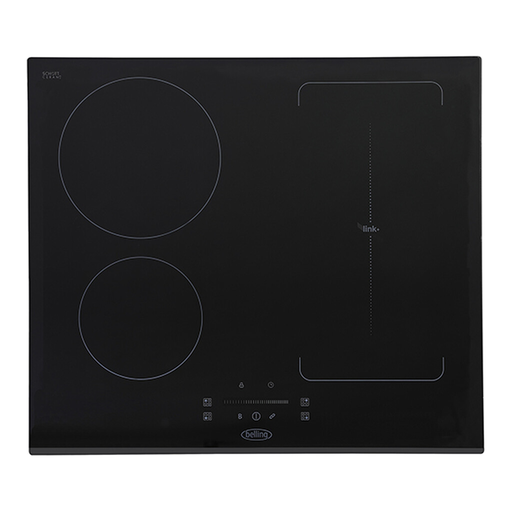
Why This Fits Their Persona: Suits home cooks who use irregular cookware such as griddle or fish pans and want a flexible cooking area.
The Link+ function is specified for joining two zones, while the 560 x 490mm cut-out helps with standard 60cm installation planning.
It has four boost functions, slider controls, individual timers, pan detection and Schott Ceran glass.
We have compiled a complete, real-time list of products that fully satisfy these strict selection criteria and UK safety regulations.
Many four-zone models have a connected load of around 7kW or more and are supplied for fixed electrical connection. The exact requirement varies by model. Check the installation instructions and arrange fitting by a qualified electrician rather than assuming an existing socket is suitable.
Running cost depends on the appliance’s efficiency, cooking time, household electricity tariff and how much power is used. Induction heats compatible cookware directly, while a ceramic hob first heats an element and then transfers heat through the glass. This can make induction responsive, but the purchase price, installation and suitable cookware should also be included in your comparison.