Family-batch cookie bakers
If cookies are the main oven task, look at the model’s fan mode, stated shelf capability and usable cavity space before deciding whether one oven is enough.


Choose a single built-in oven with a documented fan or multilevel mode if cookies are the main oven task and one cavity will handle the planned batch. A double oven makes more sense when you also need to cook another dish separately; whichever type you choose, check the exact cabinet opening and electrical requirements before ordering.
If cookies are the main oven task, look at the model’s fan mode, stated shelf capability and usable cavity space before deciding whether one oven is enough.
If the gathering meal needs oven space while the cookies bake, separate cavities may help you manage the dishes without sharing one cooking zone.
Measure the existing cabinet opening and check the new model’s connection instructions. Cleaning features and energy-label information can then help distinguish ovens that fit.
Choose it when: Cookies are the main oven task and one cavity can accommodate your planned batches.
Trade-off: A single cavity cannot keep cookies separate from another dish needing different oven settings.
Choose it when: You need a separate cavity for another gathering dish while baking cookies.
Trade-off: It needs a suitable taller cabinet opening; for example, AEG specifies an 875 mm-high opening for its OU5NP20B double oven.
| Concern | What to check | Who this matters to |
|---|---|---|
| Baking several trays | Check the exact model’s fan mode and manufacturer-stated number of simultaneous baking levels. | If I need several trays of cookies, I want to know which shelf arrangement the oven is designed to handle. Around 40% of consumers put multitray baking first. |
| Cooking other dishes | Check whether there are two usable cavities and whether the cabinet can accommodate the model. | When cookies and the gathering meal both need oven time, I would rather give them separate cavities. For around 30% of consumers, that separation is the primary need. |
| Fit and upkeep | Compare the required cabinet opening and connection instructions; check the cleaning procedure and the exact model’s energy information. | Before replacing an oven, I need it to fit my kitchen and have maintenance requirements I can manage. Those practical checks come first for around 30% of consumers. |
A single oven and a double oven can need very different cabinet heights. AEG specifies a 590 mm-high built-in opening for the BSX23101XM single oven and 875 mm for the OU5NP20B double oven.
Measure the opening’s height, width and depth, then compare all three with the exact model’s installation instructions.
If the opening does not match, fitting the oven could also involve altering the cabinet.
Connection requirements differ by model. Bosch and NEFF specify an electrician connection for cited ovens without plugs; AEG specifies a hardwired connection and a 30 A fuse requirement for the OU5NP20B.
Check the chosen model’s installation instructions and electrical requirements before arranging installation.
A required change to the electrical installation can add work beyond fitting the appliance.
A double oven helps separate cookies from other dishes, but its second cavity does not by itself establish how many cookie trays can bake together in the main oven.
If cookies are the only oven task, compare the exact fan mode, stated multilevel capability and cavity space before choosing a double model.
An energy class alone does not describe how often you will use the oven or which cooking functions you will select.
For covered products, GOV.UK guidance from the Department for Energy Security and Net Zero and the Office for Product Safety and Standards requires an energy label at the point of sale, including online, and a product information sheet. Compare the documentation for the exact ovens and cavities you are considering.
A reference point for comparing conventional built-in ovens with models that add steam assistance.
Its cited models illustrate the choice between a single true-fan cavity and a double oven for cooking separate dishes.
A comparison point for households interested in frequent multilevel baking alongside access and cleaning features.
These built-in single and double ovens relate to two decisions: baking cookies in one cavity or keeping another gathering dish separate. Compare each model’s installation instructions and guidance for the number of trays you plan to use.
 No image available
Consider the two-cavity layout if cookies need oven time alongside another dish. This model is intended for eye-level installation; confirm the housing dimensions and hardwired electrical requirements before ordering.
 No image available
A single cavity suits a cookie-focused gathering when another dish does not need separate oven settings. Check the model’s multilevel baking instructions, required cabinet opening and hardwired connection details.
 No image available
The two cavities are relevant when cookies and another gathering dish need separate oven space. Check the required cabinet opening, electrical connection and guidance on simultaneous cookie trays.
 No image available
The single 65 L cavity is an option when cookies are the main oven task. If you plan to bake several trays at once, check the fan-mode instructions; also confirm the electrical connection, as a plug is not supplied.
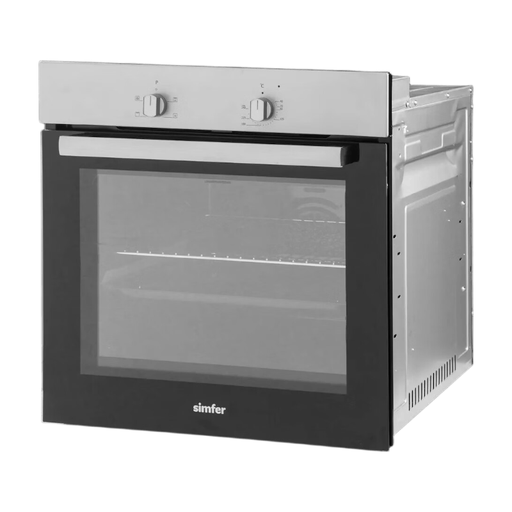 No image available
A single fan oven is relevant if you can bake the gathering’s cookies without a separate cooking cavity. Check its permitted tray arrangement, cabinet cut-out and electrical connection before purchase.
A documented fan or multilevel mode is worth considering if you plan to bake more than one tray. AEG, Bosch and NEFF describe multilevel capability for the cited models, but results still depend on the recipe, tray spacing and the exact mode used.
No: exterior width does not establish the required opening. AEG lists a 590 x 560 x 550 mm built-in opening for its BSX23101XM single oven and 875 x 560 x 550 mm for its OU5NP20B double oven, so measure your cabinet against the exact model’s instructions.
Do not assume the oven has a plug. Bosch and NEFF specify an electrician connection for cited models, while AEG lists its OU5NP20B as hardwired only with a required 30 A fuse; follow the chosen model’s installation instructions and use a suitably qualified installer where required.
Compare the energy label and product information sheet for the exact oven, rather than relying on its energy class alone to predict household running cost. GOV.UK guidance from the Department for Energy Security and Net Zero and the Office for Product Safety and Standards says covered products must display an energy label at the point of sale, including on a website, and be accompanied by a product information sheet.
Choose a cleaning system whose procedure you are willing to follow; the feature name alone does not establish which will suit your kitchen. AEG lists Aqua Clean for the BSX23101XM, Bosch lists EcoClean Direct for the HQA534BB3B, and NEFF lists pyrolytic and hydrolytic cleaning for the B54CR71N0B. Check each model’s manual for the steps and removable parts involved.