Care-home kitchen buyers planning regular menus
Pack size, cupboard storage and the use of opened tins matter when beans appear repeatedly on a menu. Compare the recipe’s declared nutrition alongside the quantity the kitchen can serve.


Choose full-size multipacks when the kitchen can use each opened tin within its stated storage period and the recipe fits residents’ assessed meal plans. Compare salt and sugars per 100g before deciding on pack size; smaller portions may be more practical when a full tin would leave leftovers. No retail label replaces checks against individual care plans, allergens or prescribed food textures.
Pack size, cupboard storage and the use of opened tins matter when beans appear repeatedly on a menu. Compare the recipe’s declared nutrition alongside the quantity the kitchen can serve.
In England, the Care Quality Commission’s Regulation 14 guidance requires services within its scope to assess nutritional needs and provide food that meets them, taking account of people’s preferences and cultural or religious backgrounds.
Where a resident has documented swallowing requirements, the decision concerns the finished meal and the home’s preparation and serving process, not just the tin. The Health and Safety Executive stresses the need for robust systems that deliver the appropriate texture at every mealtime.
Start with the residents’ meal requirements, then compare recipes on the same per-100g basis and choose a tin size the kitchen can use within the label’s storage instructions.
| Priority | What to check | Your needs |
|---|---|---|
| Recipe | Compare salt and sugars per 100g across the exact products. Read the ingredients as well as any reduced-salt or no-added-sugar wording. | I’m planning meals where the bean recipe needs to fit assessed requirements, rather than choosing by tin count alone. |
| Portions | Check tin weight, tins per pack and the quantity expected at each service. Compare declared fibre and protein per 100g as part of the wider menu, not as a substitute for an individual meal plan. | Will a full-size tin be used at one service, or would smaller portions leave less unused food? |
| Opened tins | Read the exact label for transferring, refrigerating and using leftovers. Allow for fridge space and the next planned service. | I need a pack size that fits our menu cycle and our process for handling opened food. |
| Individual requirements | Check current ingredients and allergen information against care plans. Where a texture is prescribed, assess the prepared meal against that requirement rather than relying on the retail product name. | Residents may need different ingredients, portions or food textures even when the kitchen buys one multipack for routine service. |
ASDA Groceries declares 0.34g salt per 100g for its reduced-salt 4 x 410g pack; Waitrose & Partners declares 0.6g per 100g for the cited Heinz standard 6 x 415g pack. Pack quantity alone does not show that difference.
Compare nutrition per 100g first, then work out which pack quantity suits the planned servings.
A reduced-salt label does not establish suitability for a particular resident or for a prescribed food texture. The Care Quality Commission’s guidance for regulated services in England centres on assessed needs, while the Health and Safety Executive emphasises appropriate texture-modified food for people with swallowing difficulties.
Check the current label and the resident’s documented requirements before serving or changing a menu.
Opened-tin instructions vary: Sainsbury’s states a two-day refrigerated use period for its cited multipack, while Marks & Spencer states three days for its cited baked beans.
Plan servings and refrigerated storage around the instructions on the exact product being used.
Leftovers that cannot be used within the stated period create avoidable food waste.
A previous product listing may not reflect the tin delivered to the kitchen, which matters when checking a resident’s allergens or other documented requirements.
Check the current pack at goods-in and before preparation, and update the kitchen’s menu records when product details change.
These named products provide label-based points of comparison; a brand name alone does not establish the details of another pack or recipe.
The cited standard six-pack offers full-size tins, while the cited No Added Sugar Snap Pots offer a different portion format.
Tesco Groceries lists own-label and branded baked beans in the same category, allowing shoppers to inspect individual product listings side by side.
The cited own-label baked beans come as a 4 x 400g multipack.
The cited reduced-salt, no-added-sugar own-label recipe comes in a 4 x 410g multipack.
The cited M&S baked beans provide a single-tin reference for kitchens comparing recipes and opened-food instructions.
The cited Essential standard and reduced-salt-and-sugar tins offer two own-label recipes to compare.
These four-tin and six-tin baked-bean multipacks are options for planning regular kitchen service. Choose between the stated pack sizes and recipes using the current label and the home’s menu requirements.
 No image available
Four 410g tins offer a full-size multipack for a menu considering a reduced-sugar-and-salt recipe. Check the current ingredients and nutrition label against residents’ meal plans, and plan how opened tins will be used.
 No image available
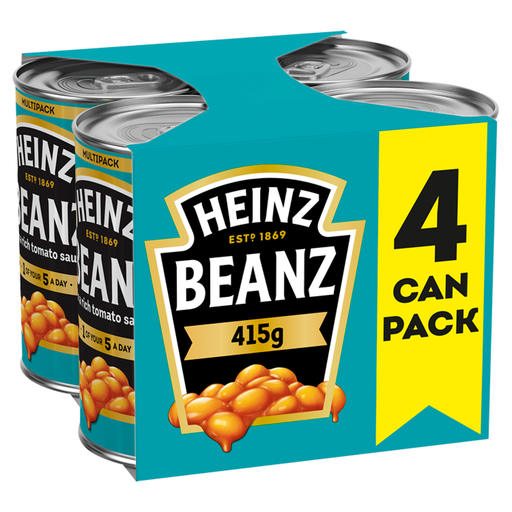
This four-tin, 415g-per-tin format can be considered for planned full-size-tin service. Compare the current pack’s per-100g nutrition with the menu requirements and check its opened-tin instructions.
 No image available
Six 410g tins may fit a kitchen that plans frequent baked-bean services. Check that the menu can use the quantity and follow the current label’s instructions after each tin is opened.
 No image available
Four 410g tins provide a smaller pack count than the six-tin Branston option. Use the current label to compare its recipe with the meal plan and to schedule safe use of opened tins.
No. A lower declared salt figure is one recipe detail, not an assessment of an individual meal. For regulated services in England, the Care Quality Commission’s Regulation 14 guidance requires food to meet assessed nutritional needs and to take account of preferences and cultural or religious backgrounds.
Follow the instructions on that tin. For example, Sainsbury’s says to transfer leftovers from its cited 4 x 400g product to a non-metallic container, refrigerate and use within two days; Marks & Spencer gives a three-day refrigerated period for its cited product. Do not apply one product’s period to another.
Only serve them when the finished food meets that resident’s documented texture and swallowing requirements. A retail tin does not establish the texture of the prepared meal; the Health and Safety Executive stresses that care providers need robust preparation and serving systems for people requiring texture-modified food.
For services within its regulatory scope in England, the Care Quality Commission says Regulation 14 requires providers to assess people’s nutritional and hydration needs and provide food and drink that meet them. Providers elsewhere in the UK should check the requirements of their applicable national regulator rather than treating this England-specific rule as UK-wide.
Check the current product label against each relevant care plan when purchasing and before preparation. Keep the kitchen’s ingredient records aligned with the packs being served rather than relying on an earlier listing for the same product name.