Households that use beans regularly
A four- or six-tin pack fits a household that routinely uses full-size tins and can store the whole pack. Check the dates and the space available before increasing the quantity.


Choose a multipack if your household regularly uses full-size tins and has room to store them; a smaller tin makes more sense if you seldom finish an opened one. Choose the recipe separately: compare salt and sugars on the nutrition panels rather than assuming that every reduced recipe has the same values. Before stocking up, check the best-before dates and storage instructions on the tins.
A four- or six-tin pack fits a household that routinely uses full-size tins and can store the whole pack. Check the dates and the space available before increasing the quantity.
If baked beans appear frequently in your meals, compare the exact recipes using the salt and sugars figures per 100g and per portion. A reduction claim refers to a named standard recipe, not every other tin on the shelf.
A single tin or smaller serving format may better match how much you use at once. Check the tin size before committing cupboard space to a multipack.
Settle on a quantity your household will use, then compare recipes and check how the tins need to be stored.
| Priority | What to check | Your needs |
|---|---|---|
| Pack size | Compare the number of tins and the grams in each tin. Consider how often you open one and whether you normally finish it. | We use full-size tins regularly, so a multipack could fit our routine; for occasional meals, I would rather open a smaller tin. |
| Recipe | Compare salt and sugars per 100g on the exact products. Check which standard recipe a reduced-sugar or reduced-salt claim uses as its reference; the NHS notes that labels may also give figures per portion. | When choosing between standard and reduced recipes, I want to compare what is in the amount I expect to eat, not rely on the variant name alone. |
| Dates and storage | Check best-before dates and unopened storage directions before stocking up. GOV.UK identifies tinned baked beans as a best-before product: the date concerns quality rather than being a use-by deadline. | There needs to be room for the tins, and our usual rate of use should suit their dates. |
| Ingredients | Read the ingredient, allergen and dietary-suitability statements on the exact variant. Recheck them when changing brand or recipe. | If someone in the household needs to avoid an ingredient, I need the statement for the tin we will actually buy. |
A large supply takes cupboard space, while GOV.UK notes that food past its best-before date may lose quality.
Check dates and storage directions before ordering, and put older tins where you will use them first.
Tins left unused for too long can mean unwanted stock and food waste.
Waitrose Essential Reduced Salt & Sugar states 30% less sugar and salt than regular Essential beans; a Waitrose listing describes Heinz No Added Sugar as having 25% less salt than standard Heinz Beanz. Those claims use different reference recipes.
Compare salt and sugars per 100g on the tins you are choosing, as well as any portion figures.
Marks & Spencer states that its Only 7 Ingredients Baked Beans are not suitable for people with milk or egg allergy.
Check the ingredient and allergen statements on the exact product, particularly when switching recipes.
These ranges illustrate recipe and pack-format differences; check the exact tin rather than applying one variant’s details to a whole brand.
Heinz appears in UK supermarket listings with standard multipacks and a no-added-sugar variant.
Tesco lists own-label standard and reduced-sugar-and-salt beans in 4 x 420g packs.
Sainsbury's lists own-label baked beans in standard and reduced-sugar-and-salt varieties, including 400g tins and four-packs.
The M&S range includes 400g baked beans and an Only 7 Ingredients recipe in a 220g tin.
Waitrose lists Essential standard and Reduced Salt & Sugar baked beans in 420g tins.
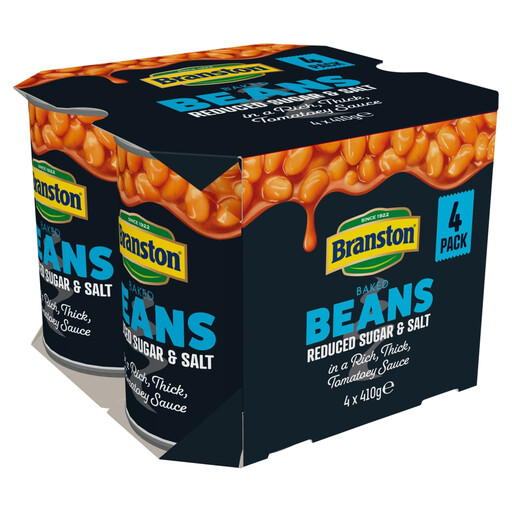
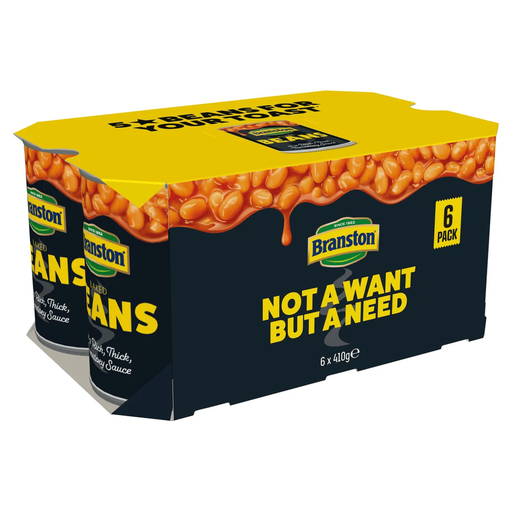
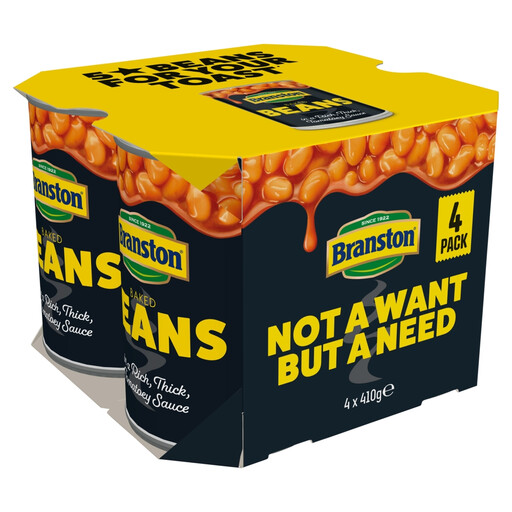
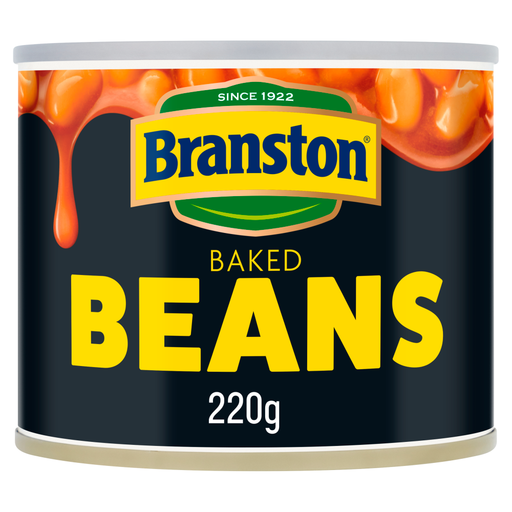
These Branston options cover full-size multipacks in standard or reduced-sugar-and-salt recipes, plus a smaller single tin for occasional use.
 No image available
Four full-size tins suit repeated use when you want to compare a reduced-sugar-and-salt recipe with standard beans. Check both nutrition panels and the best-before dates before stocking up.
 No image available
This six-tin standard-recipe pack suits a household that regularly uses 410g tins. Check that you have storage space and compare its nutrition panel if salt or sugars affect your choice.
 No image available
This four-tin standard-recipe pack offers a smaller cupboard supply than the six-tin Branston option. Match the quantity to your use and check the dates on the tins.
 No image available
This single 220g tin is an alternative when you want to open less at once rather than store a multipack. Follow the tin’s instructions for any contents left after opening.
Usually, a best-before date is about quality rather than a use-by safety deadline. GOV.UK specifically identifies tinned baked beans as a best-before product and says food may not be of the same quality after that date; check that it has been stored correctly and assess the product before using it.
Follow the instructions on the exact tin. Joybuy’s Branston 4 x 410g listing instructs shoppers to transfer opened contents to a container, refrigerate them and use them within two days; check your own product’s labelled period rather than applying that instruction to every recipe.
No: reduction claims refer to particular standard recipes. Waitrose says its Essential Reduced Salt & Sugar beans have 30% less sugar and salt than regular Essential beans, while its Heinz No Added Sugar listing states 25% less salt than standard Heinz Beanz. Compare the actual salt and sugars figures per 100g on the tins you are considering.
No. Waitrose describes its standard Heinz 4 x 415g pack as suitable for vegetarians and vegans, but Marks & Spencer states that its Only 7 Ingredients Baked Beans are not suitable for people with milk or egg allergy. Read the exact product’s ingredient, allergen and suitability statements.
Use the per-100g figures to compare recipes on the same basis, then check any per-portion figures against the amount you expect to eat. The NHS notes that nutrition labels give information per 100g and sometimes per portion, including sugars and salt.