People who eat beans regularly
If baked beans feature in your breakfasts, jacket potatoes or quick dinners, compare protein for the portion you actually eat as well as the number and size of tins in a pack.


Baked beans can contribute protein and fibre to a meal, as the NHS Eatwell Guide notes for pulses, but a tin should not be assumed to meet a whole meal’s protein requirements. Compare the exact recipe per 100g and for the portion you plan to eat, then choose a multipack size that lets you use each opened container within its stated storage period. Reduced-sugar-and-salt recipes are worth comparing when those label differences matter to you, but check their protein and ingredients too.
If baked beans feature in your breakfasts, jacket potatoes or quick dinners, compare protein for the portion you actually eat as well as the number and size of tins in a pack.
If sugar or salt is part of your decision, compare the exact standard, no-added-sugar or reduced-sugar-and-salt recipe. A claim about one nutrient does not tell you its protein amount or full ingredient list.
If you rarely finish a large tin at once, check how the remaining beans must be stored and how soon they must be used. Smaller containers may be more practical than a cupboard full of large tins.
Start with the nutrition panel for the exact recipe, then check whether the container size fits the way you use beans.
| Priority | What to check | Your needs |
|---|---|---|
| Protein per portion | Compare protein per 100g on the exact recipe. Work out the amount for the portion you intend to eat rather than treating a whole tin as one serving. | I use beans as part of a protein-focused meal and want to know what my usual portion contributes. |
| Sugar and salt | Read sugar, salt and protein per 100g together. Check what a reduced claim is compared with, and read the ingredients if sweeteners matter to you. | A no-added-sugar or reduced-sugar-and-salt recipe interests me, but I still want to compare its full label with a standard tin. |
| Pack and storage | Check the number of containers, their individual size and the instructions after opening. The listed Branston standard beans say to refrigerate and use within 2 days, according to Waitrose & Partners; M&S Only 7 Ingredients beans say within 3 days, according to Marks & Spencer. | I want enough tins for repeat meals without regularly leaving part of an opened container unused. |
| Allergens | Read the current allergen statement for the exact product. A vegan or vegetarian description is not a substitute for an allergy check. | If milk or egg allergy affects my choice, I need the product-specific warning, not just a dietary label. |
The amount of protein you get depends on both the recipe and how much you eat. For example, the product information from Marks & Spencer, Waitrose & Partners and Joybuy lists between 4.2g and 5.0g protein per 100g for the specific recipes cited here.
Use the per-100g figure to calculate your planned portion, then consider the beans alongside the other foods in the meal.
Post-opening instructions differ: Waitrose & Partners lists 2 days for standard Branston beans, while Marks & Spencer lists 3 days for its Only 7 Ingredients beans, in each case with refrigeration instructions.
Check the tin you buy, follow its container and refrigeration instructions, and consider smaller portions if you are unlikely to use the remainder in time.
A reduction claim describes a particular recipe against a stated comparison product; it does not establish its protein content. The Branston Reduced Sugar & Salt listing on Joybuy, for example, compares sugar and salt with standard Branston.
Compare protein, sugar and salt per 100g for the exact pack, and check its ingredients and allergen information.
Marks & Spencer describes its standard baked beans as vegan and vegetarian but also states that they are not suitable for people with milk or egg allergy.
Use the current allergen statement on the specific product when an allergy affects your purchase.
These ranges offer different recipes and container sizes; compare the exact product label rather than applying one recipe’s figures to an entire brand.
Waitrose & Partners lists Heinz baked beans in 4 x 415g and 6 x 415g tins, alongside 4 x 200g Snap Pots.
Branston has standard 410g baked beans and a separate Reduced Sugar & Salt 4 x 410g recipe in the supplied product information.
Tesco Groceries lists both standard and Reduced Sugar & Salt own-brand baked beans in 4 x 420g packs.
Marks & Spencer lists standard baked beans and an Only 7 Ingredients recipe with distinct nutrition panels.
Waitrose & Partners lists standard and Reduced Salt & Sugar Essential baked beans in 420g tins.
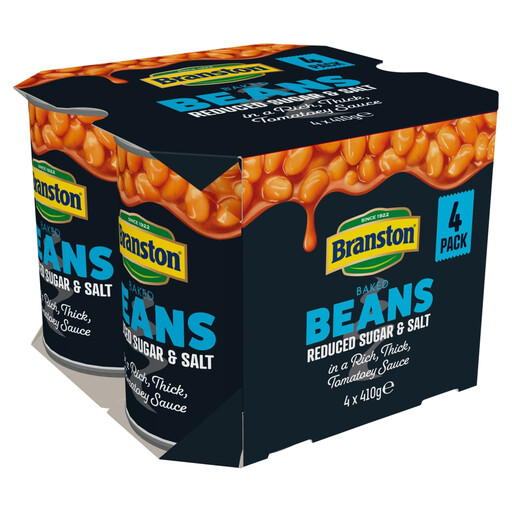
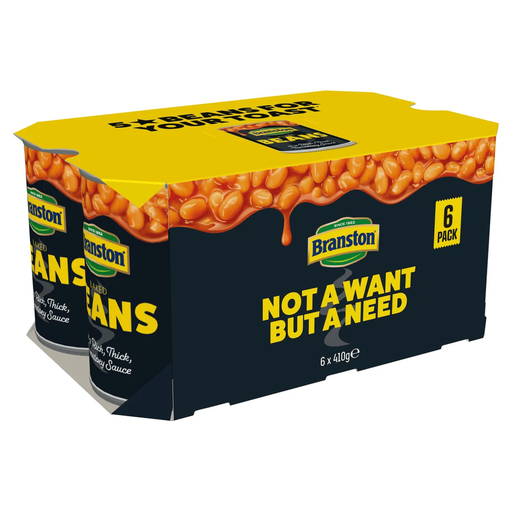
These Branston multipacks offer a choice between a reduced-sugar-and-salt recipe in four 410g tins and a standard recipe in six 410g tins. Compare the recipe as well as the number of tins.
 No image available
A four-tin format to compare if you use beans regularly and want the reduced-sugar-and-salt recipe.
The Joybuy product information lists 5.0g protein and 0.39g salt per 100g. Its stated 30% reduction in sugar and salt is relative to standard Branston; the ingredients include sugar and steviol glycosides. After opening, transfer unused contents to a suitable container, refrigerate and use within 2 days.
 No image available
A six-tin standard-recipe pack to consider if 410g tins fit your regular meals.
The product information lists 4.6g protein per 100g. Calculate the amount for your usual portion rather than assuming a full tin is one serving. After opening, empty unused contents into a covered container, refrigerate and use within 2 days.
Do not assume so from a front-of-pack claim. The NHS Eatwell Guide identifies pulses as a source of protein and fibre, but the contribution from baked beans depends on the recipe and portion: the specific product information cited here lists 4.2g to 5.0g protein per 100g. Compare your planned portion with the rest of your meal.
Choose by comparing the exact labels for the differences that matter to you, including protein per 100g. Joybuy describes Branston Reduced Sugar & Salt as having 30% less sugar and salt than standard Branston; that comparison does not describe its other nutrients or how it compares with other brands.
Follow the instructions on that tin and refrigerate the unused contents as directed. Marks & Spencer says to move its Only 7 Ingredients beans into a non-metallic container and eat them within 3 days; the standard Branston information listed by Waitrose & Partners says to empty, cover and refrigerate the beans and use them within 2 days.
No. Marks & Spencer describes its standard baked beans as vegan and vegetarian but also states that they are not suitable for people with milk or egg allergy. Check the current allergen statement for the exact product.
Seek individual advice from your clinical team before changing your protein intake. Guidance from University Hospitals of Leicester NHS Trust says that people with reduced kidney function, described as low eGFR, should avoid a high-protein diet; a baked-bean label cannot establish what intake is appropriate for an individual.