Frequent packed-lunch bean eaters
If beans regularly go with toast, jacket potatoes, rice or grains, compare the recipe as well as the number of tins. Plan how you will use any beans left after opening a tin.


For repeated lunches, compare baked-bean recipes by their salt and total sugars per 100g rather than choosing by tin count or a front-of-pack claim alone. A reduced-sugar-and-salt multipack suits shoppers who want to compare those figures with a standard recipe; a no-added-sugar pack addresses a different preference but can still contain sugars and sweeteners. Check the portion you will eat and whether you can use an opened tin within its label instructions.
If beans regularly go with toast, jacket potatoes, rice or grains, compare the recipe as well as the number of tins. Plan how you will use any beans left after opening a tin.
Reduced-sugar-and-salt and no-added-sugar labels describe different things. The salt and total-sugars figures per 100g, followed by the amount you intend to eat, make the recipes easier to compare.
Multipacks provide tins for repeated meals, but can sizes and opened-tin instructions vary. Check the exact recipe’s ingredients and dietary-suitability statement if these affect meals in your household.
Start with comparable nutrition figures, then work out how much of each tin you will use. GOV.UK recommends traffic-light labels as a quick comparison tool, while the NHS explains that nutrition information is given per 100g and sometimes per portion.
| Priority | What to check | Your needs |
|---|---|---|
| Salt and sugars | Compare both figures per 100g, then check the amount in your intended portion. Read a reduced or no-added-sugar claim alongside the nutrition panel. | I eat beans regularly and want to compare what each recipe contributes, not assume a claim means zero salt or sugars. |
| Fibre and protein | Use per-100g figures for a like-for-like comparison, then consider how much bean product your lunch includes. Tesco Groceries lists 4.2g of each per 100g for its Reduced Sugar & Salt recipe. | Beans are one part of my lunch, and I want to know the stated fibre and protein amounts in the recipe I choose. |
| Tin size and leftovers | Check grams per tin and the portion you expect to use. Follow the exact tin’s instructions for transferring, refrigerating and using leftovers. | A multipack works for my routine only if I can use each opened tin within its stated storage period. |
| Ingredients and suitability | Check the exact variant’s ingredient list, sweetener declaration, allergens and any explicit vegetarian or vegan statement. Recheck the physical label when you buy. | I may need to avoid a particular ingredient or choose a recipe with an explicit dietary-suitability statement. |
These claims do not replace the total-sugars and salt figures. Tesco Groceries lists 0.29g salt and 3.0g sugars per 100g for its Reduced Sugar & Salt beans; the Heinz No Added Sugar listing describes a recipe with sweetener.
Compare the numerical panel per 100g and check the portion you expect to eat. Read the ingredients if sweeteners matter to you.
A multipack does not change how an individual opened tin must be stored. Waitrose & Partners instructs shoppers to refrigerate its Essential Reduced Salt & Sugar beans after transfer to a non-metallic container and use them within two days; the cited M&S beans specify three days.
Choose a tin size that fits your meals, and follow the storage period printed on the exact product you open.
Ingredients and allergen information can change when a recipe is reformulated, as Tesco Groceries cautions.
Read the label on the tin before use, particularly when an allergy, dietary requirement or ingredient preference affects your choice.
These references describe particular recipes or listings, not every baked-bean product sold under each name.
The Heinz No Added Sugar range includes a 6 x 415g multipack for shoppers seeking that specific recipe format.
Tesco lists its Reduced Sugar & Salt baked beans in a 4 x 420g multipack.
Sainsbury's lists the Heinz No Added Sugar 6 x 415g multipack, providing a reference for that branded large-pack format.
Waitrose & Partners lists Essential Reduced Salt & Sugar beans in individual 420g tins, rather than as a pre-packed multipack in the cited listing.
The cited M&S standard baked beans provide a reference for comparing an individual 400g tin with multipack recipes.
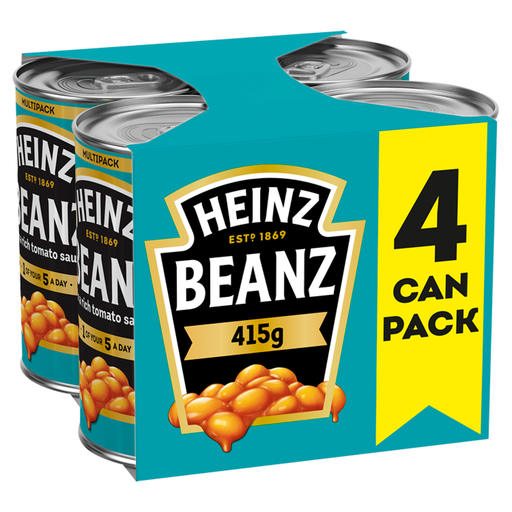
These four-tin packs represent two lunch-shopping choices: a Branston reduced-sugar-and-salt recipe and a standard Heinz recipe. Compare the exact tin labels if their different recipes affect your decision.
 No image available
This four-tin reduced recipe is an option for repeated lunches when you want to compare salt and sugars with a standard recipe. Tesco Groceries lists 2.8g sugars, 0.39g salt, 5.1g fibre and 5.0g protein per 100g for the same Branston pack; its stated reductions are relative to standard Branston beans.
 No image available
This four-tin standard recipe suits repeated lunches when a reduced-sugar-and-salt variant is not your deciding requirement. Check its current per-100g salt and total-sugars figures against any reduced recipe you are considering.
Start with salt and total sugars per 100g, then check the amount you expect to eat. GOV.UK describes traffic-light labels as a quick way to compare products where those labels appear; the NHS notes that nutrition information is supplied per 100g and sometimes per portion.
No. The phrase describes added sugar, not necessarily the total sugars in the finished product. Check the total-sugars figure and ingredients; the cited Heinz No Added Sugar listing describes beans with sweetener.
No. A reduction is relative to the product used for comparison: Tesco Groceries states that its Reduced Sugar & Salt beans have 25% less salt than Tesco standard baked beans, while listing 0.29g salt per 100g. Use the numerical figure and your intended portion when comparing tins.
Follow the instructions on the exact tin. Waitrose & Partners tells shoppers to transfer leftover Essential Reduced Salt & Sugar beans to a non-metallic container, cover and refrigerate them, and use them within two days; the cited M&S beans specify three days.
Look for an explicit suitability statement on the exact product, then read its current ingredients and allergen information. Tesco Groceries cautions that reformulation can change product details, so a description viewed earlier should not replace the tin label.