Households reducing sugar from regular cola
If cola is routinely kept at home, compare sugars per 100ml before choosing a case or large bottles. A diet or zero-sugar label is a starting point, not a substitute for checking caffeine and ingredients.


If reducing sugar is the reason for stocking up, choose a cola labelled zero sugar or diet rather than making regular cola the household default. Check caffeine and sweeteners on the exact pack before buying in quantity: zero sugar does not mean caffeine free, and some varieties contain aspartame, which is unsuitable for people with phenylketonuria (PKU). The NHS also notes that acidic fizzy drinks are associated with dental erosion regardless of their sugar content.
If cola is routinely kept at home, compare sugars per 100ml before choosing a case or large bottles. A diet or zero-sugar label is a starting point, not a substitute for checking caffeine and ingredients.
When someone sharing the supply does not want caffeine, select an explicitly caffeine-free variety. Standard zero-sugar colas and their caffeine-free counterparts can be separate products.
People with phenylketonuria (PKU) need to avoid aspartame. Check the current ingredients and phenylalanine warning on every flavour and pack before buying several at once.
Decide whether reducing sugar, avoiding caffeine or checking a particular sweetener is the household’s first requirement. Then choose a pack format you expect to use.
Consider when: You want cola labelled with 0g sugars and caffeine is acceptable; Coca-Cola Zero Sugar and Pepsi Max list both characteristics.
Bear in mind: Both cited varieties contain aspartame, and zero sugar does not remove the acid-related dental consideration.
Consider when: The household wants both 0g sugars per 100ml and a product explicitly labelled caffeine free, such as Coca-Cola Zero Sugar Caffeine Free or Pepsi Max No Caffeine.
Bear in mind: These cited caffeine-free variants still carry a phenylalanine warning; caffeine free does not mean aspartame free.
Consider when: The regular recipe is the household’s preference and reducing sugar is not the purpose of the purchase.
Bear in mind: Pepsi UK lists 4.5g sugars per 100ml for regular Pepsi. UK Scientific Advisory Committee on Nutrition guidance advises having drinks high in free sugars less often and in small amounts.
| Priority | What to check | Your needs |
|---|---|---|
| Sugars | Compare sugars per 100ml on the exact product, then consider the amount in a usual serving. Pepsi UK lists 4.5g per 100ml for regular Pepsi and 0g for Pepsi Max. | I want the cola kept at home to fit a plan to reduce sugar, rather than assuming every product in a multipack is equivalent. |
| Caffeine | Look for an explicit caffeine-free designation and check the variant name. Coca-Cola Zero Sugar and Pepsi Max list caffeine; their separately named caffeine-free variants do not. | Someone sharing this supply avoids caffeine, so the exact variety matters more than the words “diet” or “zero sugar”. |
| Sweeteners | Read the current ingredient list for aspartame and any source-of-phenylalanine warning. Sweeteners differ between the cited products. | For a household member with PKU, I need to rule out aspartame before buying a full case. |
| Acidity | Consider how often fizzy drinks will be consumed. The NHS associates acidic carbonated drinks with dental erosion whether they contain sugar or sweeteners. | I do not want a zero-sugar label to settle a separate question about regularly drinking fizzy cola. |
| Pack format | Check the number and size of cans or bottles, where they will be stored and whether the household expects to use that quantity. | Cans may suit individual servings; if I choose large bottles, I want a quantity that fits how we actually use cola at home. |
The NHS associates acidic carbonated drinks with dental erosion regardless of whether they contain sugar or sweeteners.
Use the sugar figure to compare sugar content, but consider separately how often fizzy drinks will be consumed.
Coca-Cola Zero Sugar and Pepsi Max list aspartame and carry a source-of-phenylalanine warning. Aspartame is unsuitable for people with PKU.
Check the current ingredients on the exact flavour and pack, even if you have bought another variety from the same brand.
Standard Coca-Cola Zero Sugar and Pepsi Max list caffeine; caffeine-free versions have distinct names.
If caffeine matters to someone sharing the pack, confirm that the chosen variant explicitly says caffeine free.
These examples show why the exact variety and current label matter; a brand name alone does not identify its sugar, caffeine or sweetener content.
Coca-Cola offers Zero Sugar, a separately named Zero Sugar Caffeine Free variant and Diet Coke.
Pepsi Max, Pepsi Max No Caffeine and regular Pepsi answer different sugar and caffeine requirements.
Its Diet Cola 2L illustrates why an own-label diet drink needs its own ingredient check.
Tesco’s diet-cola listing includes its own-label Tesco Xero Cola in an 8 x 330ml format alongside branded multipacks.
These options are zero-sugar or diet cola in can multipacks or large bottles. One is a caffeine-free variety; check each exact pack’s ingredients if caffeine or aspartame affects your choice.
 No image available
A can multipack for a shared supply when both zero sugar and no caffeine are wanted. Check the current pack for aspartame and its phenylalanine warning if buying for someone with PKU.
 No image available
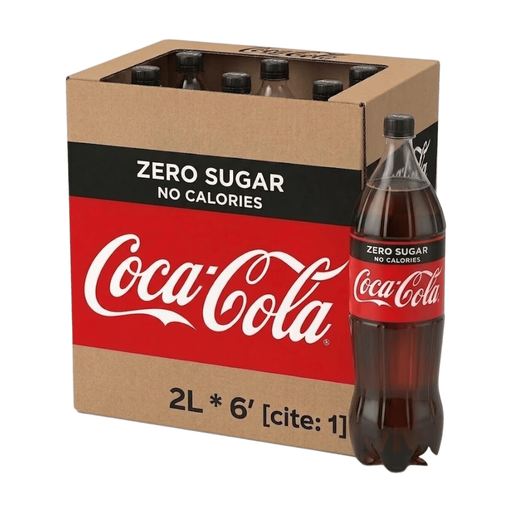
Six large bottles for a household that wants zero-sugar cola and does not need a caffeine-free variety. Coca-Cola Zero Sugar lists caffeine and aspartame; check the current bottle label, particularly for a household member with PKU.
 No image available
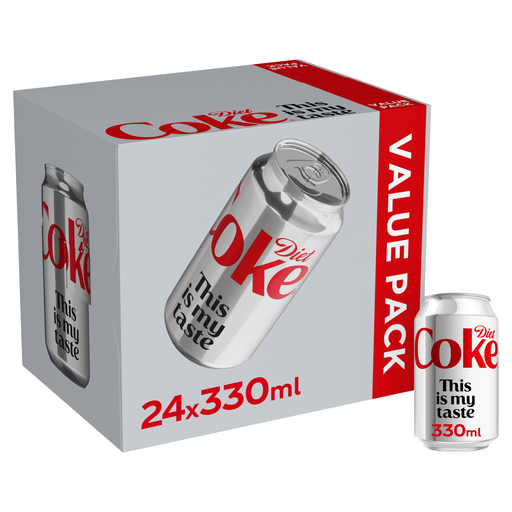
A 24-can option for shoppers choosing the Diet Coke variety rather than Coca-Cola Zero Sugar. Check the current pack for caffeine, aspartame and its phenylalanine warning before buying for a household with those requirements.
 No image available
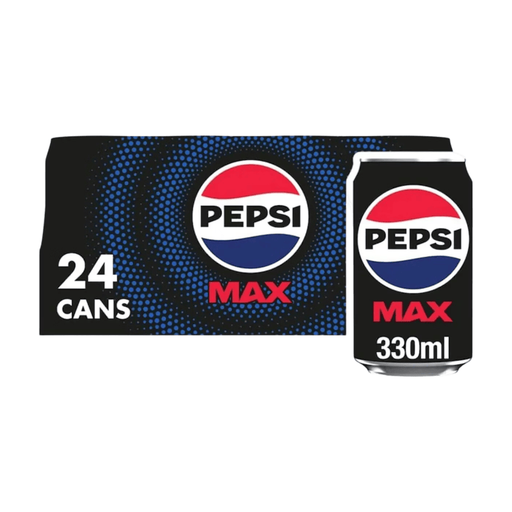
A zero-sugar can multipack when caffeine is acceptable. Pepsi UK lists 0g sugars per 100ml for Pepsi Max, alongside caffeine and aspartame in its ingredients and a source-of-phenylalanine warning.
 No image available
A 24-can format for shoppers who want Coca-Cola Zero Sugar rather than large bottles. Coca-Cola GB lists 0g sugars per 100ml; the standard variety contains caffeine and aspartame and carries a source-of-phenylalanine warning.
Choose a product labelled with 0g sugars if reducing sugar from regularly stocked cola is your aim. Pepsi UK lists 4.5g sugars per 100ml for regular Pepsi and 0g for Pepsi Max; UK Scientific Advisory Committee on Nutrition guidance advises having drinks high in free sugars less often and in small amounts. Check the exact product rather than assuming all recipes match.
No. Standard Coca-Cola Zero Sugar and Pepsi Max list caffeine. If someone sharing a bulk pack avoids it, choose an explicitly caffeine-free variant and confirm the exact pack.
Check the current ingredients for aspartame and a source-of-phenylalanine warning: aspartame is unsuitable for people with phenylketonuria (PKU). Coca-Cola Zero Sugar and Pepsi Max list aspartame, but sweeteners differ across diet colas, so check the specific variety before buying in quantity.
No. The NHS associates acidic carbonated drinks with dental erosion whether they contain sugar or sweeteners. Consider how often fizzy drinks will be consumed separately from the sugar figure on the label.