Regular decaf drinkers
If you make instant coffee frequently, a larger jar may mean fewer repeat purchases. Choose a size you expect to use while following the pack’s storage instructions.


For regular use, choose a decaf instant coffee in a pack size you can store cool and dry after opening. A refill makes sense if you already have a suitable sealable container; otherwise, a jar is more straightforward. Check the stated coffee style too, rather than assuming that pack size or format tells you how it will taste.
If you make instant coffee frequently, a larger jar may mean fewer repeat purchases. Choose a size you expect to use while following the pack’s storage instructions.
A jar kept for household members or visitors needs to suit both the number of drinkers and their preferences. Compare the available pack weights and stated coffee styles before choosing one to keep in the cupboard.
If you already have a clean, dry, sealable coffee container, a refill may fit your routine. Kenco describes its Decaf refill as a pack intended for refilling a jar.
Start with the decaf product and pack format, then consider how you will store it and whether its stated coffee style appeals to you.
| Priority | What to check | Your needs |
|---|---|---|
| Decaf status | Check that the particular pack is labelled decaffeinated instant or soluble coffee. Do not treat “decaf” as a promise of zero caffeine. | I’m choosing decaf, but I need to check the individual product if avoiding caffeine altogether matters to me. |
| Pack weight | Compare the stated weights and the number of jars you would need. NESCAFÉ UK & IE lists Original Decaf in 100g, 190g and 300g packs. | For a regularly used household jar, I may prefer a larger pack; for occasional visitors, I may want less open at once. |
| Jar or refill | Check whether a refill needs a separate container and whether you have one that closes securely. Check the refill’s weight rather than assuming it matches a jar. | I have a suitable container to refill, or I would rather buy coffee in a jar I can close after each use. |
| Coffee style | Read the stated blend, roast or format on the specific product. NESCAFÉ describes Gold Decaf as freeze-dried Arabica-and-Robusta coffee; Kenco describes its Decaf as a medium roast with intensity 7. | I want a stated style that appeals to the people drinking it, without treating a brand’s flavour description as an independent taste test. |
| Storage | Follow the chosen pack’s instructions after opening. Sainsbury’s advises keeping its Gold Roast Decaffeinated 200g jar cool and dry and replacing the cap after use. | I need a cupboard spot and a container that I can close properly between cups. |
A decaffeinated label does not establish that an instant coffee contains zero caffeine.
If you need to avoid caffeine altogether, check the individual product rather than relying on the word “decaf”.
A refill is intended to be transferred to a suitable container; a pouch does not serve the same storage role as a closable jar.
Before choosing a refill, make sure you have a clean, dry container that seals securely.
These product-line references help distinguish formats and pack sizes; they do not indicate which brands are available in the product selection below.
NESCAFÉ UK & IE lists Original Decaf in 100g, 190g and 300g packs and Gold Decaf in its instant-coffee range.
Kenco describes its standard Decaf as a medium-roast instant coffee and also offers a Decaf refill format.
Sainsbury’s lists Douwe Egberts Pure Decaf Instant Coffee in a 190g pack.
Tesco Groceries lists 200g decaffeinated instant-coffee jars under its own label, including Classic and Gold versions.
Sainsbury’s lists own-label decaffeinated instant coffee in 200g jars, including Gold Roast.
These options cover decaf instant coffee in 100g to 300g packs. Compare the particular product’s format and stated style with how often your household uses decaf.
 Image unavailable
A 300g decaf pack to consider for regular household use. Keep it cool and dry after opening, following the pack instructions.
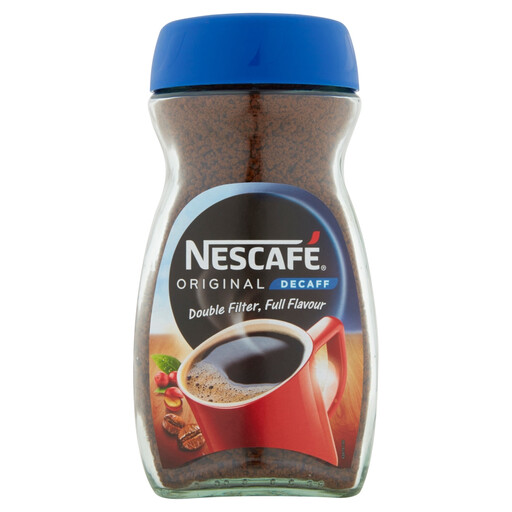 Image unavailable
This 200g decaf pack is an alternative if you would rather keep a smaller amount open than with a 300g pack. Store it cool and dry after opening.
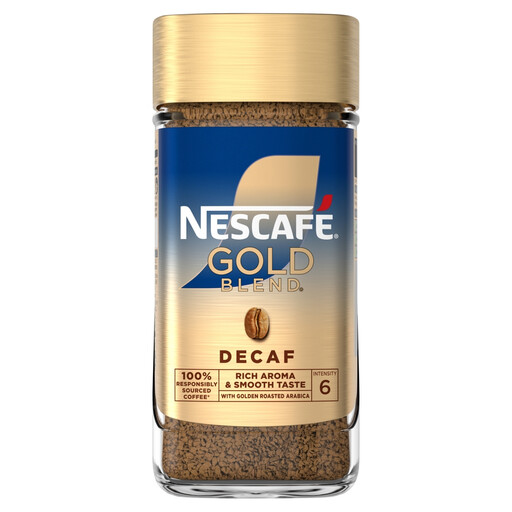 Image unavailable
A 190g decaf pack for shoppers considering Gold Blend’s stated coffee style. Its flavour description is the brand’s own, not an independent taste assessment.
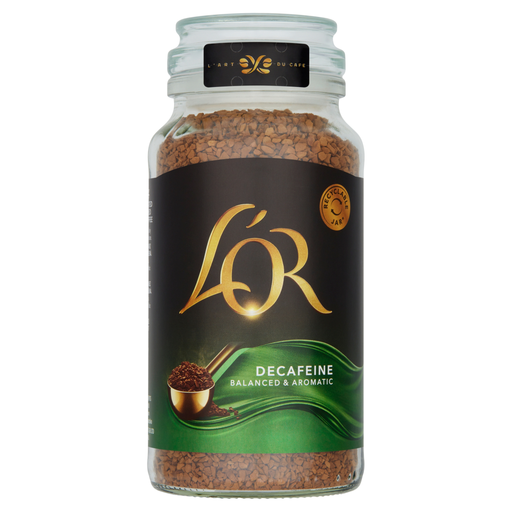 Image unavailable
This 150g decaf instant coffee is a smaller pack than the 190g to 300g options here. Check the pack’s preparation and storage instructions before ordering.
 Image unavailable
A 100g decaf instant-coffee pack for households that want less coffee open at one time. The product instructions specify one to two teaspoons with hot water just off the boil.
No: “decaffeinated” is not a guarantee of zero caffeine. If you need to avoid caffeine altogether, check the individual product rather than relying on the decaf label alone.
Choose a refill if you already have a clean, dry, suitable container that seals securely. A jar is more straightforward if you need a container you can close after each use; compare the stated pack weights as well.
Follow the instructions on that jar. For its Gold Roast Decaffeinated 200g product, Sainsbury’s says to store it in a cool, dry place and replace the cap after use.
Use the serving guidance for the particular coffee you buy. Sainsbury’s states 55 servings for its Gold Roast Decaffeinated 200g jar; that figure should not be assumed for every 200g product or every serving size.