Buying priorities
Start with storage and how quickly the household will use the oats, then choose the flake texture that suits the intended recipes.
| Priority |
What to check |
Your needs |
| Bulk storage |
Check the exact pack size, best-before date and storage instructions. For an opened bag, use a cool, dry, airtight container where the pack directs this. Treat a tin's unopened storage claim as specific to that tin. |
I have enough cupboard space and will use a large quantity often enough to make a bulk format practical. GOV.UK explains that a best-before date concerns quality rather than the same safety rule as a use-by date. |
| Pack format |
Decide whether separate smaller packs would be easier to manage than one opened large bag. Check whether the product is actually a tin, bag or multipack before ordering. |
I want cupboard stock without committing to a format that is awkward to store once opened. |
| Texture and cooking time |
Choose jumbo flakes for a thicker texture, quick-cook oats when speed matters, or standard rolled oats for general porridge and baking. Check the preparation instructions for the exact product. |
I want the bowl or recipe to suit my preferred texture, rather than buying a large pack of an oat cut I will not enjoy using. |
| Gluten-free and allergens |
Look for an explicit gluten-free label where required, then read the ingredient list and allergen statement on the physical pack. Check again if the packaging changes. |
I need product-specific labelling that fits a gluten-free requirement or an oat allergy concern. The Food Standards Agency states that food labelled gluten-free must contain no more than 20 mg/kg gluten as sold. |
Joybuy product options
Joybuy product options for plain porridge oats, including a larger multipack, standard-size packs and an explicitly labelled gluten-free option.
 No image available
Flahavan's Organic Porridge Oats 2kg (2 x 1kg)
A larger plain-oat option for households building cupboard stock.
Two 1kg packs; 100% organic wholegrain oat flakes. Store in a cool, dry place. This is a multipack, not a tin.
Joybuy
 No image available
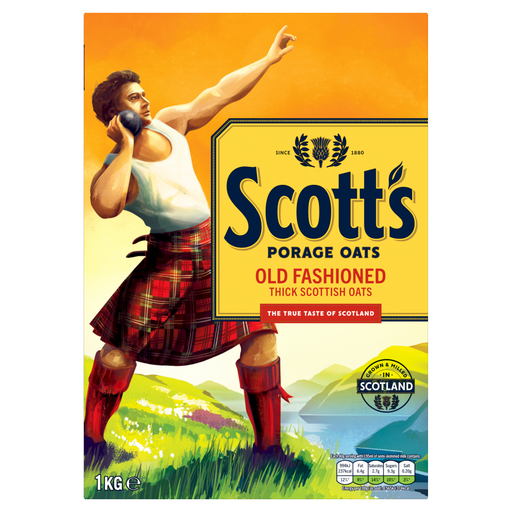
Scotts Porage Oats Old Fashioned Porridge Oats 1kg
A 1kg option for a thicker rolled-oat texture with stated preparation guidance.
100% rolled oats; 4–5 minutes on the hob or 2–3 minutes in a microwave. Store cool and dry, then transfer to an airtight container after opening and use within two months for best quality. May contain wheat and barley.
Joybuy
 No image available
Morrisons Free From Gluten Free Oats 1kg
An option to consider when an explicitly labelled gluten-free plain oat product is required.
1kg of 100% gluten-free oat flakes with wheat-free positioning. Store cool and dry and seal tightly after opening. Oats remain the declared allergen.
Joybuy
 No image available
Flahavan's Organic Porridge Oats 1kg
A standard-size organic plain-oat pack for everyday cupboard use.
1kg; 100% organic wholegrain oat flakes. Store in a cool, dry place. This is not a tin or bulk pack.
Joybuy
Frequently asked questions
Does a bulk porridge-oat purchase have to be a tin?
No. Large bags and multipacks can also suit regular oat use. A tin may be useful for long unopened storage when the exact product supports that claim; Mornflake says its tins can keep for up to three years unopened.
How should opened oats be stored?
Follow the pack's instructions. The referenced Waitrose oats advise a cool, dry place and an airtight container once opened, while Mornflake also refers to a sealed container in a dry, cool place.
Are ordinary porridge oats suitable for a gluten-free diet?
Do not assume so. The Food Standards Agency states that food labelled gluten-free must contain no more than 20 mg/kg gluten as sold; check the exact pack's gluten-free claim, ingredient list and allergen statement.
What is the practical difference between jumbo and quick-cook oats?
Jumbo oats are thicker and generally take longer to cook, giving more bite. Mornflake says thinner, smaller-cut oats cook faster, while Flahavan's describes jumbo oats as larger and thicker for more texture.
How should UK shoppers interpret the best-before date on bulk oats?
A best-before date concerns quality rather than the same food-safety rule as a use-by date, according to GOV.UK. Store the oats as the label directs, as poor storage can reduce quality before that date.


