Regular pantry stocker
You use tuna across several meals and want a pack quantity you can store and use before its best-before dates. Check the number and size of the individual tins as well as the total bundle.


Choose a multipack by the amount of tuna you expect to use and the size of each tin, not the tin count alone. Larger packs suit regular meals and cupboard storage; smaller tins or no-drain formats may be more practical for one-person meals. If salt matters, compare the exact nutrition labels rather than assuming spring water or brine determines the salt level.
You use tuna across several meals and want a pack quantity you can store and use before its best-before dates. Check the number and size of the individual tins as well as the total bundle.
You want to compare spring-water and brine products using the salt figure on each exact nutrition label, rather than treating the packing medium as a guarantee.
You usually need tuna for a small meal. Individual tin size and whether the product needs draining may matter more to you than the largest possible cupboard stock.
For a retirement-oriented household or shop, start with how often the tuna will be used. Then compare tin size, packing medium and the information on the exact pack.
| Concern | What to check | Who this matters to |
|---|---|---|
| Cupboard stock | Check the number of tins, individual tin size and best-before dates against your expected use. | When stocking tuna for regular meals, I need enough unopened tins without taking home more than I can use. About 33% of consumers put planned cupboard stock first. |
| Salt and packing medium | Compare salt per 100g on the exact labels, noting whether the figures use the same drained-weight basis. | If salt matters to me, I want to assess the actual can rather than judge it by brine or spring water alone. About 27% of consumers prioritise salt and packing medium. |
| Portions and leftovers | Check individual tin size, whether the format is no-drain and the post-opening storage instructions. | For a one-person lunch, I would rather open a suitable tin than manage unused tuna. Roughly 20% of consumers put portion size and preparation first. |
| Labelling and handling | Read the fish allergen declaration and check any sourcing or opening claims on the exact pack. | When shopping for others, I need clear fish identification and any sourcing information that matters to them. About 20% of consumers primarily consider labelling and handling. |
Four tins of one size and four tins of another provide different amounts for meal planning. A larger bundle also needs enough cupboard space and a realistic plan for using it.
Compare individual tin sizes, the stated bundle contents and best-before dates before stocking up.
Salt values vary by product. Princes lists 0.85g salt per 100g drained for its researched spring-water chunks, while John West lists 0.9g per 100g for its researched brine four-pack; those figures describe different products, not every tin in either medium.
Read the salt line on the exact pack and compare figures stated on the same basis.
An individual tin can leave unused tuna if the meal needs only a small amount. M&S instructs buyers of its researched spring-water product to transfer unused contents to a non-metallic container, refrigerate them and eat them within two days.
For smaller meals, compare individual tin sizes and follow the post-opening instructions on the tin you buy.
The NHS says fresh and canned tuna do not count as oily fish.
If you are choosing fish specifically for an oily-fish portion, do not count tinned tuna as that portion.
These brands provide useful product formats or label details to compare; a brand name alone does not establish the contents of every pack.
Princes lists spring-water tuna chunks in single 145g tins and several multipack sizes, including 4 x 145g, 6 x 145g and 8 x 145g.
John West provides a brine-chunk four-pack for comparison with its separately listed no-drain formats.
Tesco listed own-brand tuna chunks in brine and spring water in 3 x 80g packs, offering a smaller-tin format to compare with larger multipacks.
The researched M&S spring-water tuna is a 160g product with product-level sourcing and post-opening storage information.
These listings cover tuna chunks in brine, spring water and sunflower oil. Compare the stated bundle contents with the size of tin you expect to open for each meal.
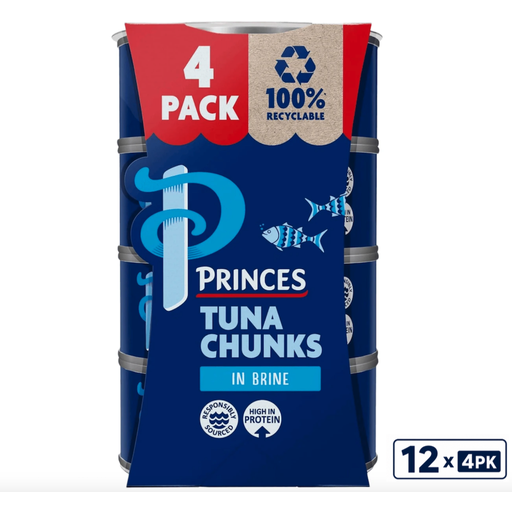 Image unavailable
The stated bundle suits someone planning to use tuna regularly across meals. Its title specifies twelve packs of four 145g tins; check that quantity and the best-before dates before committing cupboard space.
 Image unavailable
This four-tin pack offers a smaller stock-up than the stated twelve-pack bundle. Each tin is labelled 145g; compare the exact can’s salt information if brine is a consideration.
 Image unavailable
Four 125g tins offer a spring-water option for planned cupboard use. If avoiding draining is important, confirm whether this exact pack is labelled no-drain rather than relying on descriptions of other John West formats.
 Image unavailable
This four-tin format is for shoppers who want tuna packed in sunflower oil. Each tin is labelled 145g; check the basis of any nutrition figures before comparing them with drained-weight figures for other packs.
 Image unavailable
The title states six packs of 145g spring-water tuna for a larger pantry purchase. Confirm the exact pack count and total quantity on the listing before ordering, as the pack-level quantity information is not consistent.
No. Tuna is fish, which the Food Standards Agency identifies as an allergen that can pose a risk to someone with a fish allergy. Check the current ingredients and allergen declaration on the exact tin when shopping for another person.
Follow that product’s storage instructions. M&S says unused contents of its researched spring-water tuna should be moved to a non-metallic container, refrigerated and eaten within two days; do not assume every brand gives the same instructions.
No. The NHS states that fresh and canned tuna do not count as oily fish. If an oily-fish portion is the reason for the purchase, choose a fish that meets that description instead.
No. Compare the salt figure on the exact products you are considering, using the same per-100g basis where possible. The packing medium alone does not tell you the salt level of a particular tin.