Hosts making one larger filter batch
If you use one bean and recipe for several friends, the filter-grind range and both container capacities matter more than the number of brewing methods a grinder covers.


For filter coffee when friends visit, start with a burr grinder whose stated adjustment range covers filter brewing, then check whether its bean and grounds capacities suit the batch you plan to make. Stepped settings make it easier to return to one recipe; finer adjustment and weighing are more relevant if you regularly change recipes, while single-dosing means portioning beans for each batch if you also switch brew methods.
If you use one bean and recipe for several friends, the filter-grind range and both container capacities matter more than the number of brewing methods a grinder covers.
If you adjust your grind and coffee dose between brews, settings you can return to and a practical way to weigh beans become more useful.
If you make filter coffee for friends but also prepare espresso or another brew, check that the exact grinder covers each method and consider whether portioning beans separately suits your routine.
For filter coffee with visiting friends, work out your planned batch first. Then decide whether returning to one setting or changing between recipes and brew methods matters more.
| Concern | What to check | Who this matters to |
|---|---|---|
| Preparing a guest batch | Compare your planned bean dose with both the stated hopper and grounds-container capacities. Check that the exact model names a suitable filter range. | If I am serving several friends from one filter recipe, I want to grind the batch without stopping to refill or empty a container; around 45% of consumers would put uninterrupted batch preparation first. |
| Repeating a recipe | Check how clearly you can return to a setting and whether you need finer adjustments or a way to weigh each dose. | When I change a filter recipe, I want to find the same setting and dose again; roughly 33% of consumers would make recipe control their main concern. |
| Switching brew methods | Confirm the published range covers each intended method, and decide whether loading beans separately for each brew suits you. | If I alternate filter coffee with espresso, I need settings for both without committing beans to one batch; about 22% of consumers would primarily value that flexibility. |
A general coffee-grinder description does not tell you which settings are intended for your brewer. Baratza identifies settings 21–40 on its Encore ESP for filter coffee, French press and cold brew; Wilfa also names filter coffee in the Uniform Evo range.
Look for a filter, drip or pour-over range stated for the exact model before choosing a starting setting.
Burr dimensions do not tell you how many beans or grounds the containers hold. Either container could interrupt a planned batch if it is smaller than the amount you need.
Calculate your bean dose for the intended servings and compare it with both capacities on the exact product listing.
Plug and electrical ratings can vary by version. Niche specifies a G-type plug and 220–240 V / 50–60 Hz for its UK Niche Zero variant.
Check the exact version’s plug, rated voltage and frequency, along with the seller’s product and support information, before ordering.
Ground coffee and residue can accumulate around the burr chamber and chute. Baratza recommends routine cleaning every 4–6 weeks in its general grinder guidance.
Follow the cleaning instructions for your exact model rather than applying another brand’s disassembly steps.
Wilfa offers grinders whose stated ranges include filter coffee. Its Uniform Evo is aimed at brewers who want to adjust and weigh doses.
Baratza’s Encore models include stepped adjustment. The brand assigns Encore ESP settings 21–40 to filter coffee, French press and cold brew.
Niche positions the Zero as a single-dose grinder with stepless adjustment for switching between brewing methods.
These grinders offer different starting points for the same hosting decision: stated filter or pour-over use, measurable container sizes, or adjustable settings. Check the exact filter range and batch capacity where those details matter to your recipe.
 No image available
Consider this model if you want timed dosing while adjusting a filter recipe; compare its bean and grounds capacities with your planned guest batch.
It has 60 grind settings, a conical burr and Dosing iQ technology.
 No image available
Its stated pour-over use makes it relevant if that is how you serve filter coffee; check whether its bean and grounds capacities suit the number of servings you plan.
The listed features include adjustable settings, one-touch operation and a Type-C rechargeable 1000mAh battery. Consider your charging routine if you will prepare several doses.
 No image available
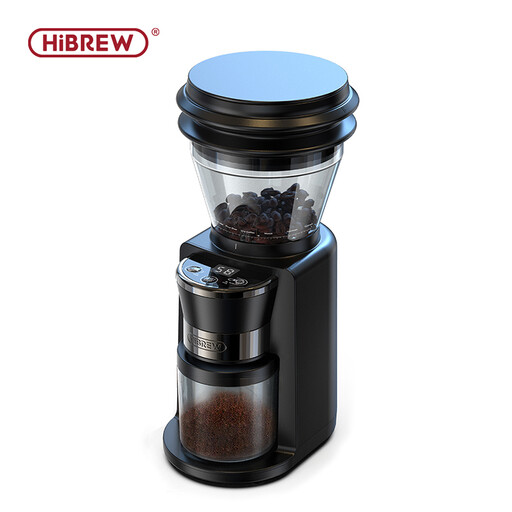
The stated container sizes help you assess a planned guest batch; confirm which settings suit your filter brewer before relying on it for that recipe.
The product name specifies a 34-gear scale, 210g bean container, 100g grounds container, 48mm conical burr, anti-static function and manual/auto modes.
 No image available
Consider this portable model if you are willing to check its capacity against each planned dose; confirm a suitable filter setting for your brewer before purchase.
Its product name lists 30 settings, auto stop and clog protection. Check the bean and grounds-container sizes if you want to prepare a larger batch.
Choose capacity against the coffee dose for your planned servings, checking both the bean container and the grounds container. A large bean container alone will not prevent you from having to empty a smaller grounds container mid-batch; burr size is not a capacity figure.
Stepped settings can suit filter coffee if the exact grinder names a filter range and you mainly want to return to a known setting. Baratza describes the defined positions on its stepped grinders as easy to track; finer adjustment matters more if you frequently refine recipes or also dial in espresso.
Follow your model’s manual for its cleaning method and interval. Baratza’s general guidance recommends routine cleaning every 4–6 weeks, including brushing loose grounds from the burr chamber and chute; do not use another brand’s disassembly procedure without checking its instructions.
Check the exact grinder’s plug, rated voltage and frequency, as well as the seller’s product information for the market where you will use it. GOV.UK states that the Electrical Equipment (Safety) Regulations 2016 apply to electrical equipment placed on the Great Britain market; Northern Ireland has different arrangements that should be checked separately.
Contact the seller about a faulty or misdescribed grinder and keep your order details and model identifier. GOV.UK states that sellers cannot restrict or remove consumers’ rights; a voluntary change-of-mind returns policy should not be treated as the answer to a fault complaint.