Cold-brew-first home brewers
If traditional cold brew is your main method, prioritise a coarse setting you can return to between batches. Sage Appliances UK describes coarse grounds as typical for cold brew.


For traditional cold brew, choose a burr grinder with a repeatable coarse setting before considering extra features. A brew-focused model suits cold brew and other brewed-coffee methods, while an espresso-capable model makes more sense if you expect to use both; prepare an immersion batch ahead of your afternoon break rather than expecting to drink it immediately.
If traditional cold brew is your main method, prioritise a coarse setting you can return to between batches. Sage Appliances UK describes coarse grounds as typical for cold brew.
If you start brewing well before your break, straightforward dosing and grounds handling may matter more to you than espresso adjustments. Fellow Products describes conventional cold brew as taking 12–24 hours to steep.
If cold brew shares your routine with espresso, filter coffee or cafetière, look for a model that explicitly covers those methods. Baratza and Wilfa each describe grinders with a range extending beyond coarse brewing.
Check for a repeatable coarse setting first, then decide whether espresso capability or easier batch preparation will matter in your routine.
Choose it when: You make cold brew and other brewed-coffee methods but do not plan to make espresso; Fellow describes the Ode Brew Grinder Gen 2 for brewed methods including cold brew.
Trade-off: Fellow explicitly says the Ode Gen 2 is not intended for espresso.
Choose it when: Espresso may join cold brew in your routine; Baratza lists filter, French press and cold-brew settings for the Encore ESP, while Wilfa describes a coarse-to-espresso range for the Uniform Evo.
Trade-off: You will have more settings to navigate, and a numbered setting on one grinder is not a universal cold-brew recipe.
| Concern | What to check | Who this matters to |
|---|---|---|
| Repeatable coarse grind | Check the exact model for a coarse, French-press or cold-brew range; adjust the starting setting to suit your brewer and filter. | If long-steep cold brew is my main drink, I want to return to a coarse setting without starting over each batch. Around 50% of consumers put that need first. |
| Batch preparation | Check the bean and grounds capacities against your recipe, plus any dosing or automatic-stop controls you want to use. | When I prepare coffee ahead of my afternoon break, I want measuring and collecting the grounds to fit my batch routine. Roughly 30% of consumers prioritise that workflow. |
| Other brew methods | If espresso is a realistic future use, confirm that the exact grinder is explicitly intended for it. | I may switch between cold brew and espresso, so a coarse-only brewing range would limit my plans. For about 20% of consumers, that flexibility is the primary concern. |
Sage Appliances UK describes coarse grounds as typical for cold brew. A grinder’s burr mechanism alone does not tell you which brewing settings its manufacturer offers.
Check the exact model’s documented coarse, French-press or cold-brew range, then adjust from a coarse starting point to suit your recipe and filter.
Fellow says its Ode Brew Grinder Gen 2 is intended for brewed coffee, not espresso. By contrast, Baratza and Wilfa describe espresso-capable ranges on the Encore ESP and Uniform Evo.
If espresso is part of your plans, verify that capability for the exact model rather than relying on the term ‘burr grinder’.
Fellow’s Ode Gen 2 product page lists 120V. That specification should not be assumed to describe a version suitable for a UK household.
For a mains-powered grinder, check the exact listing’s voltage, plug, warranty territory and applicable conformity information before ordering.
The Encore ESP is an all-purpose option for people considering espresso as well as brewed coffee.
Wilfa UK positions the Uniform Evo for several brewing methods and a measured-dosing workflow.
The Ode Brew Grinder Gen 2 is positioned for brewed methods, including cold brew.
These grinders offer coarse French-press coverage relevant to a cold-brew starting point. The selection includes electric and manual models, with different dosing arrangements and adjustment ranges; check the exact model against your batch size and other brewing plans.
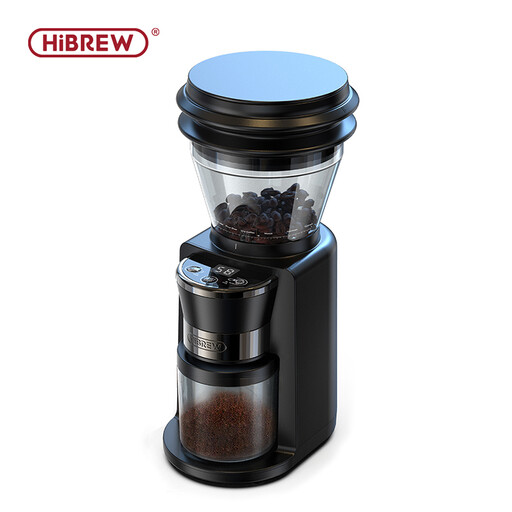 No image available
Consider this model if you want controls for preparing a measured batch and plan to start with a coarse setting. Its title specifies 34 grind settings, a 48 mm conical burr, a 210 g bean container, a 100 g grounds container and manual and automatic modes.
Check the exact listing’s plug, warranty territory and applicable conformity information. Follow the stated cooling guidance after no more than 10 grinding cycles.
 No image available
Consider this all-purpose conical-burr model if you also plan to grind for other brewing methods. The title specifies 60 grind settings and Dosing iQ™ technology; for cold brew, check where a suitable coarse setting falls with your brewer and filter.
Check capacity, voltage, plug, warranty territory and applicable conformity information for the exact listing.
 No image available
Consider this portable option if you want one grinder for cold brew and other listed methods, including French press and espresso. The title specifies adjustable settings, one-touch operation and a Type-C rechargeable 1000mAh battery.
Check its capacity against your batch and the charging arrangement for your use. The stated cleaning guidance calls for a dry brush rather than rinsing the burr with water.
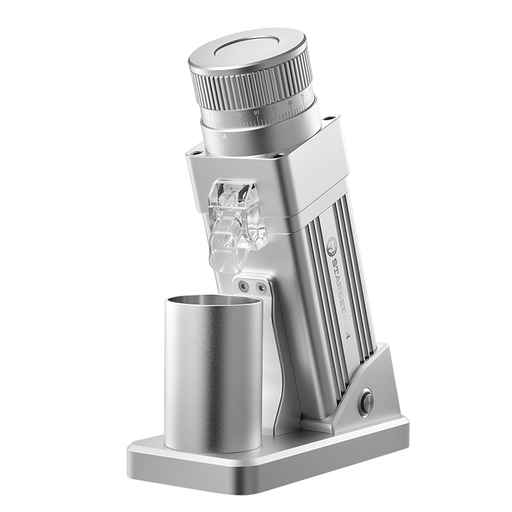 No image available
Consider this model if you want stepless adjustment while making cold brew and possibly espresso. Its title specifies a 55 mm titanium-alloy conical burr and a 72W AC motor.
Check that its dosing arrangement and capacity suit your batch, and confirm the exact listing’s voltage, plug, warranty territory and applicable conformity information.
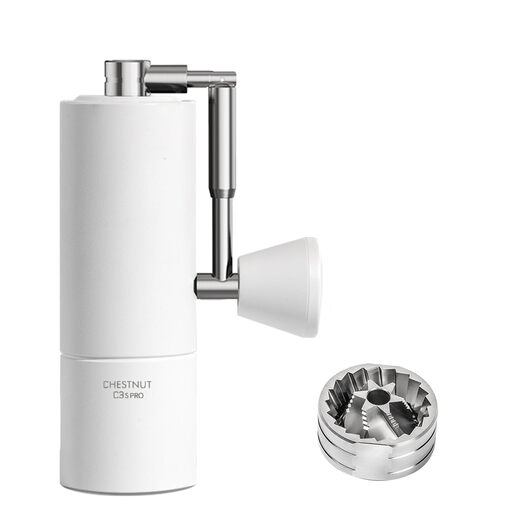 No image available
Consider this manual grinder if you are comfortable grinding by hand for cold brew and want a foldable handle. Its title specifies a stainless-steel S2C conical burr and adjustment for espresso through French press.
Manual grinding takes effort, and its stated 30 g bean capacity may mean refilling it for a larger batch.
Start medium-coarse to coarse, then adjust for your coffee, filter and taste. Sage Appliances UK describes coarse grounds as typical for cold brew, while Fellow Products gives a medium-coarse to coarse starting point in its brewing guidance.
Not with a conventional immersion recipe. Fellow Products describes a 12–24 hour steeping window, so begin brewing ahead of the break; buying a grinder does not shorten that steeping step.
No, provided the grinder has a suitable coarse range for your cold-brew method. Fellow Products says the Ode Brew Grinder Gen 2 is intended for brewed methods including cold brew, but not espresso; choose espresso capability if you expect to use it.
Check the exact grinder’s voltage, plug and applicable conformity marking for where you will use it. In its 31 March 2026 guidance, the Department for Business and Trade lists UKCA or CE marking for electrical equipment in Great Britain; Northern Ireland has distinct marking arrangements, so the Great Britain position alone does not settle a Northern Ireland purchase.
Adjust it when you change your coffee, recipe, brewer or filter, or when the resulting drink calls for a different grind. Fellow Products treats its suggested cold-brew setting as a starting point rather than a fixed setting for every batch.