Shared-bedroom bush pilots
You want a PC for flight simulation without letting its case, controls or operating noise take over a small shared space.


For virtual bush flying in a shared bedroom, compare the exact PC configuration with Microsoft Flight Simulator’s recommended specification before deciding on a case size; its published reference includes 32 GB RAM, a Ryzen 7 2700X or Core i7-10700K, and a Radeon RX 5700 XT or GeForce RTX 2080. Choose a compact desktop if desk space is the constraint, or consider a conventional tower if room for the PC and later changes matters more. Neither case size establishes how quiet a particular system will be under load.
You want a PC for flight simulation without letting its case, controls or operating noise take over a small shared space.
You want to start with a suitable prebuilt configuration while checking whether its memory and storage can be changed later.
You plan to use a joystick, HOTAS, yoke, throttle or pedals, so the available desk area and connections matter alongside the PC itself. Microsoft Flight Simulator’s hardware guide describes these control options.
Start with the simulator specification, then decide how much space the PC and planned controls can occupy. Assess bedroom noise for the exact configuration rather than from its case size or product-line name.
Consider it when: Desk space for the PC is tight and you want a ready-built system with a smaller case.
Allow for: Checking the exact dimensions, connections and load-noise evidence; CORSAIR’s small-footprint positioning for its ONE line does not establish those details for every configuration.
Consider it when: There is room for a larger case and later memory or storage changes are important; Lenovo describes these as upgradeable in its Legion tower line.
Allow for: More space around the case and model-specific checks of internal access and noise. A larger case does not establish quiet operation.
| Concern | What to check | Who this matters to |
|---|---|---|
| Simulator specification | Compare the exact CPU, graphics card and RAM with Microsoft Flight Simulator’s recommended specification; seek testing at your intended resolution and settings. | If regular bush flying is the priority, I want more than a PC that merely meets the minimum requirements. Roughly 33% of consumers put simulator specification first. |
| Desk footprint | Check the case’s width, height and depth against the space left for a monitor, controls, cables and ventilation. | When the desk is shared with other equipment, I need the PC to fit without crowding my controls; around 25% of consumers make desk fit their primary concern. |
| Bedroom disturbance | Look for an independent noise review of the exact configuration under a comparable load, and plan a position that leaves vents clear. | If someone else uses the bedroom, I do not want to rely on a quiet-looking case as proof of low noise. For roughly 25% of consumers, limiting disturbance comes first. |
| Controls and future changes | Count connections for planned flight controls and displays; check memory and storage access on the exact model. | As I add a joystick or other controls, I need somewhere to put and connect them, while keeping later PC changes in mind; around 17% of consumers prioritise this planning. |
Microsoft Flight Simulator lists different minimum and recommended configurations. Meeting the minimum alone does not answer whether a PC suits the resolution, settings and additional content you intend to use.
Compare the exact configuration with the recommended specification, then look for relevant independent performance testing.
Case size and a manufacturer’s quiet-operation description do not establish sound levels for a particular CPU and graphics configuration under simulator load.
Look for exact-model acoustic testing and check that the planned position will not obstruct ventilation.
Microsoft Flight Simulator describes options including a joystick, HOTAS, yoke, throttle quadrant and rudder pedals. Each planned device changes the space and connection checks.
Sketch the full desk layout and count the required connections before choosing where the PC will sit.
Controls also need space for use, cable routing and storage when the desk is needed for something else.
HP’s UK OMEN listings include different case sizes and memory configurations, so a family name cannot stand in for an exact specification.
Check the full model and configuration for RAM, graphics, storage, ports and terms before ordering.
The CORSAIR ONE small-form-factor line is relevant when the space occupied by the PC is a leading constraint.
HP’s UK OMEN desktop range offers compact and larger-tower configurations worth comparing by exact model.
Lenovo’s Legion towers are relevant if you have space for a conventional case and want to assess later changes.
These desktop towers and one desktop bundle are options to compare if your shared-bedroom setup has room for a conventional PC. Check their exact configurations and planned placement against the simulator and desk-space questions above.
 No image available
Consider this tower if you want to compare a 32GB configuration with Microsoft Flight Simulator’s recommended memory figure.
The product name also specifies a 2TB SSD and Windows 11. Check the exact processor configuration, intended game settings, case fit and independent load-noise evidence before deciding.
 No image available
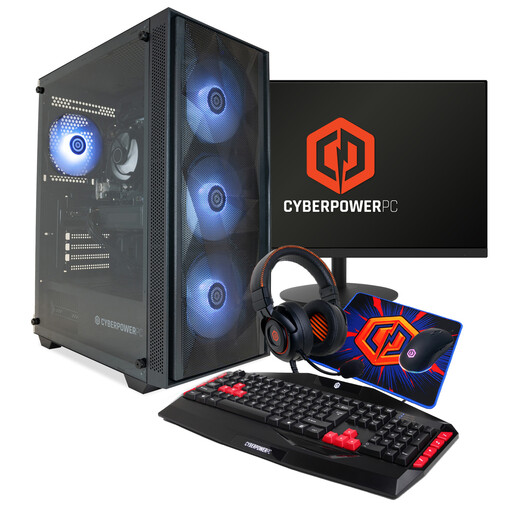
Consider this bundle if you also need general desktop equipment, while checking separately which flight controls will fit your desk and connections.
The product name specifies an RTX 5060 with 8GB graphics memory, 16GB DDR5 RAM, a 1TB NVMe SSD, a monitor, keyboard, mouse, headset and mousepad. Its 16GB RAM is below the 32GB figure in Microsoft Flight Simulator’s recommended specification; assess that trade-off for your intended use.
 No image available
Consider this tower if a 32GB memory configuration suits your simulator plans and you have space for its case.
The product name specifies 32GB DDR5 RAM, a 2TB NVMe SSD and Windows 11 Home. Compare performance evidence for your intended settings, and check desk fit, ventilation and exact-model noise before relying on it in a shared bedroom.
 No image available
Consider this tower if you are comparing 32GB desktop configurations and can accommodate a conventional case.
The product name specifies 32GB DDR5 RAM, a 1TB NVMe SSD and Windows 11 Home. Check performance at your intended settings, the case’s placement and independent noise evidence for this exact configuration.
No: Microsoft Flight Simulator lists 16GB RAM in its minimum specification and 32GB in its recommended specification. For a new PC intended for regular bush flying, compare 32GB configurations with your other requirements, including the resolution and settings you plan to use.
No, you can choose the PC first, but plan for the controls you expect to use. Microsoft Flight Simulator’s hardware guide describes gamepad or joystick control and options such as HOTAS, yokes, throttles and pedals; check the desk space and connections those choices require.
Not necessarily: a compact case or quiet-operation claim does not establish the sound of an exact configuration during flight simulation. Look for independent acoustic testing under a comparable load and leave the vents unobstructed in the intended position.