Home cooks making a curry sauce
The choice between salted butter, unsalted butter and ghee depends on the recipe and how much seasoning its other ingredients contribute.


For a curry recipe that calls for butter, choose an unsalted block if you want to control the seasoning, or a salted block if its salt content suits the other ingredients. Check the recipe before substituting spreadable butter or using ghee, and clarify the intended gram weight or number of packs before treating “6 pint” as a butter quantity.
The choice between salted butter, unsalted butter and ghee depends on the recipe and how much seasoning its other ingredients contribute.
A block, a spreadable product and ghee are different choices. Check what the recipe calls for, then buy the required weight rather than relying on the phrase “6 pint”.
The Food Standards Agency identifies milk as a common ingredient in butter and a possible risk for people with a milk allergy or intolerance. Check the exact product label before cooking for someone affected.
Start with the recipe’s ingredient and quantity, then compare the product’s salt declaration, format and pack label.
| Priority | What to check | Your needs |
|---|---|---|
| Salt | Read the salt declaration on the exact pack. Anchor lists 0.02g salt per 100g for its Unsalted Block Butter and 1.7% salt for its Original Block Butter; those figures describe these products, not every brand. | I want to decide how much salt to add when the curry also contains paste, stock or sauce. |
| Cooking format | Check whether the recipe specifies block butter or ghee, and compare the label before using a spreadable product instead. Anchor lists 82g fat per 100g for its Original Block Butter and 77g per 100g for Original Spreadable. | If the recipe calls for butter, I want to avoid assuming a spreadable tub is interchangeable. If it calls for ghee, I can choose a ghee product or allow for the preparation involved in making it from butter. |
| Quantity | Find the recipe’s required weight in grams and check the pack weight. Tesco’s UK block-butter listing includes examples weighing 200g, 250g and 500g; “6 pint” does not specify which butter pack to buy. | I need enough for the recipe without guessing whether the shopping note meant a weight, several packs or another grocery item. |
| Milk allergen | Read the ingredients and allergen information for the exact product. The Food Standards Agency identifies milk as a common ingredient in butter and a possible risk for people with a milk allergy or intolerance. | Someone eating the curry needs a product that is suitable for their milk-allergen requirements. |
| Date and storage | Check the date and storage instructions on the pack. GOV.UK distinguishes use-by dates, which relate to safety, from best-before dates, which relate to quality. | If I am buying ahead of curry night, I want to know how to store the product and which date appears on it. |
That wording does not tell you how much butter the curry needs. Tesco’s listed block-butter examples are labelled by weight in grams.
Check the recipe quantity and ask whether the note means several packs, a particular gram weight or a different item.
Product composition can differ: Anchor lists 77g fat per 100g for Original Spreadable and 82g per 100g for Original Block Butter. Those label figures do not establish how either will turn out in your curry.
If the recipe specifies block butter or ghee, check its substitution instructions and the product label before choosing a spreadable tub.
Butter can contribute salt alongside ingredients such as curry paste, stock or sauce. Anchor’s salted and unsalted blocks have different salt declarations.
Read the declaration on your chosen pack and account for it when seasoning the dish.
The Food Standards Agency identifies milk as a common ingredient in butter and a possible risk for people with a milk allergy or intolerance.
Check the exact label and choose a suitable non-dairy product when required.
These examples help distinguish pack types and labels; they are not a comparison of how the brands perform in curry.
Anchor lists salted and unsalted block butter alongside a spreadable product.
Kerrygold UK lists salted and unsalted 200g butter products; Tesco also lists a Kerrygold salted 500g product.
Tesco’s UK block-butter listing includes Lurpak Slightly Salted 200g and Lurpak Unsalted 200g.
Tesco’s block-butter listing includes an own-label Organic Unsalted Butter 250g product.
This ghee option is relevant if your curry recipe calls for ghee; check the recipe quantity before choosing a 500g pack.
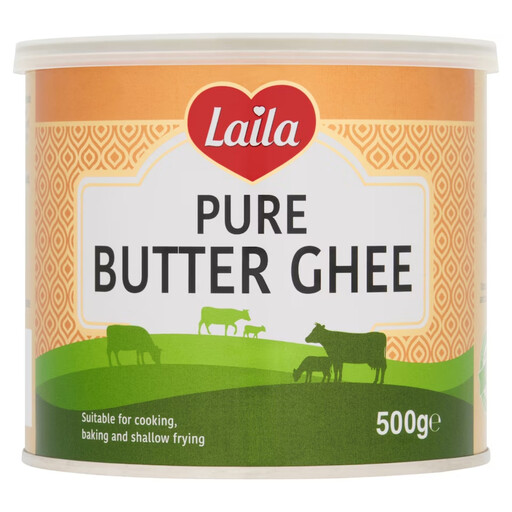 Image unavailable
Consider this ghee if your curry recipe calls for ghee rather than block butter. The pack is labelled 500g; check the recipe quantity and the product’s milk-allergen label before buying.
It does not identify the weight of butter needed for the recipe. Tesco’s UK block-butter listing shows examples labelled 200g, 250g and 500g; confirm the intended gram weight, number of packs or other item before buying.
Choose unsalted block butter if you want to control the salt added alongside paste, stock or sauce; salted butter may suit a recipe that allows for its salt contribution. Check the exact label: Anchor lists 0.02g salt per 100g for its Unsalted Block Butter and 1.7% salt for its Original Block Butter.
Anchor’s curry recipe describes melting butter and filtering it for a ghee-style curry base. If your recipe calls for ghee, follow its preparation instructions or consider a ghee product, and check how much is required.
Do not assume it is. The Food Standards Agency identifies milk as a common ingredient in butter and a possible risk for people with a milk allergy or intolerance; check the exact label and choose a suitable alternative when needed.
Check which date appears on the pack and follow its storage instructions. GOV.UK explains that a use-by date relates to food safety, while a best-before date relates to quality.