Cafetiere-only home brewer
If a cafetiere is your main way of making coffee, start with a coarse setting you can return to reliably. Sage Appliances UK and Adams + Russell both recommend a coarse grind for French press or cafetiere coffee.


Choose a grinder with an identifiable coarse setting for cafetiere coffee, then decide how much adjustment and daily convenience you need. If repeatability matters, an adjustable burr grinder is a sensible starting point: Sage Appliances UK describes burr grinding as producing more uniform particles than blade grinding. A cafetiere-only household can focus on its usual dose, while anyone switching brewing methods should check that the exact grinder covers each method they use.
If a cafetiere is your main way of making coffee, start with a coarse setting you can return to reliably. Sage Appliances UK and Adams + Russell both recommend a coarse grind for French press or cafetiere coffee.
If you also make filter coffee, cold brew or espresso, check the stated range for each method rather than relying on the total number of settings. Baratza and Wilfa describe model-specific ranges that include French press and other brewing styles.
If you regularly prepare several cups, the amount you can grind and the effort involved in each batch may matter alongside the coarse setting. Lakeland lists a cup selector on its Conical Burr Coffee Grinder, while Wilfa describes automatic stopping on the Zense; compare either control with the amount you actually brew.
Confirm a suitable coarse range before comparing controls, capacity and cleaning access: those extras are useful only if the grinder also fits your cafetiere routine.
| Concern | What to check | Who this matters to |
|---|---|---|
| Repeatable coarse grinding | Look for a stated French press, cafetiere or coarse-brew range. If consistency is a priority, compare adjustable burr designs with blade grinding. | When I make cafetiere coffee regularly, I want to return to a coarse grind without finding the plunger difficult to press. Roughly 33% of consumers would put coarse-grind consistency first. |
| Range for other brews | Check which settings the maker assigns to cafetiere and to the other methods you use; a setting count alone does not explain the range. | If my household switches between cafetiere and other brewing methods, I need the same grinder to cover those different grind sizes. Around 27% of consumers would make that flexibility their primary concern. |
| Batch size and daily handling | Compare stated dose controls and container capacities with your usual pot. Consider whether manual grinding or an electric stopping control suits your routine. | When I prepare several cups at once, I want to handle a familiar batch without unnecessary refilling or guesswork. Approximately 20% of consumers would prioritise that daily workflow. |
| Cleaning and upkeep | Read the exact model's cleaning instructions and check access to the burr area and grounds container. Check replacement parts for that model if long-term upkeep matters to you. | If I plan to use the grinder often, I want to know how I will remove retained grounds and look after its working parts. About 20% of consumers would put upkeep ahead of their other concerns. |
Sage Appliances UK says blade grinders chop beans unevenly, whereas adjustable burrs produce more uniform particles. That difference matters if you want to return to a similar coarse grind each time.
If repeatability is important to you, compare adjustable burr grinders first. Treat blade grinding as a compromise in grind control, not an equivalent setting system.
The number of settings does not show where the coarse range sits. Lakeland labels settings 26–35 for French press on its cited model; Baratza assigns settings 21–40 on the Encore ESP to filter, French press and cold brew.
Check the exact model's instructions for a French press, cafetiere or coarse-brew range before choosing it.
A labelled cup range cannot tell you whether its resulting dose matches your cafetiere, recipe or preferred amount of coffee.
Compare the bean and grounds capacities with your normal batch, and measure your dose if you want to reproduce your coffee-to-water ratio.
Grounds left in the grinder can complicate the next dose. Baratza describes a quick-release burr system on the Encore ESP, but cleaning access differs by model.
Find the manual for the exact grinder and check its cleaning steps and replaceable parts before buying.
Lakeland's Conical Burr Coffee Grinder offers a clearly labelled French press range and a cup selector for shoppers comparing a straightforward electric routine.
Baratza is relevant if you want to examine how a grinder's adjustment range is divided between cafetiere and other brewing methods.
Wilfa's Zense is an electric option to examine if you want a stated French press range alongside a simple stopping control.
These manual and electric choices cover different ways of preparing cafetiere grounds. Compare the stated adjustment, batch size and handling of each model with the amount you usually brew.
 No image available
Consider this rechargeable grinder if you want electric grinding away from a fixed countertop; check that its adjustable coarse range and batch size suit your cafetiere. Its name specifies one-touch operation, Type-C charging and a 1000mAh battery. Follow the model's dry-brush cleaning instructions rather than rinsing the burr.
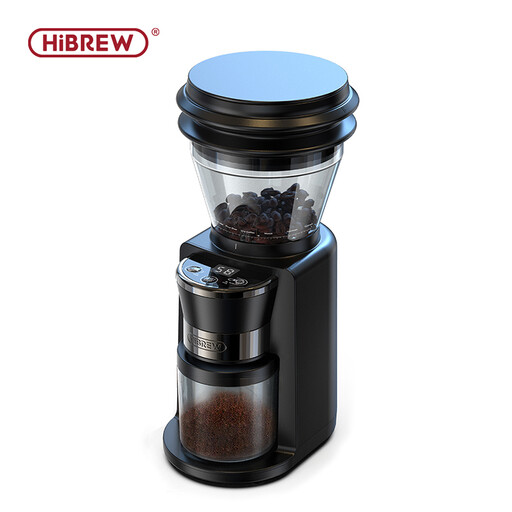 No image available
This model may suit someone comparing electric grinding with defined container sizes; establish which adjustment gives the coarse grounds you want. Its name specifies a 34-gear scale, a 48mm conical burr, a 210g bean container and a 100g grounds container. Check the supplied plug type before buying.
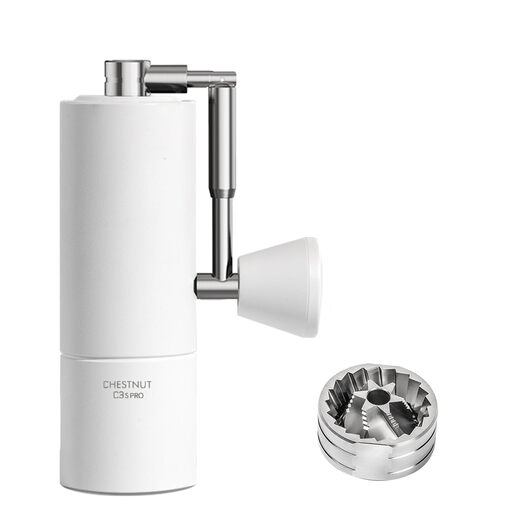 No image available
Consider a hand grinder if turning the handle fits your cafetiere routine; check the coarse adjustment with your beans rather than assuming a particular setting will work. The product name specifies an S2C conical burr and a foldable handle.
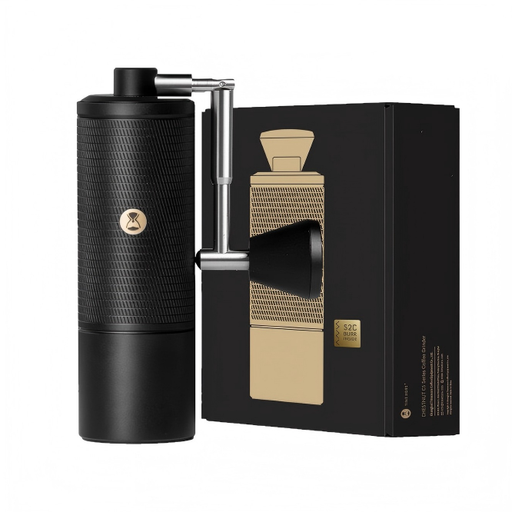 No image available
This is a manual choice for someone comfortable grinding each cafetiere batch by hand. Check the available coarse adjustment and the amount of beans it holds against your usual pot.
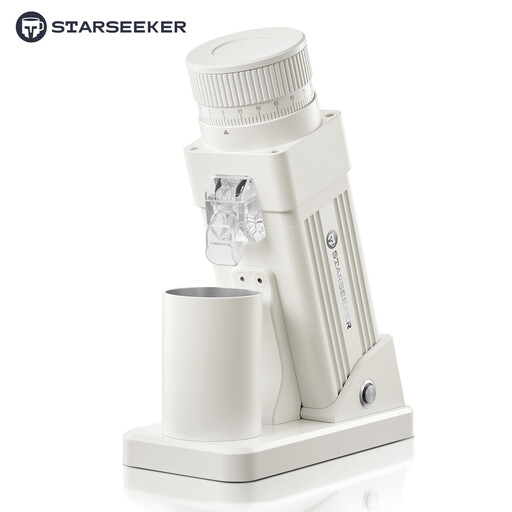 No image available
Consider this model if you also want to assess adjustment beyond cafetiere grinding; confirm where its coarse French press range sits before choosing it for that use. Its name specifies stepless adjustment, a 55mm titanium-alloy conical burr and a 72W AC motor. Check capacity and cleaning instructions for your routine.
Start with a coarse grind. Sage Appliances UK likens the French press texture to sea salt, and Adams + Russell recommends a coarse grind for cafetiere coffee because the grounds remain in contact with water for several minutes. If the plunger is very hard to press, try a slightly coarser setting next time.
A blade grinder can break down beans, but it gives you less control if a repeatable coarse grind is your priority. Sage Appliances UK describes blade grinding as producing uneven particles and adjustable burr grinding as producing more uniform ones. Decide whether that difference matters to your brewing routine.
No: concentrate on a usable, repeatable coarse setting if a cafetiere is your only brewing method. A wider range becomes relevant when you also use other methods; for instance, Baratza identifies settings 21–40 on the Encore ESP for filter, French press and cold brew.
Check how the exact model's burr area and grounds container are cleaned, and whether parts you may need are available. Baratza describes a quick-release burr system on the Encore ESP, while Lakeland lists a removable grounds container and cleaning brush for its cited Conical Burr Coffee Grinder. Follow the instructions for whichever model you choose.