What to check before buying
Start with the exact blend and the people who will drink it. Once those checks are settled, choose a flavour range and pack format that the home can manage in daily service.
| Priority |
What to check |
Your needs |
| Caffeine status |
Check the caffeine statement on the exact infusion. Distinguish a fruit or herbal infusion from a fruit-flavoured tea made with tea leaves. |
I’m looking for a fruity alternative when the menu calls for a caffeine-free drink, rather than simply a tea with fruit flavouring. |
| Ingredients |
Read the full current list for every blend, including named botanicals. Review individual suitability where medicines, conditions or care plans make an ingredient relevant. |
I need to know what is in the drink before serving it routinely. NHS guidance cautions that herbal products are not suitable for everyone and can interact with some medicines. |
| Modified drinks |
Check the resident’s assessed drink requirements, prescribed thickener and documented consistency. Follow the preparation instructions in their care plan. |
If I prepare drinks for someone with dysphagia, a standard brewed cup cannot replace their individual instructions. Sheffield Teaching Hospitals and South Yorkshire Integrated Care Board guidance calls for specialist assessment when modified drinks are needed. |
| Flavour choice |
For an assortment, check each flavour’s ingredients separately. Compare the work involved with offering one repeatable blend. |
Several flavours may help residents choose a drink they enjoy, but I must be able to identify and serve the appropriate blend each time. |
| Pack format |
Compare bag or envelope counts with likely demand, storage space and the number of blends kept in use. |
A catering pack makes sense for a regularly requested, suitable blend; a smaller pack gives us room to establish preferences before making it a routine order. |
Brand and range references
These examples show different flavour and pack-format routes; a brand’s wider range should not be treated as one ingredient formula.
Twinings
Twinings describes its fruit and herbal infusions as naturally caffeine-free. Its Fruit Selection offers four flavours in a 20-bag assortment.
- An assortment can provide a choice of fruit flavours.
- The Joybuy listing names liquorice root in three flavours, so check each flavour separately.
Clipper
Clipper describes its Organic Berry Burst infusion as naturally caffeine-free and offers it in a 250-envelope catering pack.
- The pack format is worth considering for a blend with established repeat demand.
- Review the exact ingredients and resident suitability before making it a standard offering.
Pukka
Pukka describes Elderberry & Echinacea as a naturally caffeine-free fruit and herbal infusion containing elderberry and echinacea.
- Its named botanical ingredients help identify the flavour route for individual review.
- A caffeine-free description does not settle whether the botanical blend suits a particular resident.
Teapigs
Teapigs describes Super Fruit as naturally caffeine-free and lists hibiscus and several berries among its ingredients. A 15-bag pack appears in the supplied Joybuy product information.
- The published ingredient list gives staff a starting point for checking the exact blend.
- Confirm the current pack label and the resident’s requirements before service.
Tesco
Tesco Ireland describes its 40-bag Red Berries hibiscus infusion as naturally caffeine-free. That Irish product should not be assumed to have an identical UK label or range listing.
- It illustrates an own-label, larger-pack fruit-infusion option.
- Check the exact UK product, its caffeine statement and ingredients before considering it for a UK care home.
Sainsbury's
Sainsbury's lists 20-bag strawberry, raspberry and cranberry, and blackberry and blueberry teas in its UK fruit-and-herbal range.
- The listed smaller packs offer an own-label route for exploring flavour preferences.
- Check the exact pack’s caffeine statement and full ingredients before classifying either blend as a caffeine-free option.
Joybuy options for this menu
These two options cover a mixed fruit-infusion assortment and a separate lemon-and-ginger herbal drink. The latter is an adjacent caffeine-free menu option, not a fruit-tea blend.
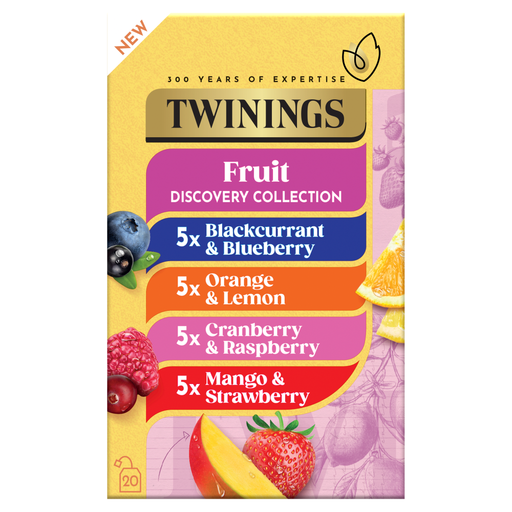 Image unavailable
Twinings Fruit Selection, 20 Tea Bags, 40g
A four-flavour assortment for offering residents a choice of fruit infusions. The product description identifies the assortment as naturally caffeine-free; the listed formulations differ, with liquorice root in three flavours. Check each current pack label and assess each flavour separately before routine service.
View on Joybuy
 Image unavailable
Twinings Lemon & Ginger, 20 Tea Bags
A single lemon-and-ginger herbal infusion to consider if the menu can include a drink outside the fruit-tea category. Its product description identifies it as naturally caffeine-free and lists ginger root, lemon peel, fennel and lemongrass. Check the current label and review individual ingredient suitability before service.
View on Joybuy
Frequently asked questions
Is fruit tea the same as decaffeinated tea?
No. A fruit or herbal infusion made without tea leaves differs from tea that has undergone decaffeination. For a care-home menu, confirm the caffeine statement on the exact product rather than assuming that a fruit flavour means a caffeine-free drink.
Can fruit tea be part of a care home’s drinks offer?
Yes, it can be one option within a resident’s individual drinks offer. Care-home hydration guidance from Dorset Council and its NHS partners emphasises offering sufficient fluids while reflecting personal choice; staff should still follow each resident’s care plan and drink requirements.
Can the same caffeine-free fruit tea be served to every resident?
Do not assume so. Check the exact blend’s ingredients and any relevant individual requirements: the Twinings Fruit Selection listing, for example, names liquorice root in three flavours. NHS guidance also cautions that herbal products can be unsuitable alongside some medicines, so seek appropriate clinical advice where an ingredient raises a concern.
What if a resident with dysphagia would like fruit tea?
Prepare and serve it only in accordance with that resident’s assessment and care plan. Sheffield Teaching Hospitals and South Yorkshire Integrated Care Board guidance calls for specialist assessment when a resident with dysphagia needs modified drinks; staff should follow the documented thickener and consistency instructions.


