One-camera road-trippers
If you mainly want to top up one camera battery between stops, check the camera’s USB charging requirements before choosing a bank for a small kit.


Start with the camera manual: a power bank can charge the battery directly only if that camera supports charging through its USB port and the bank meets its input requirements. A 10,000mAh bank is a starting point for one compatible camera and a phone; consider a 20,000mAh multi-port model when several devices need power between stops. If the camera cannot charge its battery in-body by USB, choose a battery-specific USB-powered charger to use with a suitable bank instead.
If you mainly want to top up one camera battery between stops, check the camera’s USB charging requirements before choosing a bank for a small kit.
If the camera shares power with a phone or navigation device, consider stored capacity, port count and what each port can deliver when several devices are connected.
If you charge removable batteries outside the camera, match a USB-powered charger to the exact battery code, then choose a bank that can power that charger.
Establish how the camera battery charges before deciding how much capacity or how many ports to carry.
| Concern | What to check | Who this matters to |
|---|---|---|
| Camera compatibility | Check the exact camera manual for in-body USB charging, the connector, any USB Power Delivery requirement and the required input. Sony recommends a 9V/3A or 9V/2A USB-PD source for its FX3. | If I cannot establish how my camera charges, a bank’s capacity will not settle the choice; around 36% of consumers put camera compatibility first. |
| Stored energy | Compare stated capacity with the camera batteries and other devices you intend to recharge; do not treat a bank’s mAh rating as a fixed number of camera charges. | For long stretches between charging stops, I want reserve for the camera as well as my other devices; around 29% of consumers make stored energy their main concern. |
| Simultaneous charging | Check port types and the output available to each port when devices are connected together, not just the bank’s total wattage. | When my camera, phone and navigation device need power together, available connections matter; roughly 21% of consumers prioritise multi-device charging. |
| Condition and recalls | Check the exact model and applicable manufacturing period against UK product recalls. Avoid using a damaged, swollen or overheating bank, and keep it away from extreme temperatures. | Before taking a bank in the car, I want to know it is in sound condition and is not an affected recalled unit; around 14% of consumers put these checks first. |
The connector alone does not establish whether a camera supports in-body charging or needs a particular USB-PD input. Sony’s FX3 guidance, for example, recommends a source capable of 9V/3A or 9V/2A.
Check the exact camera manual for its charging method, connector and input requirements before selecting a bank.
A multi-port bank’s stated total output does not tell you what the camera’s port can supply while a phone or navigation device is also connected.
Read the per-port output information for the combination of devices you plan to charge.
The UK Office for Product Safety and Standards has issued recalls for specific power-bank models. Mid and West Wales Fire and Rescue Service advises against charging or storing lithium batteries in very hot or cold conditions.
Check the exact model and manufacturing period against the applicable recall notice. Stop using an affected recalled unit, and do not leave a bank in a hot vehicle.
A power bank does not replace a charger designed for a removable camera battery when the camera cannot charge that battery through its own USB port.
Match a USB-powered charger to the battery’s exact code, then check its power requirements against the bank.
This route means carrying a separate battery-specific charger.
Anker UK lists the Nano A1259 as a 10,000mAh power bank with a built-in USB-C cable and 30W USB-C output.
UGREEN UK lists 20,000mAh Nexode power banks with multiple ports, including models with stated total outputs of 100W and 130W.
SmallRig offers USB-powered chargers for specified removable camera-battery families.
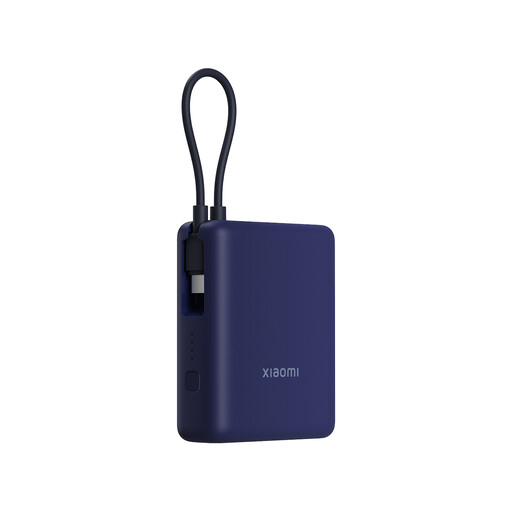
This power bank is an option to consider if an integrated cable suits your road-trip kit and your camera’s charging requirements match its output.
 No image available
The integrated cable reduces the need to pack a separate one, provided its connector and the bank’s output meet your camera’s charging requirements.
Check the exact bank model against UK recall notices before use; the 33W rating alone does not establish a camera-compatible voltage and current profile.
No: the camera must support USB battery charging, and the bank must meet its specified input requirements. Sony’s FX3 guidance recommends a 9V/3A or 9V/2A USB-PD source, but another camera may require a different setup.
Consider 10,000mAh when the main job is topping up one compatible camera battery and carrying less equipment matters. A 20,000mAh multi-port model offers a larger stated reserve for additional devices, but capacity alone cannot tell you how many camera charges you will get.
Yes, when it powers a charger designed for the exact battery family. SmallRig says its USB-C camera-battery chargers can run from power banks; check the charger variant against the battery code rather than relying on the camera brand alone.
Search the UK Office for Product Safety and Standards product-safety alerts and recalls service for the exact model, then check any affected manufacturing period. Its notices instruct owners of specified recalled Anker and Xiaomi power banks to stop using the affected products; a recall of one model does not automatically apply to another.
Keep it away from extreme heat or cold, including direct sun in a parked car. Mid and West Wales Fire and Rescue Service advises against charging or storing lithium batteries in very hot or cold conditions; stop using a bank that is swollen, damaged or overheating.