Choose the lens for the detail you need to capture before choosing a camera body. A true macro lens suits embroidery, jewellery or fabric texture that must fill the frame; for a moving wearer, prioritise a shutter speed that freezes movement, a suitable lens aperture and autofocus. Stabilisation can reduce camera shake when shooting handheld, but it cannot freeze the wearer.
Who needs which setup?
Close-detail costume archivists
If embroidery, trims, jewellery or fabric weave must fill the frame, check the lens’s maximum magnification. Nikon describes at least 1:1 reproduction as true macro for full-frame photography; a camera body’s pixel count does not establish that capability.
Handheld venue photographers
For static costumes in dim exhibitions or backstage spaces where a tripod is impractical, body or lens stabilisation can help counter camera movement. It will not prevent blur if the wearer moves during the exposure.
Live costume-performance photographers
When the wearer is moving, consider autofocus, shutter speed and lens aperture together. Canon’s low-light and shutter-speed guidance explains the trade-off: a faster shutter can freeze movement but lets in less light, while a wider aperture narrows depth of field.
What matters when choosing?
Full-frame body with a macro lens
Choose it when: Small beads, stitching or fabric texture need to occupy much of the frame.
Accept: Close focusing makes depth of field difficult to manage; static details may need support or additional light when you stop down.
Full-frame body with a non-macro lens
Choose it when: Wider costume views or a moving wearer matter more than frame-filling views of tiny trim.
Accept: Stabilisation cannot freeze movement, and the lens’s close-focus capability still needs checking if you also want small details.
| Concern |
What to check |
Who this matters to |
| Frame-filling detail |
Check the lens mount and maximum magnification; Nikon defines true macro on full frame as at least 1:1. |
If I need a bead or stitched motif to fill the frame, close-up reproduction takes priority over body specifications. Roughly 36% of consumers put frame-filling detail first. |
| Static handheld shots |
Check whether stabilisation is in the body, the lens or both, and read the conditions behind any stated stop rating. |
When I cannot use a tripod beside a static display, reducing camera shake matters most to me. Around 29% of consumers make handheld sharpness their primary concern. |
| Moving wearers |
Check autofocus capabilities and whether the lens aperture permits the shutter speed the scene requires. |
If a performer moves, I need to keep their costume details from blurring even though a faster shutter admits less light. About 21% of consumers prioritise capturing movement. |
| Room to crop |
Compare effective megapixels for the exact body, alongside the lens’s close-focus capability. |
When I cannot get close enough to compose tightly, I want room to crop a sharply focused image. Approximately 14% of consumers put cropping flexibility first. |
Mistakes to avoid
-
Expecting any lens to make tiny details fill the frame
Maximum magnification is a lens specification, not a camera-body feature. The Canon, Nikon and Sony macro lenses discussed here are specified at 1.4x, 1:1 and 1.0x respectively by their manufacturers.
Decide how closely you need to photograph the detail, then check magnification and mount compatibility before selecting the body.
A kit supplied with a general-purpose zoom may require a separate compatible macro lens for frame-filling close-ups.
-
Relying on stabilisation to freeze a performer
Stabilisation counters camera movement, not the performer’s movement. Canon’s shutter-speed guidance notes that faster exposures freeze motion while admitting less light.
For a worn costume in motion, assess the shutter speed you need and whether the lens aperture and available light make it practical.
-
Using the widest aperture for every close-up
A wider aperture admits more light but leaves a shallower area in focus, which may not cover all the beadwork or trim you want sharp.
For a static costume, try different apertures and consider support or additional light if a narrower aperture better covers the detail.
-
Assuming a camera purchase settles image-sharing permissions
The UK Intellectual Property Office advises that photographs and other images are generally protected by copyright; permission from the copyright owner is usually needed to copy or share an image online.
For commissioned work, clarify with the relevant parties who may use and publish the finished photographs before sharing them.
Relevant brands to consider
Canon
Canon’s EOS R8 and RF 100mm F2.8L Macro IS USM illustrate a compact-body route with a separate, high-magnification macro lens.
- Canon specifies a 24.2MP full-frame sensor, autofocus sensitivity down to -6.5EV under its test conditions and an approximately 414 g body-only weight for the EOS R8. Its RF macro lens is specified at 1.4x magnification.
- Canon lists the RF macro lens at 685 g, so the body-only weight does not describe the weight of the close-up kit.
Nikon
Nikon’s Z6III and NIKKOR Z MC 105mm f/2.8 VR S offer a route centred on handheld shooting of static details and 1:1 macro reproduction.
- Nikon specifies a 24.5MP sensor and up to 8.0 stops of in-camera stabilisation for the Z6III. Its 105mm macro lens is specified at 1:1, f/2.8 and with in-lens vibration reduction.
- The stabilisation rating does not mean a moving wearer will remain sharp; shutter speed still matters.
Sony
Sony’s α7 IV and FE 90mm F2.8 Macro G OSS provide a full-frame route for buyers considering both cropping room and close-up reproduction.
- Sony specifies 33.0 effective megapixels for the α7 IV and 1.0x maximum magnification, f/2.8 and optical stabilisation for the 90mm macro lens.
- Sony lists the macro lens at 602 g. Its 1.0x magnification is below the 1.4x specified for Canon’s RF 100mm macro lens, if greater-than-life-size reproduction is the deciding requirement.
Joybuy camera choices
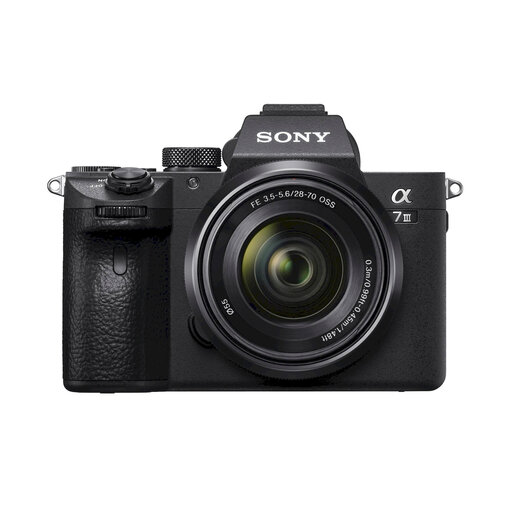
This camera-and-zoom kit is a choice to consider for wider costume views and handheld photographs of static subjects. If tiny details must fill the frame, check the included lens’s close-focus specifications or consider a compatible macro lens.
 No image available
Sony Alpha 7 III with 28–70mm zoom lens
Consider this full-frame camera kit for wider costume views or handheld shots of static subjects. The included 28–70mm zoom lens gives you a starting lens, but check its maximum aperture and close-focus magnification against the light and detail you need to capture; do not assume it provides 1:1 macro reproduction.
View on Joybuy
Frequently asked questions
Do I need a macro lens for costume details?
Choose a true macro lens when small details need to fill much of the frame. Nikon defines true macro for full-frame photography as at least 1:1 reproduction; for a wider view of the whole costume, that magnification is not automatically necessary.
Will image stabilisation prevent blur when a performer moves?
No: stabilisation reduces camera shake, while a moving performer needs a sufficiently fast shutter speed. Canon’s shutter-speed guidance notes that faster exposures admit less light, which may call for a wider aperture or higher ISO.
Should I always use f/2.8 for a close-up in low light?
No: f/2.8 admits light but can leave too little depth of field for layered trim or beadwork. For a static subject, try a narrower aperture if more of the detail must be sharp, accounting for the resulting need for a longer exposure or more light.
Can I share costume photographs online in the UK?
Check who holds the relevant rights before publishing, particularly for a commissioned shoot. The UK Intellectual Property Office advises that photographs and other images are generally copyright-protected and that permission from the copyright owner is usually needed to copy or share an image online; the permissions for a particular commission need clarifying with the parties involved.


