Choose the camera and lens together, starting with a view wide enough to frame the whole arrangement at your available shooting distance. If peel, seeds or cut surfaces are your main subject, check the lens’s magnification and working distance too: greater close-up capability can leave less room for lighting, while a tighter view may require you to move farther from the table.
Who needs which setup?
The useful starting point is the photograph you need to make most often: the complete display, a small fruit detail or a mixture of stills and video.
Overhead arrangement photographers
If you mainly photograph the complete display from above or at a shallow angle, prioritise a lens that fits it into the frame from your available position. A screen you can see while the camera is above the table also makes composition easier.
Close-detail food photographers
If peel, seeds, droplets or cut surfaces are the subject, compare lens magnification and focusing distance. A tighter crop is useful only if you can still position the camera and light around the fruit.
Photo-and-video sellers
If you photograph arrangements and record short demonstrations, consider video and screen features alongside still-image framing. Check the supplied lens separately for the close-up shots you intend to make.
What matters when choosing?
Set your framing distance first, then decide how much close detail the lens must capture. Screen access and video features matter most once the lens can make the images you need.
| Concern | What to check | Who this matters to |
|---|
| Whole-arrangement framing |
Check the lens’s angle of view on the chosen sensor format and whether the screen is visible from your shooting position. Canon UK suggests wider focal lengths as a starting point for top-down food photographs. |
I need the whole display in frame without raising the camera beyond the space I have. Around 31% of consumers would put whole-arrangement framing first. |
| Close fruit detail |
Compare the exact lens’s maximum magnification and working distance; make sure there is room for your lighting at close focus. |
Seeds or rind texture are the point of my photograph, so a distant crop will not give me the composition I want. Close detail would come first for around 31% of consumers. |
| Repeatable setup |
Check screen movement, controls and the package contents, including the lens and charging accessories. |
When I adjust fruit between shots, I want to see and repeat the composition without an awkward viewing position. Around 23% of consumers would make a straightforward setup their primary concern. |
| Stills and short video |
Confirm the camera’s video modes, screen position and the lens supplied; video features alone do not establish close-focus capability. |
I also film the arrangement being assembled, but still need to frame the finished display. For around 15% of consumers, covering both stills and video would take priority. |
Buying pitfalls
-
Choosing the body without checking the lens
A body-only camera does not supply the focal length or close-focus capability needed for a particular fruit photograph. Canon lists the EOS R50 body and RF 35mm F1.8 Macro IS STM as separate products.
Read the exact package contents and lens model. For texture shots, compare the lens’s magnification and focus specifications rather than relying on the body’s megapixel count.
A compatible close-focusing lens may be an additional item to obtain.
-
Assuming 1:1 macro suits every tabletop shot
Life-size magnification helps with tiny details, but close shooting can crowd the space needed for lights or reflectors. Sony quotes a 2.4 cm minimum working distance for its E 30mm F3.5 Macro.
Choose 1:1 magnification when the detail itself needs to fill the frame. For complete arrangements and moderate close-ups, compare the framing and working distance of a less specialised lens as well.
-
Comparing focal-length numbers without sensor format
The angle of view changes with sensor format. Nikon describes its NIKKOR Z MC 50mm f/2.8 as giving a 75mm-equivalent view on a Z DX camera, which can feel tight when there is little room to step back.
Check the angle of view for the camera-and-lens combination at your intended table distance before choosing a lens for overhead framing.
Brands and lens routes to consider
These examples show how different body-and-lens combinations address the tabletop task; the lens and package still need checking for the particular photograph you want.
Canon
The EOS R50 and RF 35mm F1.8 Macro IS STM form an APS-C route for overhead compositions and selective close details.
- Canon specifies a vari-angle touchscreen for the EOS R50 and up to 0.5x magnification for the RF 35mm lens.
- The lens does not offer life-size 1:1 magnification. An EOS R50 body-only package needs a lens, and Canon states that a USB-C charger is not included in that package.
Nikon
A Z DX body such as the Z50II paired with the NIKKOR Z MC 50mm f/2.8 puts tightly framed fruit details first.
- Nikon specifies 1:1 magnification for the macro lens and a 75mm-equivalent angle of view on a Z DX body.
- That tighter view may require more distance from the table; shooting at close focus can also restrict space for lighting.
Sony
The ZV-E10 II offers an interchangeable-lens APS-C route for stills and video; the E 30mm F3.5 Macro is a separate option for close details.
- Sony specifies a 26.0-megapixel sensor for the ZV-E10 II and 1:1 magnification for the E 30mm macro lens.
- Sony quotes a 2.4 cm minimum working distance for that lens, leaving little space to control light or reflections at its closest setting.
Joybuy camera choices
These Sony interchangeable-lens camera listings are starting points for framing fruit arrangements and, where needed, recording video. Check the exact supplied lens and its close-focus capability before choosing one for texture shots.
 No image available
Sony Alpha ZV-E10 II K with 16–50 mm f/3.5–5.6 Power Zoom lens
Consider this kit if you want to vary whole-arrangement framing and record short video alongside still photographs.
- The listing specifies an APS-C camera, a 16–50 mm kit lens, 26-megapixel stills and 4K60p video.
- Before relying on the kit for fruit texture, check the supplied lens’s minimum focus distance and maximum magnification.
- The product specifications state that a memory card is not included.
Joybuy
 No image available
Sony A6700 with 16–50mm lens
Consider the A6700 if a movable screen matters for composing above the table, subject to confirming the lens in this package.
- The listing describes an APS-C camera with a rotating touchscreen, a 26-megapixel sensor and 4K video.
- Its title and description name a 16–50mm lens, but the included-components list does not name one. Confirm the package contents before ordering.
- For tightly framed fruit details, check the exact supplied lens’s minimum focus distance and magnification.
Joybuy
 No image available
Sony A6400 with 16–50mm Power Zoom lens
The supplied zoom gives you focal lengths to compare for a complete arrangement, while the tilting screen helps when composing from a high position.
- The listing specifies an APS-C camera, a 24.2-megapixel sensor, 4K video and a 180° tiltable touchscreen.
- Check the 16–50mm lens’s minimum focus distance and magnification if small fruit details are important.
Joybuy
 No image available
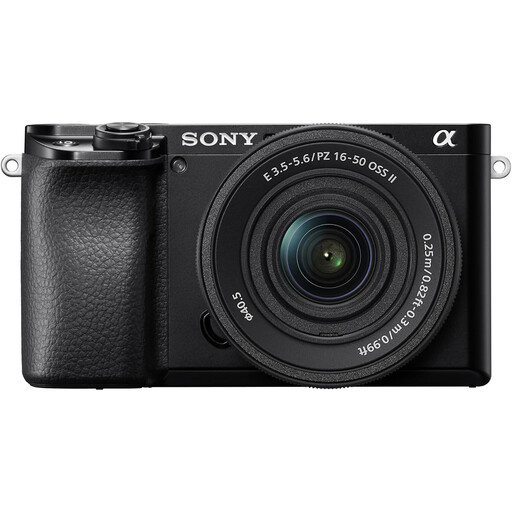
Sony A6100 with 16–55mm zoom lens
Consider the A6100 for high-angle composition only after confirming which lens this listing supplies.
- The listing describes an APS-C camera with 24.2-megapixel stills, 4K video and a 180° tiltable touchscreen.
- The title and English description say 16–55mm, while the detailed description refers to a 16–50mm II lens. Confirm the exact model and package contents.
- Check that lens’s minimum focus distance and magnification before choosing it for fruit texture.
Joybuy
Common questions
Do I need a macro lens for fruit arrangements?
Not for every photograph: frame the complete arrangement at your available table distance before prioritising macro magnification. A close-focusing or macro lens becomes more important when seeds, peel or cut surfaces need to fill much of the image; check its working distance as well as its magnification.
Why does working distance matter for close-up fruit photographs?
Working distance determines how much space remains between the front of the lens and the fruit for lighting and styling. Sony quotes a 2.4 cm minimum working distance for its E 30mm F3.5 Macro, so plan where a light or reflector can sit before choosing it for very close shots.
What should I check before ordering a camera kit online?
Confirm the exact camera body, supplied lens and included accessories against the package contents, not just the listing title. Check the lens’s focus specifications for your intended detail shots and read the retailer’s return terms; a change-of-mind policy is distinct from remedies for faulty goods.
How should I dispose of an old camera or battery in the UK?
Keep old electrical equipment and batteries out of household rubbish and use an appropriate electrical or battery collection route. GOV.UK advises against putting these products in household rubbish; check local collection instructions for the camera and any removable battery.


