Catalogue-first handmade sellers
If most of your work is photographing whole items, collections and packaging for listings, look for a manageable camera-and-lens combination that covers the framings you use regularly.


Choose the lens around the items you need to photograph: an interchangeable-lens camera with a standard zoom is a starting point for whole-product listings, but small details call for a lens whose close-focus ability you have checked. If demonstrations are a regular part of the shop, consider the screen, audio connections and recording format as well; confirm the exact lens in any bundle before buying.
If most of your work is photographing whole items, collections and packaging for listings, look for a manageable camera-and-lens combination that covers the framings you use regularly.
For jewellery, miniature work, textiles and other items where fine construction matters, check the chosen lens’s close-focus specifications rather than judging the camera by sensor resolution alone.
If you switch between listing photos and demonstrations or face-to-camera clips, consider how you will view the screen, record sound and focus on an item you hold up to the camera.
Start with the size of the products and the views your listings need, then decide whether regular video work or carrying the setup between locations changes the camera you choose.
| Concern | What to check | Who this matters to |
|---|---|---|
| Whole-product listings | Confirm the lens supplied in the bundle and whether its focal-length range covers your usual product views. | I need repeatable photos of complete items and sets without changing lenses for every composition. Around 36% of consumers would put that listing workflow first. |
| Fine details | Check the intended lens’s minimum focus distance and stated magnification, including how the distance is measured. | Stitches, settings or maker marks need to occupy enough of my image to be seen clearly. Close-detail framing would be the primary need for around 29% of consumers. |
| Product video | Match the screen, audio connections, focus behaviour and recording settings to the clips you intend to make. | I regularly demonstrate how an item is made or used, so filming it matters alongside still photos. Around 21% of consumers would prioritise that video workflow. |
| Portability | Compare the complete body-and-lens setup, and check that the chosen lens still frames your products as needed. | I photograph items at markets, workshops or other changing locations and need a setup I can carry. Portability would come first for around 14% of consumers. |
The lens affects how closely you can frame a small item. Canon specifies 15cm minimum focus distance and 0.25x magnification for its RF-S 18-45mm zoom; Nikon specifies 0.16m and a 0.67x full-frame-equivalent reproduction ratio for its separate NIKKOR Z DX MC 35mm f/1.7.
Check the exact lens and box contents, then compare its focusing distance and magnification with the smallest items you sell.
A different lens may be needed if the supplied one cannot frame those details closely enough.
Sensor resolution and the size of a subject in the frame are different considerations. A high-resolution body does not establish how closely its selected lens can focus.
For detail-led listings, check lens magnification and close-focus distance before comparing body resolution.
Manufacturer-listed functions such as 4K 60p recording, presenter-to-product focus modes and audio connections serve filming tasks; they do not by themselves improve an ordinary still listing.
Decide whether you will make listing photos, occasional clips or regular demonstrations, then choose recording features for that workload.
The EOS R50 and RF-S 18-45mm form one route for sellers combining general listing stills with occasional video.
The Z50II is worth considering when presenter-led demonstrations accompany product photos, with a separate Z DX close-detail lens option.
The ZV-E10 II offers a video-oriented E-mount option for sellers making product clips alongside stills.
The X-M5 is an X-mount option for sellers considering a compact interchangeable-lens body and a RAW-file workflow.
These interchangeable-lens camera bundles offer zoom-lens starting points for handmade-product listings; some also suit shops planning video. For small craft details, check the supplied lens’s close-focus ability before choosing a bundle.
 No image available
Consider this bundle if you want a zoom for composing different whole-product listing views.
The product name identifies a full-frame camera and a 28–70mm lens. Check whether that lens can frame your smallest items closely enough before relying on it for detail shots.
 No image available
This bundle is relevant if you make product demonstrations as well as listing photos.
Its product name specifies an APS-C camera, a 16–50mm f/3.5–5.6 kit lens, 26 megapixels and 4K 60p recording. Check the lens’s close-focus specifications for small craft details, and allow for a compatible memory card: the product information identifies one as not included.
 No image available
Consider the supplied zoom if your listing work calls for different views of complete products.
The product name identifies an APS-C camera with a 16–50mm power zoom lens. If fine details are central to your listings, check that lens’s minimum focus distance and magnification.
 No image available
This camera-and-zoom bundle is an option for varied whole-product compositions and a shop that also makes video.
The product name identifies an APS-C camera and 16–50mm lens. Check the supplied lens’s focusing distance and magnification before using it as the basis for close-detail photography.
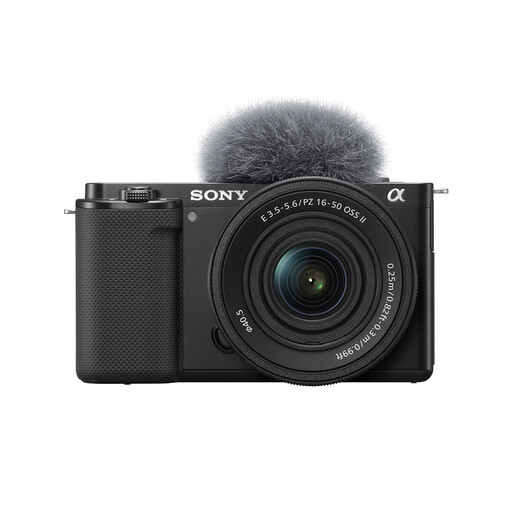 No image available
This interchangeable-lens bundle suits consideration if you want to make shop videos as well as whole-product photos.
The product name identifies the ZV-E10K variant with a 16–50mm power zoom lens. Check the lens’s close-focus ability for small items and the camera’s exact specifications if sensor resolution will affect your choice.
A standard kit lens can suit whole items, sets and some closer views if its framing and focusing specifications fit your products. Canon specifies 15cm minimum focus distance and 0.25x magnification for its RF-S 18-45mm zoom; if tiny details must fill much of the image, compare your intended lens with a close-detail option rather than assuming every kit zoom will do the same job.
Choose video functions for the way you actually film, particularly screen position, sound connections and how focus behaves when you show an item. Nikon lists Product Review Mode and microphone and headphone sockets for the Z50II, while Sony specifies 4K 60p for the ZV-E10 II; check the recording settings and lens included in the particular bundle.
For a UK consumer purchase, the Consumer Rights Act 2015 requires supplied goods to be of satisfactory quality. Keep the listing, order confirmation and exact bundle description so you can explain the fault and what was supplied.
Use an appropriate electrical-waste collection or retailer take-back route rather than putting it in ordinary household waste. GOV.UK explains that UK waste electrical and electronic equipment rules aim to reduce disposal through incineration or landfill and encourage recovery, reuse and recycling.