Whole-model studio photographers
You photograph finished pieces on a tabletop or copy stand and want to adjust framing with a standard zoom before considering a specialist macro lens.


For photographs of complete origami models in a home studio, start by considering an APS-C interchangeable-lens camera with a movable screen and a close-focusing standard zoom. If small folds or paper texture need to fill the frame, choose the lens for its stated magnification rather than assuming a high-resolution body or kit zoom will do the job; a macro lens also needs enough working distance for your lighting.
You photograph finished pieces on a tabletop or copy stand and want to adjust framing with a standard zoom before considering a specialist macro lens.
You want small folds, layered edges or paper texture to occupy much of the image. Lens magnification and room to position lights matter alongside camera resolution.
You photograph finished models and record folding demonstrations or process clips, so screen movement, video options and audio connections may influence your choice.
Decide how small a detail must appear in the finished image before choosing a lens; then check how you will frame and light the model in your workspace.
| Concern | What to check | Who this matters to |
|---|---|---|
| Small fold detail | Check the exact lens's maximum magnification and the space between its front element and the subject at close focus. | If a crease or paper texture needs to fill the image, I need a lens that reproduces it closely without blocking my lights. Around 46% of consumers put this detail requirement first. |
| Whole-model framing | Check screen movement and whether the supplied zoom covers the compositions you need from your planned camera position. | Working around a tabletop, I want to compose a complete model from above or near table height without repeatedly moving the camera. For around 36% of consumers, that framing need takes priority. |
| Stills and demonstrations | Check the video options and screen position; check microphone connections if you plan to record narration. | Alongside finished-model photographs, I want to record how a piece is folded or presented. Roughly 18% of consumers primarily need that combination of stills and video. |
Resolution does not tell you how large a tiny fold will appear in the frame. The lens's focusing and magnification specifications also matter.
Check the exact lens supplied with the camera. If frame-filling detail is essential, compare its maximum magnification with a dedicated macro lens specification rather than relying on the body's resolution.
Canon UK specifies 0.25x magnification for the RF-S 18-45mm zoom, while Sony UK specifies 1:1 for the E 30mm F3.5 Macro. Those specifications describe different close-up reproduction capabilities.
Choose a standard zoom for flexible views of complete models if its close-focus capability meets your needs. Consider a compatible macro lens when small details must occupy much more of the frame.
Adding a macro lens later means managing another piece of equipment.
Sony UK specifies a 2.4 cm minimum working distance from the front of the E 30mm F3.5 Macro lens to the subject. At that distance, the lens and camera position can restrict where you place a light.
Plan the model, camera angle and light positions together; check working distance as well as magnification before choosing a macro lens.
The EOS R50 and RF-S 18-45mm are a camera-and-zoom combination to consider for complete models and moderate close views.
The Z50II and NIKKOR Z DX 16-50mm are worth considering when a movable screen and standard-zoom framing suit your studio layout.
The α6700 is an APS-C E-mount option to consider if RAW recording and body stabilisation matter alongside a plan for a compatible close-up lens.
These APS-C cameras are listed with zoom lenses for framing complete origami models. Before relying on any included lens for small fold or texture shots, check its exact identity and close-focus specifications; a camera body alone does not establish macro capability.
 No image available
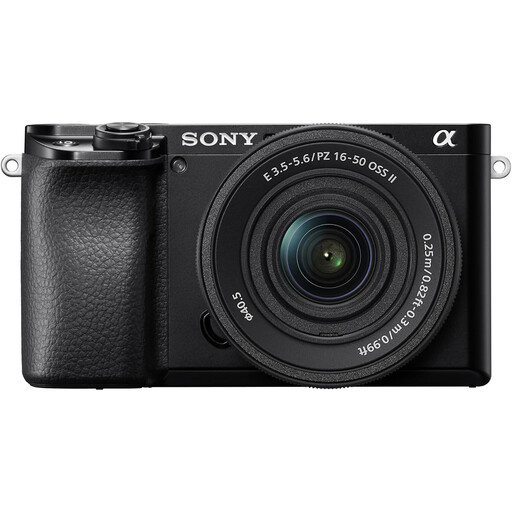
Consider this APS-C kit if you want a zoom for complete-model framing and also plan to record folding demonstrations.
The listed lens is a 16–50 mm f/3.5–5.6 power zoom; the camera title also specifies 26 MP stills and 4K 60p video. Check the included lens's minimum focus distance and maximum magnification before planning small-detail shots.
 No image available
Consider this APS-C camera and zoom for composing views of complete models from a tabletop setup.
The listed lens has a 16–50 mm range. Check its minimum focus distance and maximum magnification if your photographs must also show small folds prominently.
 No image available
Consider this camera for general views of origami models if the supplied zoom suits the framing you need.
Confirm the exact lens before purchase: the product information identifies it inconsistently as 16–50 mm and 16–55 mm. Check that lens's close-focus distance and maximum magnification separately for detail shots.
 No image available
Consider this APS-C kit for photographing complete models when a supplied zoom fits your planned compositions.
The listed lens is 16–50 mm. Check its minimum focus distance and maximum magnification for fold-detail work, and confirm compatibility with any particular macro lens you intend to add.
A kit zoom can suit photographs of complete models and some closer views if its magnification works for the size of your subject. Canon UK specifies 0.25x magnification for the RF-S 18-45mm, while Nikon UK specifies a 0.2 m minimum focus distance for the DX 16-50mm; neither specification alone establishes 1:1 macro reproduction.
Consider a compatible macro lens when small folds or paper texture need to fill much of the frame. Sony UK specifies 1:1 magnification for its E 30mm F3.5 Macro, but also a 2.4 cm minimum working distance from the lens front, so check whether your lighting arrangement will fit around the subject.
Stabilisation is more relevant if you also photograph models handheld. Sony UK describes the α6700's in-body system as compensating for camera shake; for a stationary model on stable support, check lens close-focus capability, framing and light placement before making stabilisation the deciding feature.