First-time overhead tutorial makers
You want to keep the whole cutting mat and your hands in view while recording spoken instructions, without making lens choice or settings unnecessarily complicated.


Choose a camera and lens that can frame the whole cutting mat from your available overhead height, with a screen you can view once the camera is mounted. If you plan to slow down hand movements in editing, Canon EOS R50 V and Sony ZV-E10 II offer 4K/60p; Panasonic Lumix G100D offers a 4K/30p kit with a 12–32 mm lens. Whichever route you take, check the loaded weight against the overhead support and position the lighting to keep hands from obscuring the work.
You want to keep the whole cutting mat and your hands in view while recording spoken instructions, without making lens choice or settings unnecessarily complicated.
You plan to edit close views of paper edges and hand movements. Recording modes and a lens that suits your working distance matter more when you intend to crop or slow footage.
You expect to connect a microphone, move footage into an editing workflow or stream lessons, so repeatable setup and connections deserve attention alongside the image.
Start with a framing test at your actual table and mounting height; then decide which recording and audio features your lessons will use.
| Concern | What to check | Who this matters to |
|---|---|---|
| Whole-table framing | Check the intended lens at your available camera-to-table distance, and whether you can see the screen once mounted. | If my hands or the mat edge leave the shot, the cutting steps become hard to follow. Around 40% of consumers put complete overhead framing first. |
| Fine detail and editing | Compare the exact recording modes you would use and check the memory-card and computer requirements for them. | If I need to show narrow cuts or slow down quick hand movements, I want footage that fits my editing plans. Fine detail and editing are the main priority for around 30% of consumers. |
| Repeatable recording and audio | Check how you will power the camera, position a microphone and transfer or stream footage. | For a series of spoken lessons, I need a setup I can reconnect and use consistently. Around 30% of consumers place that recording and audio workflow first. |
An interchangeable lens gives you framing options, but the chosen lens still has to show the cutting area from the height your support allows.
Measure the work surface and available height, try the framing with a phone or existing camera, and check the intended lens before buying.
A different lens or a larger mounting arrangement may be needed if the planned setup cannot cover the work surface.
Shadows, missed focus or a poorly chosen camera distance can still hide fine paper edges, regardless of the recording resolution.
Test the light and framing over the cutting mat before choosing a higher frame rate or more demanding recording format for editing.
The mount carries the lens, battery, plate and attached accessories as well as the camera. NEEWER gives its ST100 overhead rig a maximum load of 4.5 kg; other supports have their own ratings and fitting conditions.
Check the complete loaded weight and your desk against the instructions for the specific support, then secure it as directed before working beneath it.
Your setup may call for a different clamp or a purpose-designed overhead stand.
A camera and its kit version can call for different lens and mounting plans. The exact supplied accessories matter when you are trying to frame a fixed cutting table.
Read the product-detail page for the complete model and bundle contents, then confirm that the supplied lens and accessories fit your intended setup.
Canon positions the EOS R50 V as a video-focused interchangeable-lens camera for creators who want recording and streaming controls.
Sony's ZV-E10 II is an APS-C interchangeable-lens option for lessons that may involve editing and later lens changes.
Panasonic's Lumix G100D offers a compact Micro Four Thirds route, including a kit version with a 12–32 mm lens.
These cameras offer different starting points for a fixed overhead lesson, from interchangeable-lens kits to compact and action-camera designs. For any of them, test whether the intended position shows your full cutting area and check how you will mount it securely.
 No image available
Consider this kit if you want an interchangeable lens and intend to edit recorded cutting demonstrations.
The listed variant has a 16–50 mm f/3.5–5.6 Power Zoom lens, 4K/60p video and 10-bit 4:2:2 recording.
Check that the lens frames your whole work surface from the available height and that your overhead support suits the loaded camera.
 No image available
This interchangeable-lens kit is an option if you want to start with a zoom lens for your tabletop framing test.
It includes a 16–50 mm Power Zoom lens. If a particular 4K frame rate matters to your editing workflow, check the recording modes for this model.
Confirm the view from your mounting height and the fit of the complete setup with your overhead support.
 No image available
Consider a compact, fixed-lens camera if you do not want to select a separate lens for your first lesson setup.
The listing identifies a 1-inch sensor and an ultra-wide lens. Check the view at your planned overhead height: a wide shot still has to keep the cutting details visible.
Confirm a secure way to position the camera above your table.
 No image available
This compact camera bundle is worth considering if you also want to record spoken instructions, provided you can arrange a suitable fixed overhead position.
Its title lists a 1-inch CMOS sensor, 4K/120 fps video and an included microphone.
Check the cutting-area framing and the intended support; a mini tripod does not by itself establish an overhead mounting arrangement.
 No image available
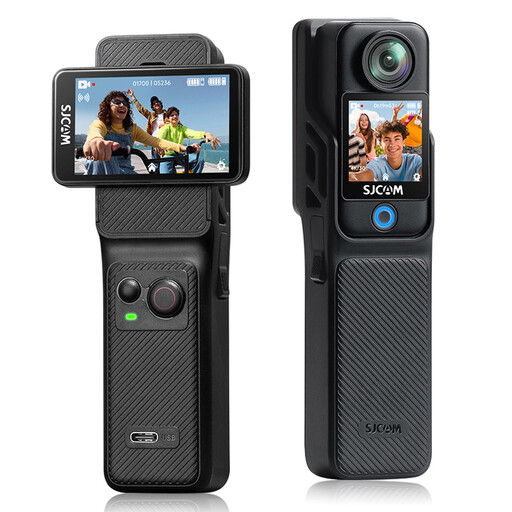
This action-camera option calls for a close framing test before you commit to it for small paper details.
The title lists a 154° wide-angle view, dual touchscreens and 2K slow-motion recording.
Check whether the cutting work remains large enough in the shot, whether a screen is viewable when mounted and which overhead support fits the camera.
No: 4K/30p can suit a normally paced, fixed overhead lesson. Consider 4K/60p if you specifically want more flexibility to slow fast hand movements in editing. Canon lists 4K/60p for the EOS R50 V and Sony for the ZV-E10 II; Panasonic lists 4K/30p for the Lumix G100D.
Check the support's stated load and fitting instructions against your entire camera setup and your desk. Include the lens, battery, plate and attached accessories when assessing the load. NEEWER specifies a maximum of 4.5 kg for its ST100 overhead rig; that figure does not apply to other mounts. Make sure you can also inspect the screen and frame the full cutting area once the camera is positioned.
Look for an appropriate electrical-recycling route or a retailer take-back option rather than assuming an old camera belongs in general household waste. GOV.UK describes the Waste Electrical and Electronic Equipment Regulations 2013, as amended, as underpinning UK measures for the recovery, reuse and recycling of electrical products.