Choose an interchangeable-lens camera with a lens suited to the smallest detail your listings must show. A flexible screen can help with tabletop framing, but the lens’s magnification and working distance matter more when you need close photographs of markings, edges or mechanisms; a 1:1 macro lens is more relevant to those tiny features than to whole-tool shots.
Who these setups suit
Detail-led craft-tool sellers
If buyers need to inspect fine teeth, engraved markings, moving parts or surface texture, choose a lens by the size of the feature you need to photograph. The 1:1 macro lenses described by Sony UK and Nikon UK are particularly relevant to very small details.
Small-shop catalogue builders
For repeatable tabletop photographs of whole tools, boxed sets and accessories, consider how easily you can frame each view and move images into your listing workflow. Canon UK lists a vari-angle screen and wireless connections for the EOS R50.
Photo-and-video demonstrators
If you also film tools in use, assess video framing, focus behaviour and audio connections alongside still photographs. Nikon UK describes a Product Review Mode for the Z50II, while Canon UK lists a microphone connection for the EOS R50.
What to check when buying
Start with the smallest feature you need to show, then decide how you will frame repeated catalogue shots and whether demonstrations are part of your workflow.
| Concern | What to check | Who this matters to |
|---|
| Small tool details |
Compare the exact lens’s maximum magnification and working distance, especially around reflective metal. |
If a marking or fine mechanism must be clear in my listing, close framing is my priority. Around 42% of consumers put small-detail photography first. |
| Repeatable catalogue shots |
Check screen movement for your tabletop position and whether the chosen lens frames whole tools and sets. |
When I photograph several tools and their accessories, I need to compose each view consistently. Whole-tool catalogue work comes first for around 33% of consumers. |
| Photos and demonstrations |
Assess video focus behaviour and whether the camera has the audio connection your demonstrations require. |
If I film a tool as well as photograph it, I need a setup that handles both tasks. Roughly 25% of consumers prioritise this combined photo-and-video need. |
Buying pitfalls
-
Choosing the body before checking the lens
A lens described as macro will not necessarily give the same close framing as another: Canon UK specifies 0.5x magnification for the RF 35mm F1.8 Macro IS STM, while Sony UK and Nikon UK specify 1:1 for the cited 30mm and 50mm macro lenses.
Identify your smallest important feature, then check the exact lens’s magnification, minimum focus distance and working distance.
If the lens supplied with a camera cannot frame that feature closely enough, you may need a separate compatible lens.
-
Overlooking space for lights around a close-up
Sony UK gives the E 30mm F3.5 Macro a working distance of about 2 cm at its closest setting. With reflective tools, the camera or photographer can also appear in the surface.
Check the shooting angle and where your lights can sit before choosing a short-working-distance lens.
A different lighting arrangement or lens may be needed if the camera blocks the light or appears in reflections.
-
Treating listing photographs as decoration alone
A photograph can give buyers the wrong impression of a tool’s condition or included accessories. GOV.UK guidance says product descriptions must be accurate and product claims must be supportable.
Show the actual tool and included parts clearly, and make sure photographs and accompanying claims agree.
Brands to consider
Canon
The EOS R50 and RF 35mm F1.8 Macro IS STM form a route for whole-tool photographs and moderate close-ups.
- Canon UK lists a 24.2 MP APS-C sensor, vari-angle touchscreen and Wi-Fi/Bluetooth for the EOS R50.
- Canon UK specifies 0.5x magnification for the RF 35mm lens, rather than 1:1 for very small features.
Sony
The α6700 and E 30mm F3.5 Macro offer an APS-C route when small details are central to listings.
- Sony UK specifies 1:1 magnification for the E 30mm F3.5 Macro.
- Sony UK puts its working distance at about 2 cm at the closest setting, leaving limited space to arrange light around reflective tools.
Nikon
The Z50II and NIKKOR Z MC 50mm f/2.8 are relevant when listings include both close details and product demonstrations.
- Nikon UK describes Product Review Mode for the Z50II and 1:1 magnification for the NIKKOR Z MC 50mm f/2.8.
- Nikon UK says the lens front can be about 5 cm from the subject at 1:1, so lighting position still needs attention.
Joybuy camera choices
These camera choices are relevant to whole-tool catalogue photographs and mixed photo-and-video work. For photographs of tiny markings or mechanisms, check the close-focusing ability of the lens you intend to use with the exact camera or bundle.
 No image available
Sony A6700 with 16–50mm lens
Consider this APS-C camera and zoom-lens bundle for varied whole-tool framing. Before planning photographs of tiny markings, check the included lens’s maximum magnification and working distance; the separate Sony E 30mm macro lens discussed above is not this bundle’s named lens.
View on Joybuy
 No image available
Sony A6400 with 16–50mm Power Zoom lens
The included zoom gives you a choice of framing for whole tools and sets. If fine teeth or small engravings are essential to your listings, check the lens’s close-focusing specifications before relying on this bundle for those shots.
View on Joybuy
 No image available
Sony Alpha 7 III with 28–70mm zoom lens
This full-frame camera bundle includes a 28–70mm zoom for framing whole tools and sets. Check that lens’s magnification and working distance if your listings must also show very small features.
View on Joybuy
 No image available
Sony Alpha ZV-E10 II K with 16-50 mm f/3.5-5.6 Power Zoom kit lens
Consider this APS-C kit if you make tool photographs alongside demonstration clips; its name specifies 4K60p video and a 16-50 mm lens. Check the kit lens’s close-focusing ability for small tool details rather than relying on the camera’s Eye Autofocus description for that task.
View on Joybuy
 No image available
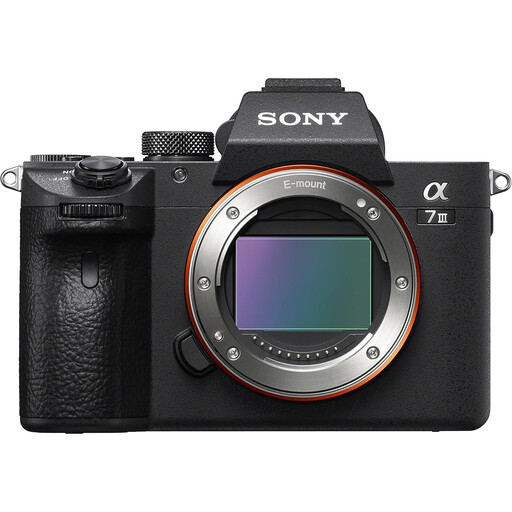
Sony Alpha 7 III full-frame camera body only
This body-only option suits a buyer arranging a compatible lens separately. Confirm the contents of the particular offer before ordering, then choose a lens whose framing and close-focusing ability suit your tools.
View on Joybuy
Common questions
Do I need a 1:1 macro lens for craft-tool listings?
Not for every listing: whole tools and moderate close-ups may suit a less specialised lens. For tiny markings or mechanisms that need to fill more of the frame, compare maximum magnification; Sony UK and Nikon UK specify 1:1 for the cited macro lenses, while Canon UK specifies 0.5x for the cited RF 35mm lens.
Why does a macro lens’s working distance matter?
Working distance is the space from the front of the lens to the subject, so it affects where you can place lights and whether the camera appears in a reflective tool. Sony UK gives the E 30mm F3.5 Macro about 2 cm of working distance at its closest setting.
Can I rely on autofocus for tiny tool details?
Check that the intended marking or edge is actually in focus rather than assuming autofocus has selected it. Choose the focus point deliberately and inspect a close-up before repeating the setup across your listings.
What should my UK shop photographs show about a tool?
Show its condition and included parts without giving buyers a misleading impression. GOV.UK guidance says product descriptions must be accurate and claims must be supportable, so check that photographs and accompanying words describe what the buyer will receive.


