Who each setup suits

Demonstrators filming fine hand movements

If viewers need to see threads, heddles and shuttle movements, plan both the camera distance and the detail shot. An interchangeable-lens camera is particularly relevant when you can leave it on a tripod and choose a lens for each view.

Filmmakers moving around the loom

If space or the demonstration requires frequent repositioning, a compact gimbal camera offers a small handheld setup with mechanical stabilisation. Check that its fixed view frames the actions you need to show.

Creators recording spoken instruction

If the demonstrator must be heard over loom noise and nearby activity, treat microphone placement and the exact camera or bundle connection options as part of the purchase decision. Built-in microphones alone do not settle how speech will sound in the workshop.

What matters when choosing

Compact gimbal camera

Choose it when: You expect to move between positions around the loom and want a small handheld kit.

Trade-off: A fixed lens gives you less control over framing than changing lenses on a tripod-mounted camera.

APS-C interchangeable-lens camera

Choose it when: You can plan a tripod shot and select lenses for the full loom and smaller details.

Trade-off: Lens choice adds setup work; stabilisation also depends on the particular camera, lens and recording mode.

Micro Four Thirds interchangeable-lens camera

Choose it when: You want lens choice alongside a compact setup and occasional mobile filming.

Trade-off: Panasonic lists the LUMIX G100D at 4K 25/30p, so it will not meet a firm 4K 50/60p requirement.

ConcernWhat to checkWho this matters to
Close-up framing and focus Check focus distance at your planned camera position and the view provided by the actual lens. Make sure you can see the screen from beside or above the loom. If fine movements are the point of the lesson, I need hands and threads to remain readable as the shot changes. Around 29% of consumers would put clear detail first.
Spoken instruction Confirm microphone compatibility and bundle contents, then plan where the microphone will sit relative to the demonstrator. When the loom and nearby conversations are audible, I need viewers to follow what I am saying. Clear speech would be the primary concern for around 29% of consumers.
Stable, practical setup Decide whether the main shot is fixed or handheld; check the relevant stabilisation mode and whether the planned mounting position leaves shared space usable. I may have to change position without obstructing the workshop, but I still want a steady shot. Around 24% of consumers would prioritise a workable, stable setup.
Recording and editing options Check the frame rate in the mode you intend to use, compatible recording media and whether your editing workflow calls for options such as log recording. If I expect to edit and reuse footage shot under indoor lighting, I need recording options that fit that workflow. Editing flexibility would come first for around 18% of consumers.

Buying pitfalls

  • Choosing a camera body before planning the shot

    A body specification cannot tell you whether the supplied lens will show both the full loom and small hand movements from your available position.

    Mark out the camera position and the wide and detail views you need, then check the exact lens in the bundle.

    An interchangeable-lens setup may require a separate lens for the framing you want.

  • Expecting stabilisation to replace a filming plan

    A gimbal helps with moving shots, while a fixed tutorial angle still needs a secure position. Stabilisation also varies by lens and video mode: Canon lists lens or digital stabilisation, rather than sensor-shift stabilisation, for the EOS R50 V.

    Decide which shots will be fixed and which will move, then check stabilisation in the mode you will actually record.

    Your chosen position may call for a tripod, mounting arm or compatible stabilised lens.

  • Leaving workshop audio to the built-in microphone

    The camera may capture the loom and nearby conversations along with the explanation. A microphone option is useful only if it suits the camera, bundle and planned placement.

    Make a short sound test in the workshop and confirm the audio components you need before buying.

    A compatible external microphone or transmitter may need to be bought separately.

  • Recording identifiable people without a filming plan

    The UK Information Commissioner’s Office distinguishes purely personal or household activity from organisational processing. Its guidance for organisational video surveillance calls for a documented lawful basis and attention to transparency; the applicable obligations depend on the purpose and context of the recording.

    Agree the purpose and filming area with the organiser, avoid including uninvolved people where possible, and settle how footage will be shared and kept before recording.

Relevant brands to consider

DJI

The Osmo Pocket 3 represents the compact gimbal route for moving around a loom.

  • DJI lists a 20 mm-equivalent fixed lens, a 0.2 m minimum focus distance and three-axis mechanical stabilisation.
  • The fixed lens cannot provide the framing changes available through lens selection; the camera also requires a microSD card for storage.

Canon

The EOS R50 V is an APS-C, RF/RF-S interchangeable-lens option for a planned setup.

  • Canon lists subject-tracking autofocus, 4K 60p and Canon Log 3.
  • Canon lists lens or digital image stabilisation, not sensor-shift stabilisation; check the chosen lens and shooting method.

Sony

The ZV-E10 II offers an APS-C E-mount route when lens choice is part of the filming plan.

  • Sony lists E-mount lens compatibility and 4K 60p recording.
  • Check which lens gives the wide and detail views you need at the available camera distances.

Panasonic

The LUMIX G100D offers Micro Four Thirds lens choice and a free-angle screen.

  • Panasonic lists Hybrid I.S.; its specifications describe four-axis compensation during 4K video recording.
  • Its listed 4K modes are 25/30p, so check another model if 4K 50/60p is required.

Joybuy camera choices

These choices cover a moving gimbal setup, an interchangeable-lens kit and compact fixed-lens cameras for filming around a loom. Check the planned camera distance and audio arrangement before choosing among them.

DJI Osmo Pocket 3 Creator Combo camera

DJI Osmo Pocket 3 Creator Combo

Consider this compact gimbal camera if you need to reposition around the loom. DJI lists three-axis mechanical stabilisation, a fixed 20 mm-equivalent lens and a 0.2 m minimum focus distance for the Osmo Pocket 3. Its normal-video 4K modes run up to 60 fps; check the mode behind the listing’s 4K/120fps wording and confirm the exact microphone components in this Creator Combo. The fixed view still needs to work for your hand-detail shots.

View on Joybuy

Sony Alpha ZV-E10 II K camera with 16–50 mm kit lens

Sony Alpha ZV-E10 II K with 16–50 mm f/3.5–5.6 kit lens

Consider this interchangeable-lens kit for a planned wide-and-detail setup. The product title identifies an APS-C camera, a 16–50 mm f/3.5–5.6 power-zoom lens and 4K 60p recording; Sony also lists E-mount compatibility for the ZV-E10 II. Check whether the included lens focuses closely enough on threads and hands at your chosen tripod position.

View on Joybuy

Sony ZV-1F compact camera

Sony ZV-1F compact camera

Consider this fixed-lens camera if a broad loom view matters more than changing lenses. Its product title identifies a 1-inch sensor and an ultra-wide lens. Before relying on it for small weaving actions, check the framing and close focus at your planned distance, as well as the audio arrangement for spoken instruction.

View on Joybuy
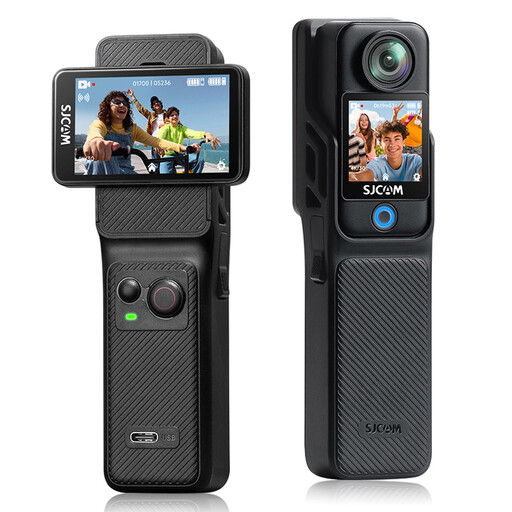
SJCAM C400 action camera

SJCAM C400 4K action camera

Consider this small action camera for a broad workshop view if its perspective suits the demonstration. Its product title lists a 154° wide-angle lens, six-axis electronic image stabilisation and a flip touchscreen. Check how clearly it captures threads and hands at the intended distance, and confirm a suitable way to record speech.

View on Joybuy

Common questions

Is a compact gimbal camera or an interchangeable-lens camera better for this demonstration?

Choose a compact gimbal camera if you will move around the loom often; choose an interchangeable-lens camera if a planned tripod position and lens-based framing changes matter more. Test whether the resulting view shows both the overall process and the hand movements your viewers need to follow.

Does the DJI Osmo Pocket 3 need a memory card?

Yes. DJI says the Osmo Pocket 3 has no built-in storage and records to a microSD card, with support up to 1 TB. For another camera, check the required card type and recording-mode requirements before buying.

Do I need 4K 60p for a weaving tutorial?

Not necessarily: choose the frame rate for the movement you need to show and the way you intend to deliver the video. Canon lists 4K 60p for the EOS R50 V and Sony lists it for the ZV-E10 II, while Panasonic lists 4K 25/30p for the LUMIX G100D; check the exact recording mode before making 60p a requirement.

How should I handle other people appearing in workshop footage?

Agree the filming purpose and how identifiable participants will be handled with the organiser before recording, and avoid capturing uninvolved people where possible. The UK Information Commissioner’s Office says purely personal or household processing without a professional or commercial connection falls outside UK GDPR scope; its organisational video-surveillance guidance calls for a documented lawful basis and transparency. Which obligations apply depends on the recording’s purpose and context.

How can I make spoken instructions easier to hear?

Test a short recording in the workshop and, if speech is central, plan microphone placement near the demonstrator. Check compatibility and the exact bundle contents before buying; DJI lists a connection option for two DJI Mic 2 transmitters on the Osmo Pocket 3, but that does not mean every package includes them.