Groups planning several meals
A multipack gives you separate tins to open across the trip. Check each tin’s weight against the portions your group expects to use, and allow for the weight you will carry.


For a camping trip with several bean-based meals, larger tins or multipacks are practical if you can use their contents; a smaller tin makes more sense when you need to finish it without refrigerating leftovers. If salt and sugar matter to your choice, compare nutrition labels per 100g and check what a reduced-recipe claim is measured against. Pack size alone cannot tell you which option offers better monetary value.
Start with how many tins you will open, and whether you can refrigerate anything left over.
A multipack gives you separate tins to open across the trip. Check each tin’s weight against the portions your group expects to use, and allow for the weight you will carry.
A smaller tin may be easier to finish at one meal. Waitrose & Partners instructs shoppers to refrigerate its essential baked beans after opening, so an unopened spare tin is different from an opened portion you cannot chill.
Compare the nutrition panels of the particular recipes you might pack. Waitrose & Partners says its essential reduced salt and sugar beans contain 30% less of each than its regular essential beans; that comparison does not extend to every brand.
Work out how much you can use from an opened tin, then compare the labels and preparation instructions for the products that fit your trip.
| Priority | What to check | Your needs |
|---|---|---|
| Tin and pack size | Check the weight of each tin, the number of tins and how many openings you are planning. Sainsbury's lists own-label 215g and 400g formats. | I am eating alone and would rather finish one small tin; for several meals, separate tins give us more chances to open only what we need. |
| Salt and sugar | Compare both products per 100g, then consider the portion you will eat. Waitrose & Partners lists 0.30g salt per 100g for its essential reduced recipe and 0.49g for its regular essential beans. | Salt and sugar are part of my decision, so I want to compare actual labels rather than assume every product called “reduced” has the same composition. |
| Fibre | Compare fibre in grams per 100g on the products’ labels. Marks & Spencer lists 3.7g per 100g for its 400g baked beans. | I want to know what the beans contribute alongside the other foods I am packing, without treating one tin as a complete meal plan. |
| Storage and preparation | Read the opened-tin storage period and check that the heating instructions suit your cookware. Waitrose & Partners says to transfer its regular essential beans to a covered, non-metallic container, refrigerate and use within two days. | Without reliable refrigeration, I need a tin I can finish after opening. I also need a suitable pan or container if I plan to heat the beans. |
A smaller tin can help avoid leftovers, while a larger tin may better match a shared meal. Neither size establishes monetary value on its own.
Decide how much you expect to use each time you open a tin, then compare the current listing for the formats that fit.
Product instructions can require refrigeration and set a time limit after opening. Waitrose & Partners specifies two days for its regular essential beans; Marks & Spencer specifies three days for its 400g beans.
If you cannot chill leftovers, plan to finish the opened tin at that meal and follow the instructions on the product you take.
An unfinished portion may need to be discarded when its storage instructions cannot be followed.
Waitrose & Partners’ stated 30% salt and sugar reductions compare its essential reduced recipe with its own regular essential beans, not with other brands.
Check the named comparator and use the per-100g panels when comparing different products.
A product page does not ensure that the item will be available when you shop.
Check the listing before departure and confirm what you will actually take.
These range examples help identify formats and label differences; they do not imply that every product mentioned is in the Joybuy selection below.
Its own-label listings include standard 400g beans and a smaller 215g tin.
Its regular and reduced salt and sugar baked beans are both 420g products.
Heinz lists Baked Beanz in individual-tin and multipack formats.
Branston baked beans appear in individual tins and multipacks, including 410g tins.
Marks & Spencer lists a 400g baked-bean tin with per-100g nutrition information.
These tins cover repeated meals, a smaller individual tin and a reduced salt and sugar recipe. Check the current listing before choosing a pack for your trip; the formats shown here do not establish which has better monetary value.
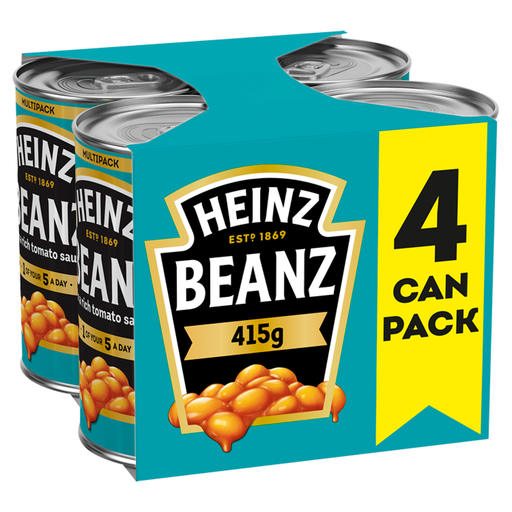 Image unavailable
Four separate 415g tins suit a trip with repeated bean-based meals. Check the pack’s heating and after-opening instructions against your camp equipment and storage arrangements.
 Image unavailable
This four-tin format can be opened across several meals. Joybuy’s Branston 4 x 410g product instructions describe transferring the beans to a saucepan for hob heating and refrigerating leftovers after opening.
 Image unavailable
Six separate 410g tins are an option when the group expects to open beans at several meals. Account for the pack’s carrying weight and check its preparation instructions before planning to heat it at camp.
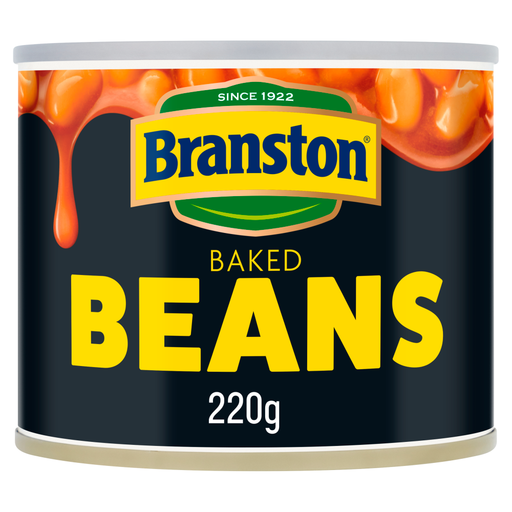 Image unavailable
This 220g tin is worth considering when one camper expects to finish the opened portion at a meal. Compare its size with what you will actually eat, and check the pack instructions for preparation and any leftovers.
 Image unavailable
Four 410g tins combine a multipack format with a reduced sugar and salt recipe. Check its per-100g panel and the named regular Branston comparator on the current pack rather than applying a reduction claim to other brands.
Choose a smaller tin when you expect to finish it at one meal and cannot refrigerate leftovers. Sainsbury's lists a 215g own-label tin alongside a 400g version; compare those quantities with your intended portion rather than assuming either size fits every solo trip.
Use the preparation method on the product you pack, rather than planning to heat the tin itself. Joybuy’s Branston 4 x 410g product instructions specify transferring the beans to a saucepan for hob heating.
Follow that product’s transfer, refrigeration and time-limit instructions. Waitrose & Partners specifies a covered, non-metallic container and use within two days for its regular essential beans, while Marks & Spencer specifies refrigeration and use within three days for its 400g beans. If you cannot refrigerate leftovers, plan to finish the tin when you open it.
Compare their nutrition information per 100g first, then consider how much you intend to eat. Waitrose & Partners lists 0.30g salt per 100g for its essential reduced recipe and 0.49g for its regular essential beans; its stated percentage reduction refers to that regular product, not every baked-bean recipe.
Plan other foods alongside the beans. NHS guidance recommends obtaining fibre from a variety of sources, so a baked-bean tin is one component to consider when planning meals rather than a substitute for variety.