Batch-prep bean cooks
If you heat canned butter beans with sauce, vegetables or grains for several meals, look for enough pot capacity for the whole dish, a non-pressure heating function you can control and a pot you can clean easily.


For batch-heating canned butter beans, choose an electric multi-cooker for its Sauté, Simmer or Reheat function rather than its pressure-cooking speed. A compact cooker can suit smaller portions, while a larger pot gives beans, sauce and other ingredients more room; pressure cooking matters more if you will also prepare dried pulses or other dishes from scratch.
If you heat canned butter beans with sauce, vegetables or grains for several meals, look for enough pot capacity for the whole dish, a non-pressure heating function you can control and a pot you can clean easily.
If you make only a few portions at a time, worktop and storage space may matter more than maximum pot volume. A compact cooker with Sauté and Keep Warm functions is worth considering.
If canned beans are only one part of your cooking routine, a pressure programme may be useful for suitable dishes made from scratch. Check that the same cooker also offers a practical way to heat canned beans without a pressure cycle.
Start with a controllable non-pressure heating function, then choose a pot size for your usual batch; give pressure programmes more weight only if you plan to use them for other cooking.
| Concern | What to check | Who this matters to |
|---|---|---|
| Controlled heating | Look for a Sauté, Simmer or Reheat function that lets you heat and stir beans with sauce without starting a pressure cycle. | If I season canned beans in the pot, I want to stir them and control the heat rather than seal the lid. Around 33% of consumers put controlled heating first. |
| Batch size and cleaning | Allow room for beans and additions; check the exact model’s fill instructions and which removable parts can be washed as directed. | When I prepare several meals with sauce and vegetables, I need space in one pot and manageable washing-up. For around 25% of consumers, batch size and cleaning take priority. |
| Compactness | Compare the pot capacity and physical dimensions with your worktop and storage space; Instant Pot lists its Classic Mini at 3.8L. | If I make only a few portions, a cooker that fits my kitchen matters more than extra volume. Roughly 25% of consumers prioritise compactness. |
| Other pressure-cooked meals | Check for both a Pressure Cook programme and a non-pressure mode, and follow the exact model’s lid and pressure-release instructions. | If I also cook dried pulses or stews from scratch, I want the appliance to do more than warm canned beans. Around 17% of consumers put that broader use first. |
Pressure programmes serve a different purpose from heating and seasoning canned butter beans. For this task, a usable non-pressure function is the more direct feature to assess.
Before comparing preset counts, check whether the exact model offers Sauté, Simmer or Reheat control and how its manual says to use the lid with that function.
A litre figure describes nominal pot capacity, not a guaranteed amount of finished bean dish. Sauce and other ingredients take up space, and pressure programmes may have their own fill limits.
Plan the full batch, then check the exact model’s fill instructions before choosing a pot size.
Holding food warm for serving is different from storing leftovers. Food Standards Scotland advises checking a product’s label for storage instructions after opening, while Food Standards Agency reheating guidance says to heat food thoroughly to the centre and reheat it only once.
Portion and chill food according to its label rather than repeatedly cooling and reheating the same batch.
Pressure-cooker components and electrical fittings need to suit the appliance and its intended market. The Instant Pot Duo Plus manual specifies using the lid supplied for that cooker base; Electrical Safety First advises a UK three-pin plug and fuse for slow and pressure cookers.
Follow the exact model’s lid instructions. For use in Great Britain, check the plug and fuse, appropriate product marking and manufacturer details before buying.
These ranges illustrate functions and capacities relevant to bean batches; check the specifications of the particular model you are considering.
Instant Pot UK lists the Classic Mini as a 3.8L multi-cooker with pressure cooking, Sauté and Keep Warm among its functions.
SharkNinja UK lists the PC201UK as a 6L pressure and rice cooker with Sear/Sauté, Simmer and Keep Warm functions.
Tefal UK lists the 6L All-in-One CY505 with brown, simmer and reheat programmes alongside pressure cooking.
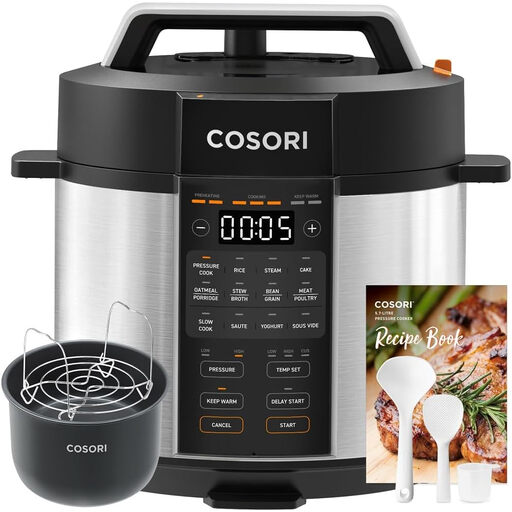
This 5.7L multi-cooker is a choice to examine if you want a larger pot for canned-bean batches and expect to use its other cooking functions too. Check its dimensions and instructions against your kitchen and usual portions.
 No image available
Consider this model if you want to use its Sauté function to heat beans with other ingredients and need more nominal pot capacity than a compact 3.8L cooker.
The product name specifies a 5.7L, 9-in-1 cooker with a ceramic non-stick coating and recipe book. The 5.7L figure is nominal capacity, not a finished-batch limit: check the model’s fill instructions, physical dimensions and UK plug details before buying.
No pressure cycle is needed for the stated heating task. Choose a cooker with Sauté, Simmer or Reheat control if you want to warm and season the beans in its pot; pressure cooking becomes a more relevant reason to buy if you also prepare suitable dishes from scratch.
Follow the food label’s storage instructions after opening and chill leftovers as directed. Food Standards Scotland advises checking the label for an open-life instruction, and Food Standards Agency guidance says reheated food should be thoroughly hot in the centre and reheated only once.
Follow the exact model’s cleaning and handling instructions, particularly for the inner pot and lid. The Instant Pot Duo Plus manual says to use only the lid supplied for that cooker base, so do not substitute a lid from another cooker.
Check the appliance and listing for appropriate product marking and manufacturer details, and confirm that the supplied cooker has a UK three-pin plug and fuse. GOV.UK advises checking product marking and manufacturer information; Electrical Safety First gives the plug-and-fuse advice for slow and pressure cookers.