
24/7 Customer Support

Free returns

Same-day & Next-day Delivery

Quality Guaranteed

Unlock Your Welcome Offers: FREE Delivery | Up to 80% OFF | Free 30-day JoyPlus trial
Download the APP
Adding a custom lighting system is one of the most popular ways to personalise a vehicle's interior. A quality car ambient lighting kit can transform your cabin's atmosphere, making night drives more enjoyable and giving your car a modern, premium feel. However, the market is flooded with options, and it's easy to end up with a product that flickers, fades or fails after a few weeks.
As a Joybuy Product Recommendation Officer, my role is to help you navigate the options and identify the key features that separate a worthwhile upgrade from a frustrating waste of money. Before you buy, be aware of these common pitfalls that many UK drivers fall into.
To ensure you get a vibrant, reliable and long-lasting lighting system, focus on these three core parameters during your search.
The key to a professional-looking installation is smooth, uniform light. This is where the technology used to diffuse the light becomes critical.
Your control over the lights is just as important as the lights themselves. Modern kits offer advanced customisation that goes far beyond a simple on/off switch.
How the kit is powered determines its installation complexity and safety. All reputable kits should operate on 12V DC, your car's standard voltage, and include short circuit protection.
Based on these criteria, we've matched several lighting kits to different types of car enthusiasts.
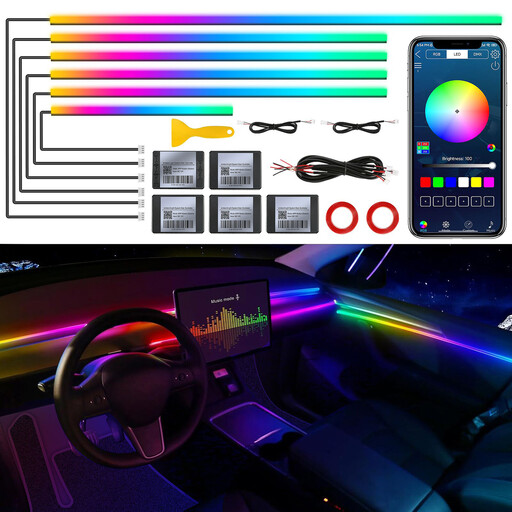
Why This Fits Their Persona: This user wants total control and the most advanced effects. The multi-controller system (1 main, 4 sub) allows for a complex, fully integrated setup across the dash and all four doors, while the RGB Smart IC provides the dynamic chasing and flowing effects they desire.
The acrylic light strips and 593 individual LEDs are designed for high brightness and uniform diffusion, directly countering the "hotspot" and fade issue seen in cheaper kits.
Features dual-zone control via the app, allowing different colours and modes for the dash and doors simultaneously. The strips are also cuttable for a fully custom fit.
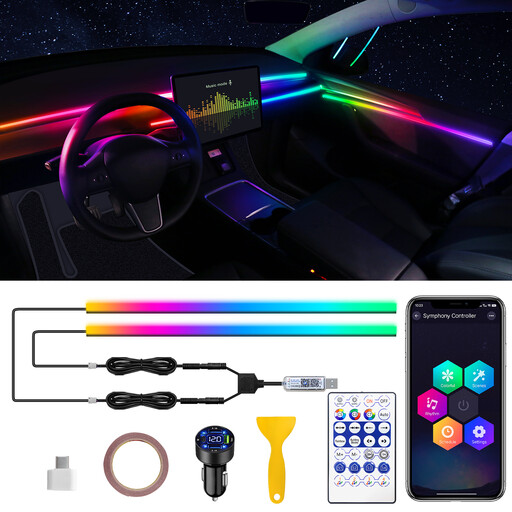
Why This Fits Their Persona: This driver's priority is creating an immersive audio-visual experience. This kit's main selling point is its sound-sensitive function, which syncs the light effects to music rhythm or even voice, turning the car into a mobile light show.
It avoids the unreliable app trap by using the established "LED LAMP" app for stable Bluetooth control, ensuring the music sync and customisation features work as intended.
The built-in high-sensitivity microphone ensures accurate synchronisation with music. It also features the same high-quality acrylic strips and RGB-IC tech for smooth, dynamic effects.
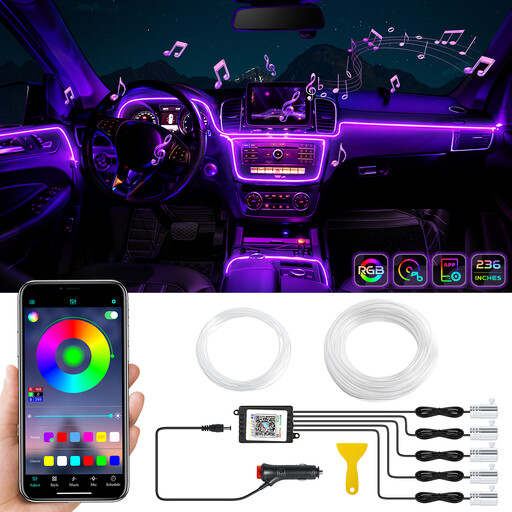
Why This Fits Their Persona: This user wants a clean, fibre-optic look with a more straightforward installation. This kit includes a long 6-metre fibre optic line that can be cut to size and a simple car charger for power, avoiding the need for complex hardwiring into the fuse box.
It avoids the misleading "plug-and-play" trap by being genuinely simple. The inclusion of a car charger and a pry tool makes it a true DIY kit that doesn't require electrical expertise.
The single, long fibre optic cable offers maximum flexibility for custom routing. You can trim it to perfectly fit your dashboard and door panels from one continuous line for a very clean look.
We have compiled a complete, real-time list of products that fully satisfy these strict selection criteria and UK safety regulations.
A quality LED lighting kit should have a very long lifespan. The LEDs themselves are typically rated for 30,000 to 50,000 hours of use. In real-world terms, this means they will likely outlast the vehicle itself. The points of failure are more often the controller, power connections or physical damage to the strips, which is why choosing a well-made kit is important.
The difficulty varies. A simple kit with a 12V cigarette lighter plug can be installed in under an hour with basic tools. You simply tuck the fibre optic tube into the gaps in your dashboard and door panels. More complex, hardwired kits with multiple controllers may require more time and confidence in removing trim panels and connecting to your car's fuse box. Always test the lights before fully installing them.
When the car is running, the alternator powers the lights, so there is no battery drain. When the car is off, a properly installed kit should not draw any power. Kits that plug into a cigarette lighter socket that is only active when the ignition is on are safest. If you hardwire a kit, ensure it is connected to a circuit that switches off with the ignition to prevent any parasitic drain on your battery.