
24/7 Customer Support

Free returns

Same-day & Next-day Delivery

Quality Guaranteed

Unlock Your Welcome Offers: FREE Delivery | Up to 80% OFF | Free 30-day JoyPlus trial
Download the APP
A well-chosen car ambient lighting kit can completely transform your vehicle's interior, turning a standard cabin into a personalised, modern space. However, the market is flooded with options, and it's easy to fall for marketing hype that leads to a disappointing purchase. Many drivers invest in a kit only to find the lighting is patchy, the controls are frustrating or the installation is a nightmare.
As the Joybuy Product Recommendation Officer, my role is to help you navigate these choices. We will look past the flashy advertisements and focus on the practical details that determine quality. Before you spend your money, let's highlight the common pitfalls to avoid.
fibre optic car lights are lit by a single LED at one end of the tube. This creates a bright spot near the source that fades into a dim glow further down the strip, resulting in an uneven and unprofessional finish.App controlled car lights are only as good as their software.universal car lighting kit might not provide enough length or components for your specific vehicle. You could be left with strips that are too short for the dashboard or a kit that lacks car footwell lights, leaving your project incomplete.To ensure you get a system that looks great and functions reliably, focus on these three core parameters. They are the true indicators of a quality car ambient lighting kit.
The material of the light strip itself is critical for a premium look.
car LED strip lights with a more robust construction.The type of colour effects you can create is another major differentiator.
RGB car lights system can display millions of colours, but only one solid colour at a time across the entire kit. You can switch from blue to red, but you cannot have blue and red simultaneously on the same strip.dreamcolor car interior lights strip can be controlled individually. This allows for dynamic, multi-colour effects like flowing gradients, chasing lights and rainbow patterns, offering a much higher level of customisation.The "X-in-1" number in a product title refers to the total number of separate light sources and controllers in the box. A "6-in-1" kit might include a main strip for the dashboard and four smaller strips for the doors, plus a controller. A "22-in-1" kit will offer far more comprehensive coverage, including lights for footwells, door handles and even storage pockets. Before buying, measure the areas of your car you want to illuminate and ensure the kit provides enough strips and connection points to achieve your desired car atmosphere lights setup.
Based on these criteria, we have matched several kits to different user needs. Instead of a one-size-fits-all approach, consider which profile aligns with your goals.
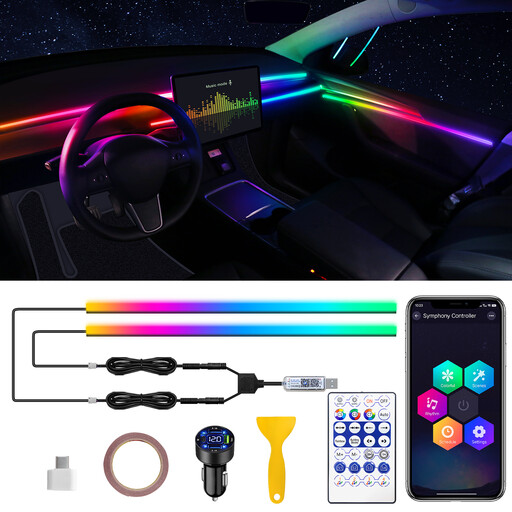
Why This Fits Their Persona: This kit is an excellent entry point for those new to car lighting modification. It provides the core components to light up the dashboard and doors, offering a significant visual upgrade without the complexity of a larger system. It's a straightforward project for a weekend DIYer.
It uses acrylic strips with embedded LEDs, ensuring you get a smooth, uniform glow and avoid the amateurish "hotspot" look common in cheaper fibre optic kits.
Features modern essentials like app control and a music sync function, providing great value and functionality for its price point.
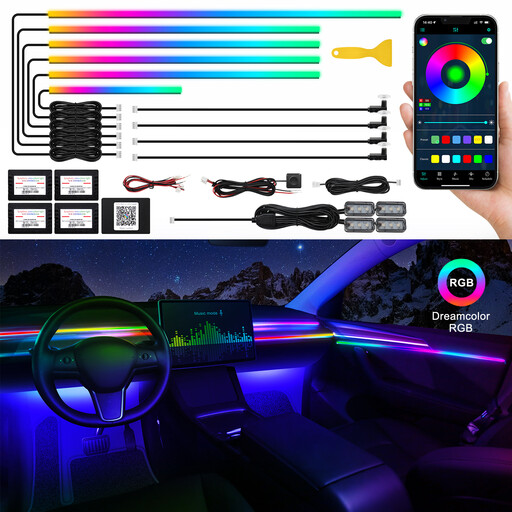
Why This Fits Their Persona: For the car enthusiast who wants more than just a single colour. This kit is built around Dreamcolor RGB Smart IC technology, enabling dynamic chasing and flowing effects that make a car's interior stand out at shows or during night drives.
This 14-in-1 kit provides comprehensive coverage, including main strips, car footwell lights and door handle lights, avoiding the "incomplete kit" pitfall.
Offers dual control via a smartphone app and a discreet touch button. The Dreamcolor effects are its main selling point, allowing for a truly customised and high-end look.
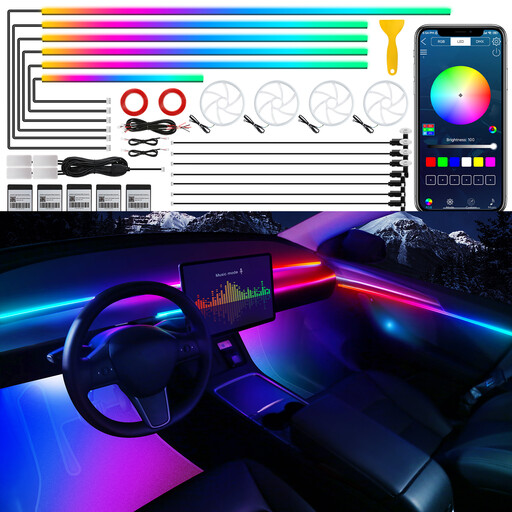
Why This Fits Their Persona: For the user who wants a complete, fully integrated lighting overhaul. This 22-in-1 kit is designed for total coverage, illuminating everything from the dashboard and doors to footwells, storage boxes and even speaker horns for a true show-car finish.
Its modular design with a main controller and four sub-controllers allows for flexible installation and power distribution, overcoming the wiring challenges of a large, complex kit.
The standout feature is Dual-Zone Control, allowing you to set different colours and modes for different areas of the car simultaneously via the app for ultimate personalisation.
We have compiled a complete, real-time list of products that fully satisfy these strict selection criteria and UK safety regulations.
Most modern kits are designed for DIY installation. They typically include a plastic pry tool to help you tuck the thin acrylic or fibre optic strips into the gaps between your car's interior panels. For power, you can often choose between a simple 12V cigarette lighter plug or hardwiring to the fuse box for a cleaner, more permanent setup. It is always advisable to test the lights before fully securing them in place.
The lighting source in these kits is LEDs, which have a very long operational life, often rated for 30,000 to 50,000 hours of use. This means the lights will likely outlast the vehicle itself. The physical durability of the strips and control modules is also important, so handling them with care during installation is key to long-term reliability.
When your car is running, the power draw from a car interior LED lights kit is negligible and is supplied by the alternator. If wired correctly to an accessory (ACC) fuse, the lights will automatically turn off when you switch off the ignition, preventing any battery drain. Even if left on, the low-heat, energy-efficient nature of LEDs means the power consumption is minimal, though it's always good practice to ensure they are off when the car is parked for extended periods.