
24/7 Customer Support

Free returns

Same-day & Next-day Delivery

Quality Guaranteed

Unlock Your Welcome Offers: FREE Delivery | Up to 80% OFF | Free 30-day JoyPlus trial
Download the APP
Driving at night can be a mundane experience, with the cabin of your car often feeling like a dark, uninspired space. While many high-end vehicles now offer sophisticated interior lighting as a premium feature, this upgrade often comes with a significant price tag. Fortunately, a quality car ambient lighting kit provides an accessible and customisable way to transform your vehicle's interior, creating a modern and inviting atmosphere without breaking the bank.
As the Joybuy Product Recommendation Officer, my role is to help you navigate the options. This guide will walk you through the key features to consider when choosing a kit and present some of our top recommendations for 2026, helping you find the perfect fit for your car and style.
With so many choices available, from simple strips to complex systems, it's important to know what to look for. Here are a few key considerations to help you make an informed decision.
The two most common types of modern kits are fibre optic car lights and acrylic LED strips. Traditional fibre optic kits use a thin, flexible tube that is lit from the ends by an LED source. This creates a subtle, continuous line of light that can be neatly tucked into the gaps between interior panels for a clean, factory-fitted look.
More recently, acrylic car led strip lights have gained popularity. These kits embed LEDs directly within a rigid or semi-rigid acrylic strip. This design often produces a brighter, more uniform glow across the entire length of the strip, eliminating the potential for dim spots that can sometimes occur with very long fibre optic runs.
The main appeal of aftermarket lighting is customisation. Look for kits that offer app controlled car lights via Bluetooth. A dedicated smartphone app gives you the most control, allowing you to select from millions of colours and a variety of dynamic modes.
Key features to look for include:
Most kits are designed for universal fitment and DIY installation. They typically include a pry tool to help you safely open gaps in your car's trim. Power is usually supplied via a 12V cigarette lighter adapter or by wiring directly to the car's fuse box. Before purchasing, measure the areas you want to light—such as the dashboard, centre console and door panels—to ensure the included strips or fibre optics are long enough for your vehicle.
Here are a few standout options that offer a great combination of features, quality and user control.

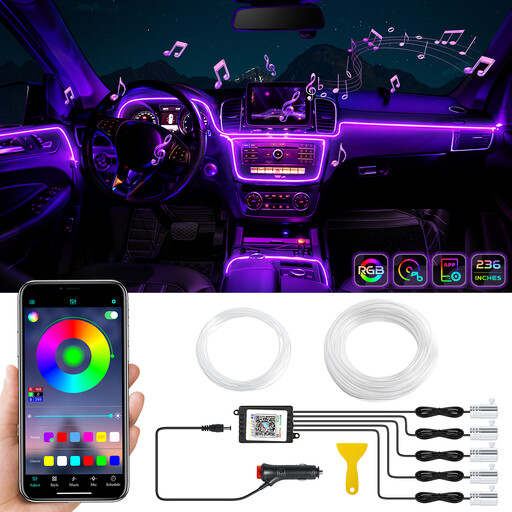

If these recommendations aren't quite what you had in mind, or if you're interested in exploring other ways to enhance your car's cabin, there are many other products to discover.
Browse our full collection of Vehicle Interior Parts to find the perfect upgrade for your ride.
Most modern kits are designed with DIY installation in mind. They typically come with all necessary components, including a pry tool for trim removal and a power source like a 12V adapter. The process usually involves tucking the light strip or fibre optic into existing panel gaps. It is always a good practice to test the lights before securing them permanently.
LEDs are highly energy-efficient and consume very little power. When the car is running, the alternator easily supplies the required electricity. Most kits are designed to power off with the ignition, preventing any drain when the car is parked. The power draw is generally too low to be a concern for a vehicle that is driven regularly.
The primary concern with interior lighting in the UK is driver distraction. According to DVSA guidelines, lights must not be bright enough to impair the driver's vision, dazzle other road users or be mistaken for an emergency vehicle's lights (e.g., flashing red or blue). When used as subtle car atmosphere lights, these kits are generally considered legal. However, it is the driver's responsibility to ensure the lighting is not a distraction.