
24/7 全天候客户支持

免费退货

当日/次日达

品质保障

开启新人专享福利: 全场免邮 | 低至 2 折 | 免费试用 30 天 JoyPlus 会员
下载 Joybuy
There are few things more frustrating than turning the key in your ignition on a cold morning only to be met with silence. A dead or weak car battery can disrupt your entire day. Whether you are dealing with an unexpected flat, preparing a vehicle for long-term storage or simply want to perform routine maintenance, having the right tool is essential.
This guide is designed to help you understand the different types of battery solutions available and choose the one that best suits your needs. We will look at the key features to consider, from charging speed to emergency jump-starting capabilities, helping you make a practical and informed decision.
Before diving into specific products, it is helpful to understand the main types of devices and what to look for.
It is important to distinguish between these two tools. A car battery charger is designed to slowly and safely replenish a battery's power over several hours. It is ideal for reviving a weak battery or for use as a battery maintainer during long periods of inactivity. In contrast, a car jump starter or battery booster pack delivers a powerful, short burst of energy to start a vehicle with a completely flat battery, getting you back on the road in an emergency.
Modern chargers offer more than just a simple power feed. A smart battery charger uses a microprocessor to monitor the battery's condition, adjusting the charging cycle automatically to prevent overcharging and damage. Many also include a pulse repair battery charger mode, which can help recondition older batteries by attempting to break down sulphate build-up on the lead plates, potentially extending their usable life. Look for key safety features like reverse polarity, short circuit and overheat protection.
Most cars, SUVs and motorcycles in the UK use a 12V electrical system, so a 12v battery charger is the standard. The amperage (A) rating indicates the charging speed—a higher amp rating means a faster charge. It is also crucial to ensure the charger is compatible with your battery type. Most modern chargers support various types, including Lead-Acid, GEL and AGM batteries, which are common in today's vehicles.
Here are our recommendations for reliable and practical battery solutions, selected to cover a range of common needs for UK drivers.
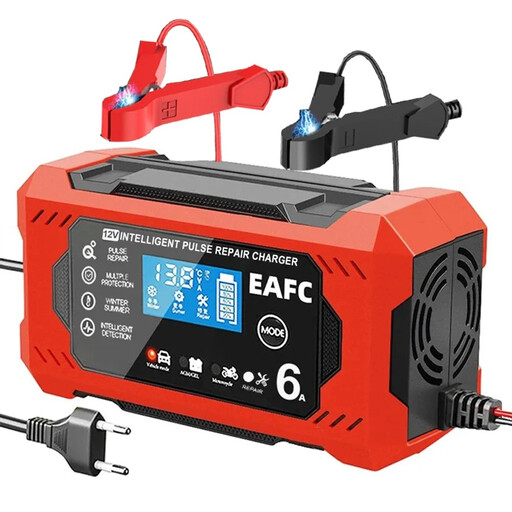
Why It Stands Out
This unit is an excellent all-rounder for general vehicle maintenance. As a microprocessor-controlled smart charger, it automatically manages the charging process for safety and efficiency. Its standout feature is the inclusion of a pulse repair mode, offering a way to potentially restore performance in older, sulphated batteries. The clear LCD screen displays voltage, charging status and internal temperature, making it very user-friendly.
Pros
Who is it for? This is a great choice for the everyday car or motorcycle battery charger user who needs a reliable device for routine charging, winter maintenance and attempting to recover a deeply discharged battery.
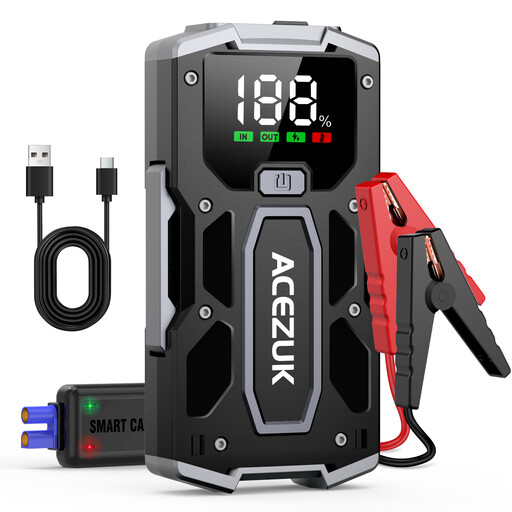
Why It Stands Out
The ACEZUK M01 is built for emergencies. This is not a slow charger but a powerful battery booster pack designed to get you out of a tight spot. With a very high peak current of 6000A, it has enough power to start large petrol (up to 7.0L) and diesel (up to 5.5L) engines. Its compact design also doubles as a portable power bank with fast-charging USB ports and it includes a multi-mode LED torch for roadside repairs in the dark.
Pros
Who is it for? This is the ideal tool for drivers who prioritise roadside assistance and peace of mind. It is particularly useful for owners of larger vehicles like SUVs and vans, or anyone who wants a versatile emergency tool for their car, boat or for camping trips.
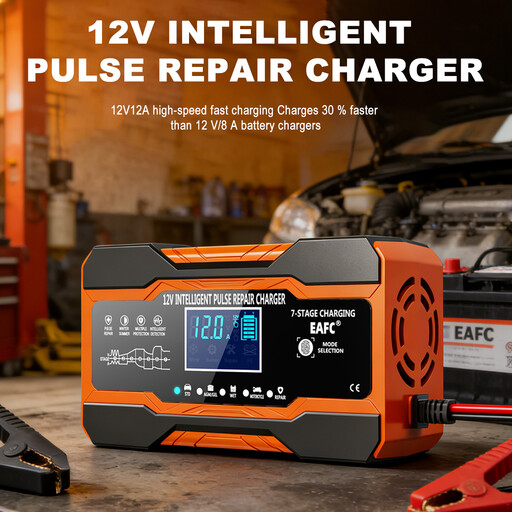
Why It Stands Out
For those who need more power and speed, this 12A model from EAFC is a significant step up. The higher amperage allows it to charge batteries much faster than standard 6A units, making it a great fit for workshops or for drivers who need a quicker turnaround. It retains all the essential smart features, including automatic charging, multi-mode selection (Car, Motorcycle, AGM) and a pulse repair function, all controlled via a simple touch-switch interface.
Pros
Who is it for? This charger is well-suited for DIY maintenance enthusiasts, owners of multiple vehicles or anyone with larger batteries who values faster charging speeds without compromising on safety or smart functionality.
If these recommendations do not quite match what you are looking for, or if you want to compare more models, there is a wider selection available.
Explore our full range of smart battery charger options to find the perfect fit for your vehicle and maintenance needs.
Modern smart battery charger and battery maintainer units are specifically designed for long-term connection. They automatically switch to a low-power "float" or "maintenance" mode once the battery is full, providing a small trickle charge only when needed to prevent self-discharge. This is ideal for storing a vehicle over winter. However, it is always wise to consult the manufacturer's instructions for your specific model.
The time required depends on three main factors: the battery's capacity (measured in Amp-hours, Ah), its level of depletion and the charger's output current (Amps, A). As a rough guide, a 60Ah battery that is 50% depleted requires 30Ah of charge. With a 6A charger, this would take approximately 5 hours. With a 12A charger, the time would be halved to around 2.5 hours. The final "absorption" phase of charging can add extra time.
A pulse repair battery charger uses high-frequency electrical pulses to attempt to break down sulphate crystals that can form on a battery's internal lead plates over time. This process, known as desulphation, can sometimes restore some of the lost capacity and improve the performance of an older or deeply discharged battery. It is a useful recovery feature, but it cannot fix a battery that is physically damaged or has reached the end of its natural service life.