
24/7 Customer Support

Free returns

Same-day & Next-day Delivery

Quality Guaranteed

Unlock Your Welcome Offers: FREE Delivery | Up to 80% OFF | Free 30-day JoyPlus trial
Download the APP
Keeping your devices powered on the move is no longer a luxury; it's a necessity. From navigating with your smartphone to keeping the children's tablets running on a long journey, a reliable car charger is an essential accessory. However, the market is flooded with options, and it's easy to make a poor choice. As your Joybuy Product Recommendation Officer, my role is to help you navigate the options and identify the key features that matter, ensuring you get a product that is safe, effective and suited to your needs.
Before you add any charger to your basket, be aware of these common purchasing pitfalls:
To make an informed decision, focus on these three core parameters. They are the non-negotiable factors that separate a dependable charger from a dud.
The speed at which your device charges is determined by wattage (W). A standard old USB port provides just 5W, which is too slow for modern devices. For a modern smartphone, look for a fast car charger that offers at least 20W from a single port. If you need a laptop car charger, you will require significantly more power, typically between 60W and 100W, delivered via a USB C car charger port that supports Power Delivery. Always check that the charger's protocols (e.g., PD 3.0, QC 3.0) match what your devices can accept.
The ports on a charger dictate what you can connect.
Your in-car power needs might go beyond charging a phone.
To simplify your choice, we've matched some well-regarded products to common user profiles.

Why This Fits Their Persona: Perfect for the daily drive to work or running errands. It's compact, keeps the dashboard tidy with its coiled cable, and provides a quick power boost for a smartphone and another accessory like headphones or a sat-nav.
It delivers genuine fast charging with a 20W PD USB-C output, avoiding the "fast charging" myth. The zinc alloy shell and secure fit counter the problem of poor build quality.
Features a built-in 1.2m coiled USB-C cable to reduce clutter. The dual-port design (USB-C and USB-A) offers versatile charging for two devices simultaneously.

Why This Fits Their Persona: For the professional driver, tech enthusiast or family with multiple power-hungry devices. This is a true mobile workstation, capable of charging a high-end laptop, tablet and phone all at once.
Directly solves the "mismatched power" pitfall. Its massive 165W total output and 100W USB-C port provide more than enough power for demanding devices like a MacBook Pro, which a standard charger cannot handle.
Features a smart digital LED display to monitor your car's voltage and the power being delivered to each port. It offers three ports (2x USB-C, 1x USB-A) for maximum connectivity.
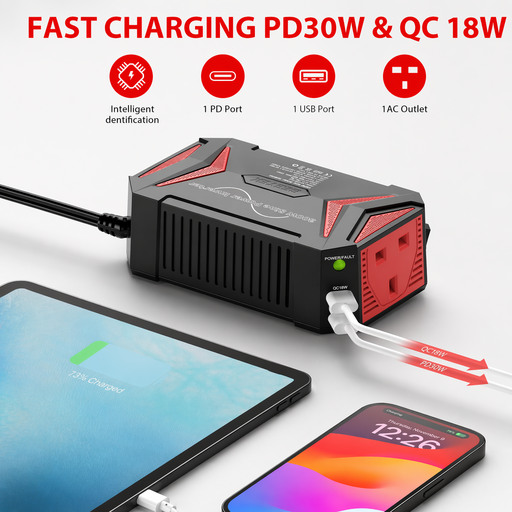
Why This Fits Their Persona: An essential for caravan holidays, camping or long family road trips. This car power inverter lets you use devices that require a standard UK plug, such as laptop chargers, camera equipment or even a small travel kettle.
This is the correct tool for those needing AC power, avoiding the pitfall of trying to power mains devices with a simple USB charger. Its pure sine wave output provides clean, stable power, which is safer for sensitive electronics than cheaper modified sine wave inverters.
Provides a 300W AC outlet plus fast-charging USB-C and USB-A ports. It includes a full suite of safety features, including a built-in fuse and a silent cooling fan.
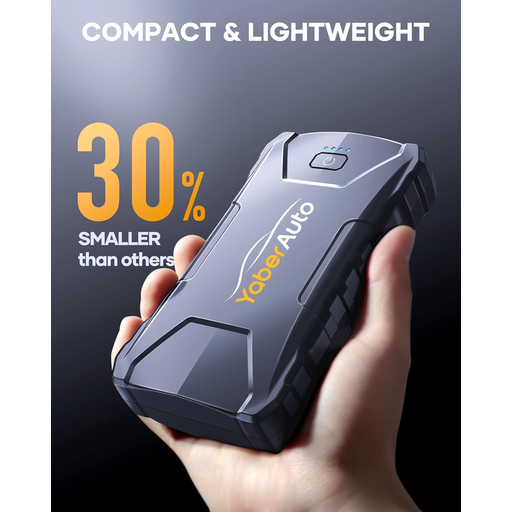
Why This Fits Their Persona: For the driver who prioritises peace of mind. This is more than a charger; it's a compact roadside emergency kit that can get you out of a difficult situation without having to wait for assistance.
This is a purpose-built emergency tool, not just a charger. It addresses the ultimate power failure—a dead car battery—a problem no standard 12v USB adapter can solve. Smart clamps prevent dangerous connection errors.
It's a 3-in-1 tool: a powerful portable car jump starter for petrol or diesel engines, a 13800mAh power bank for charging phones and a multi-mode LED torch for emergencies.
We have compiled a complete, real-time list of products that fully satisfy these strict selection criteria and UK safety regulations.
Can a car charger drain my car battery? Most modern cars cut power to the cigarette lighter socket when the ignition is off, preventing any battery drain. However, in some older vehicles where the socket is always live, a charger with an LED light or one that is actively charging a device can slowly drain the battery over a long period. It is good practice to unplug the charger when you leave your vehicle for an extended time.
How can I tell if a car charger is safe to use? Look for chargers made from fire-retardant materials (often listed as PC or Zinc Alloy) and those that explicitly mention built-in safety protections like over-current, over-voltage, short-circuit and overheating protection. A secure, snug fit in the power socket is also a good indicator of quality construction. Avoid unbranded, lightweight plastic chargers that feel cheap.
Do I need a special charger for my laptop? Yes. A standard car phone charger will not have enough power. To charge a laptop, you need a charger that can deliver high wattage (typically 60W or more) through a USB-C Power Delivery port. Alternatively, a car power inverter will allow you to use your laptop's original mains charger. Always check your laptop's power requirements before purchasing.