
24/7 Customer Support

Free returns

Same-day & Next-day Delivery

Quality Guaranteed

Unlock Your Welcome Offers: FREE Delivery | Up to 80% OFF | Free 30-day JoyPlus trial
Download the APP
A car cooling fan can make a noticeable difference during warm commutes, long journeys, camping trips and delivery routes. However, many buyers focus on blade count or advertised airflow while overlooking the details that determine whether a fan is genuinely practical inside a UK vehicle.
The most suitable option depends on your power socket, mounting surface, seating layout and tolerance for noise. This guide explains the key specifications to check before buying, highlights common marketing traps and matches several options to different driving needs.
A high airflow figure does not always mean better comfort. A fan may move plenty of air but still be ineffective if it cannot point towards the driver or passengers. In a vehicle, adjustable positioning is often more useful than a headline airflow number.
Look for a 360° rotating car fan, tilting head or multi-angle adjustment. These features allow you to direct air around headrests, dashboards and passenger seats rather than cooling one fixed area.
A USB car fan is convenient because it can connect to a car charger, power bank or compatible USB port. It may also be useful in a tent, campervan or at a desk. However, USB output varies between vehicles and chargers, so check that the charger can supply the fan’s stated requirements.
A 12V car fan generally suits standard car sockets, while a 24V car fan is designed for many lorries, trucks and larger commercial vehicles. A model supporting both 12V and 24V input offers broader vehicle compatibility, but the product instructions should still be followed carefully.
A fan mounted on a smooth dashboard may gradually lose grip if the surface is dusty, textured or exposed to heat. A windscreen-mounted car fan can provide useful positioning, but it must not block the driver’s forward view or interfere with controls.
Before buying, check whether the product uses a suction cup, air vent clip, dashboard base or another mounting method. Clean the surface before installation, secure the mount firmly and position it outside the driver’s direct line of sight.
Match the fan to your vehicle before considering extra features:
Avoid relying on an adaptor without checking voltage compatibility. An unsuitable power supply can cause poor operation or damage.
A 3-speed car fan provides basic low, medium and high settings for different conditions. Lower speeds are generally more suitable when you want gentle circulation, while higher settings can help move air more quickly around a warm cabin.
A dual head car fan can direct air towards two seating positions at once. This may be more practical for couples, families or passenger vehicles than a single head. A single adjustable car fan can be easier to position in a compact car and may take up less space.
Five-blade designs, such as those included in the options below, are an objective construction feature. They should not automatically be treated as proof of stronger performance, so also consider mounting, adjustment range and controls.
A portable car fan should not distract the driver or make conversation difficult. Product descriptions may use terms such as “low noise”, but perceived sound varies with speed, mounting surface and vehicle acoustics.
Check whether the fan can be folded or removed easily. A foldable design is useful when parking in public areas, storing the fan during colder months or freeing dashboard space. Keep blades, vents and mounting surfaces free from dust, and inspect the cable periodically for visible wear.
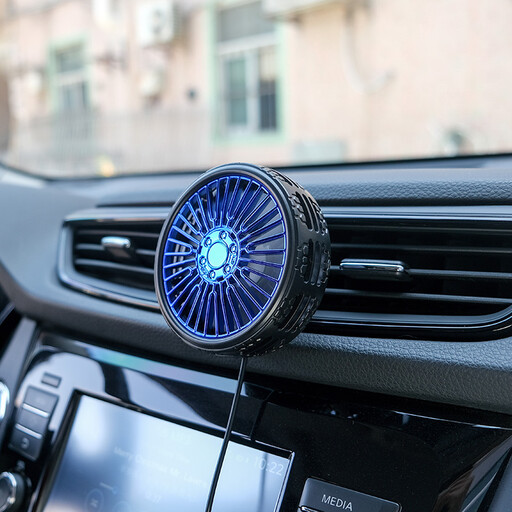
Why This Fits Their Persona: This USB-powered option suits commuters who want straightforward installation, adjustable airflow and compatibility with a car charger or power bank.
The suction cup and air vent clip provide two installation approaches, while three speed settings avoid dependence on one fixed airflow level.
USB plug-and-play power; 360° rotation; five-blade design; low, medium and high wind control.
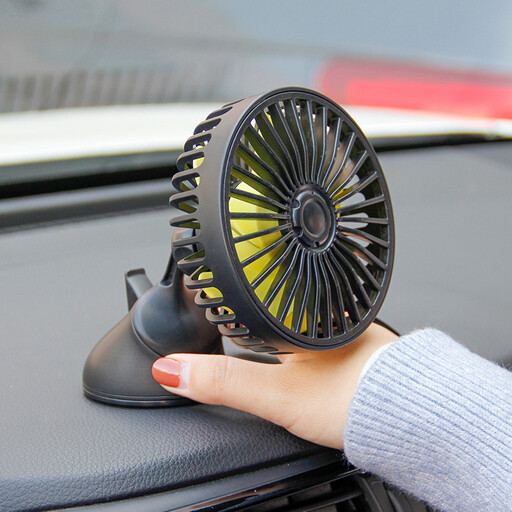
Why This Fits Their Persona: Drivers who prioritise neat placement and precise direction may prefer this dedicated dashboard and windscreen-mounted car fan.
Its stated mounting method and 360° head make positioning a central part of the design rather than an afterthought.
USB power; strong suction cup; five blades; three adjustable speeds; flexible placement.

Why This Fits Their Persona: This model is suited to families, van drivers, lorry drivers and frequent road-trip travellers who need wider airflow and broad vehicle compatibility.
The twin-head layout serves two directions, while 12V/24V input reduces the risk of buying a fan unsuitable for a larger vehicle.
Dual fan heads; 360° multi-angle adjustment; foldable design; two built-in USB charging ports; 12V/24V cigarette lighter input.
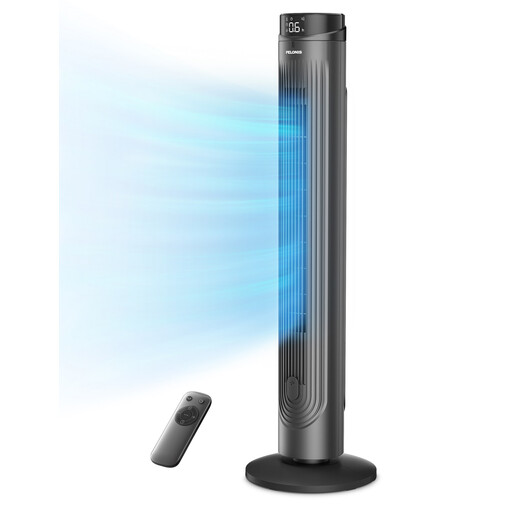
Why This Fits Their Persona: For bedrooms and living spaces rather than vehicles, this tower fan provides a taller floor-standing format with remote control and timer functions.
The DC motor, 12 speeds and 24-hour timer provide more control than a simple fixed-speed fan, helping users select operation for their room.
42-inch tower format; remote control; 12 speeds; 24-hour timer; LED display; oscillating operation.
We have compiled a complete, real-time list of products that fully satisfy these strict selection criteria and UK safety regulations.
For a suction-mounted vehicle cooling fan, wipe the dashboard or windscreen with a clean, suitable cloth before attaching the base. Press and lock the suction mechanism according to the instructions. Recheck the mount after the vehicle has been parked in direct sunlight, as heat can affect adhesion.
Position the fan so it does not obstruct:
Switch the fan off before leaving the vehicle unless the product and power arrangement are specifically designed for unattended operation. Leaving accessories connected may draw power from the vehicle battery, depending on the socket and ignition system.
For household use, a DC motor tower fan can offer multiple speed settings and timer control. Actual electricity cost depends on wattage, selected speed and local energy tariffs. Check the product’s rated power rather than assuming that “energy efficient” means a fixed saving.
Not necessarily. It requires a compatible USB port or car charger with sufficient output. Some vehicles provide USB ports intended mainly for data or low-power charging, so a dedicated car charger may be more suitable. Check the fan and charger specifications before use.
No. A 12V system and a 24V system have different electrical requirements. Choose a model that explicitly supports your vehicle’s voltage, such as a 12V/24V model for compatible cars, vans and trucks. Do not assume that an adaptor makes an incompatible fan safe to use.
Lifespan varies according to construction, dust exposure, heat, storage and frequency of use. Keep the blades and vents clean, avoid pulling the cable and remove the fan when it is not needed for extended periods. A firm mount and careful storage can also reduce unnecessary wear.