
24/7 Customer Support

Free returns

Same-day & Next-day Delivery

Quality Guaranteed

Unlock Your Welcome Offers: FREE Delivery | Up to 80% OFF | Free 30-day JoyPlus trial
Download the APP
A dash cam can provide useful video evidence after a collision, help document damage in a car park and make long journeys easier to review. However, choosing between car dash cams is not simply a matter of selecting the highest resolution. A product may advertise 4K recording yet still be unsuitable for your vehicle, difficult to install or expensive to keep running.
Before buying, check three common pitfalls:
A 2K dash cam can offer more detail than Full HD while using less storage than a 4K dash cam. This may suit commuters who want a compact front-facing camera and clear footage of road signs or number plates in suitable lighting.
A 4K dash cam records at a higher resolution, but file sizes are larger and the result depends on lens quality, exposure control, weather and windscreen cleanliness. For broader evidence, a dual system such as 4K front and 2.5K rear can be more practical than paying for a high-resolution front camera alone.
Drivers of taxis, vans or family cars may also consider a 3-channel dash cam. This records the front, rear and cabin, although the interior camera may be an optional package rather than included as standard. Always check the product listing carefully.
Parking monitoring can record an impact or activity while your vehicle is unattended. There are several operating methods, including collision-triggered recording and time-lapse recording. These functions can place a continuing demand on the vehicle battery, so many systems require a compatible hardwire kit with low-voltage protection.
For example, the LNDU V100 supports 24-hour parking mode when connected to the separately purchased LNDU JYX05 hardwire kit. This requirement should be included in your installation budget.
If you prefer a simpler setup, a camera powered from the vehicle’s 12V socket is usually easier to install, but parking functions may not operate after the ignition is switched off.
A microSD card for dash cam use should match the camera’s specification. Class 10 or UHS-I cards are common, while some higher-resolution models recommend U3-rated cards. Capacity affects how much footage is retained before loop recording overwrites unlocked files.
Practical storage habits include:
A Wi-Fi dash cam can transfer clips to a smartphone without removing the card. A GPS dash cam can add route, time and location information to recordings, but reception may be affected by metallic windscreen coatings. Check that the camera’s mounting position has a suitable view of the sky.
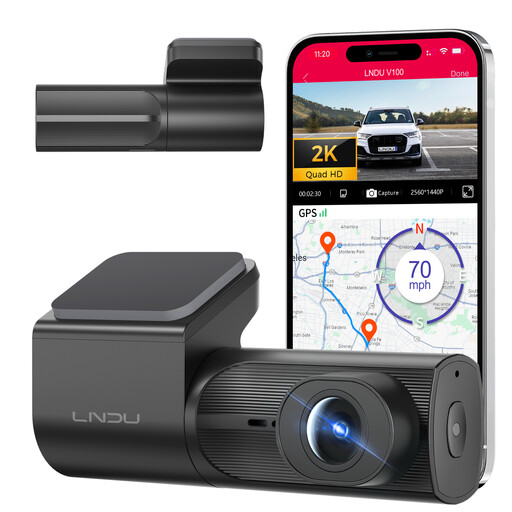
Why This Fits Their Persona: A compact front-facing option for commuters and first-time buyers who want app access, 2K footage and parking monitoring without a built-in display.
The listing clearly states that 24-hour parking mode requires a separately purchased hardwire kit, helping buyers plan installation correctly.
2K recording, built-in Wi-Fi, app control, G-Sensor, loop recording and night vision support.
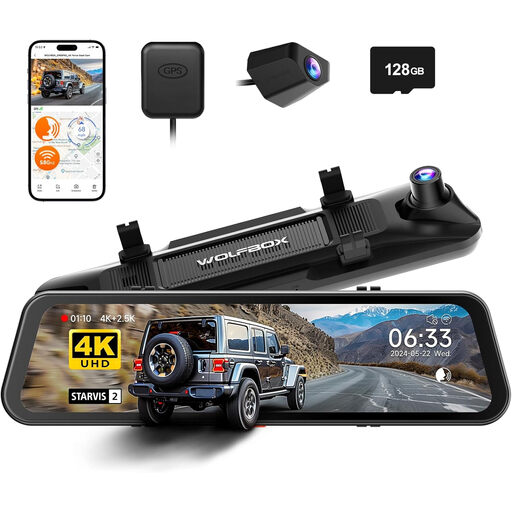
Why This Fits Their Persona: Suitable for drivers wanting front and rear coverage, built-in GPS and fast smartphone transfers, with a 128GB card supplied.
It combines two recording channels rather than relying on front resolution alone, and the included 128GB card reduces the need for an immediate storage purchase.
4K front and 2.5K rear recording, 5GHz Wi-Fi, voice control, GPS, G-Sensor and 12V adapter included.
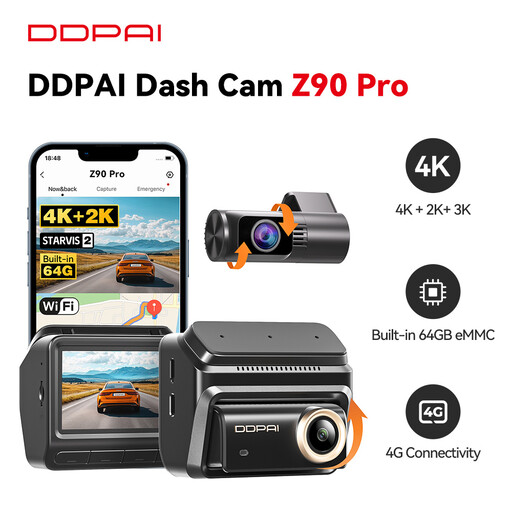
Why This Fits Their Persona: A feature-rich choice for professional drivers, frequent travellers and vehicle owners seeking extended recording and optional cabin coverage.
The listing separates included dual-camera functions from optional 3-channel, 4G and parking-mode features, making additional purchases easier to identify.
4K front and 2K rear HDR recording, built-in 64GB eMMC, GPS, 5GHz Wi-Fi and support for external storage up to 512GB.
Mount the front camera behind the rear-view mirror without obstructing the driver’s view. Keep cables away from airbag deployment areas, particularly around the A-pillar and door trim. Rear cameras generally mount inside the rear windscreen, but heavy tinting can affect image quality.
Check the power system before ordering. The featured products are designed around standard vehicle power arrangements, while heavy-duty vehicles with 24V systems may require a suitable converter. Convertibles, heavily tinted rear windows and vehicles with unusual windscreen coatings may also need extra compatibility checks.
We have compiled a complete, real-time list of products that fully satisfy these strict selection criteria and UK safety regulations.
Usually, yes. Many parking-monitoring systems need a hardwire kit connected to a suitable fuse circuit. Confirm whether it is included or sold separately, and choose a kit with low-voltage protection where specified.
Lifespan depends on capacity, recording resolution, driving hours and parking use. Continuous writing can wear cards faster than occasional recording. Format the card through the camera and replace it if footage becomes corrupted or recording stops unexpectedly.
Choose 4K when higher front-camera detail and larger files are acceptable. A 2K model may be more practical for everyday commuting, particularly if you want lower storage demands. For collision evidence, camera coverage, reliable power and a suitable microSD card matter alongside resolution.