
24/7 Customer Support

Free returns

Same-day & Next-day Delivery

Quality Guaranteed

Unlock Your Welcome Offers: FREE Delivery | Up to 80% OFF | Free 30-day JoyPlus trial
Download the APP
For many car enthusiasts, maintaining a vehicle’s pristine condition is a source of pride. The right set of automotive detailing tools can transform this task from a chore into a satisfying ritual. However, the market is flooded with gadgets that promise professional results but often fall short. Navigating through marketing hype to find effective and durable equipment can be a challenge.
As a Joybuy Product Recommendation Officer, my role is to help you identify the key features that matter and avoid the common purchasing pitfalls. This guide will focus on the practical considerations for selecting car detailing tools that deliver genuine value and performance.
Before investing in new gear, be aware of these frequent traps that lead to wasted money and frustration:
To ensure you are making a smart purchase, focus on these essential technical specifications.
For any cordless car polisher or portable car vacuum, the battery is the heart of the device. Look for tools with modern Lithium-ion (Li-ion) batteries, which offer a better power-to-weight ratio and longevity. Pay close attention to the runtime versus charging time. A tool that runs for 30 minutes and recharges in under two hours offers far more practical value than one that runs for 15 minutes but takes four hours to charge. Furthermore, tools equipped with a brushless motor are generally more efficient, run cooler and have a longer operational lifespan than their brushed counterparts.
Power figures like RPM (revolutions per minute) or Pa (Pascals for suction) can be misleading. For a cordless car polisher, understanding the mechanism is more important. A rotary polisher offers more aggressive cutting power for correcting heavy defects, while a dual-action (DA) or orbital polisher is safer for beginners and ideal for finishing, as its motion is less likely to burn the paint. For a mini car vacuum or compressed air duster, consider how that power is applied. High suction is useful, but only if it is paired with nozzles that can concentrate the airflow into tight crevices.
A tool's usefulness is defined by its attachments and overall construction. An electric spin scrubber is only as good as its interchangeable brush heads; look for a set that includes various shapes and stiffness levels for different surfaces like tyres, carpets and glass. A complete car interior cleaning kit should not just be about the number of items, but the quality of the materials. Are the brush bristles soft enough not to scratch delicate surfaces? Is the plastic durable enough to withstand repeated use? These are the questions that separate a worthwhile investment from a box of future landfill.
Instead of a one-size-fits-all approach, we have matched some promising tools to specific user needs.
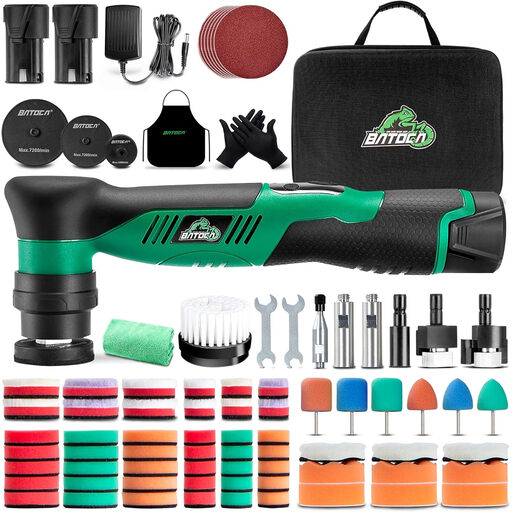
Why This Fits Their Persona: For the detailer who obsesses over every emblem, piano-black trim and tight body line, a full-size polisher is too clumsy. This mini polisher is designed specifically for those hard-to-reach areas, enabling true paint correction and polishing on a micro-scale.
It sidesteps the "impractical design" pitfall by being compact and lightweight. The inclusion of two replaceable batteries directly addresses the poor runtime issue common in cordless tools.
Its 3-in-1 functionality allows switching between rotary, 3mm orbital and 12mm orbital actions. Comes with 1-inch, 2-inch and 3-inch pads for ultimate precision.
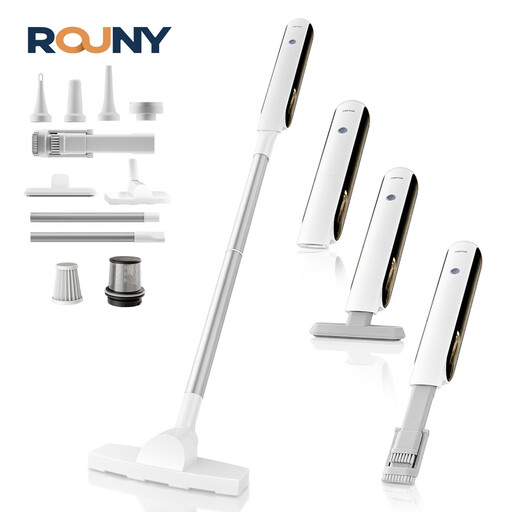
Why This Fits Their Persona: This user needs a reliable tool for regular interior maintenance—clearing away crumbs, dust and pet hair without hassle. This vacuum's combination of suction, blowing and useful attachments makes it a versatile workhorse for keeping a car's cabin tidy.
It avoids the "underpowered" trap with a brushless motor and a practical 30-minute runtime on its low setting. The dual vacuum/blower function provides genuine versatility, unlike gimmicky "all-in-one" tools.
The built-in LED light is excellent for illuminating dark footwells and under-seat areas. It includes an extension rod and floor brush, adding to its utility.
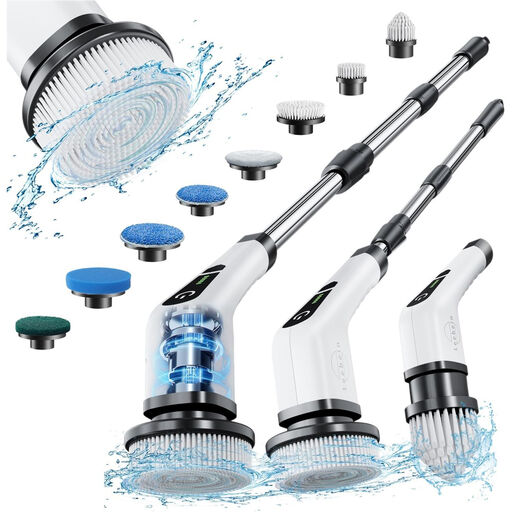
Why This Fits Their Persona: This user isn't afraid to tackle the toughest jobs, from brake dust-caked alloy wheels to heavily soiled floor mats and grimy wheel arches. An electric scrubber provides the torque and endurance to power through dirt that manual brushing can't shift.
This tool's value is in its specialised attachments, avoiding the "useless kit" problem. The adjustable handle (up to 137 cm) makes it highly practical, preventing the need to kneel or bend uncomfortably.
It offers a long 90-minute runtime and is IPX7 waterproof, so it can be safely used with water and cleaning solutions and rinsed clean afterwards. The 8 brush heads provide true versatility.
We have compiled a complete, real-time list of products that fully satisfy these strict selection criteria and UK safety regulations.
A rotary polisher spins on a single, central axis, generating significant heat and friction. This makes it very effective at removing deep scratches and heavy oxidation but requires skill to use without damaging the paint. A dual-action (DA) polisher spins in a concentric circle while also oscillating in an irregular orbit. This random motion generates less heat, making it much safer for beginners and ideal for applying wax, sealant or performing light paint correction.
For effective use, a cordless polisher's battery should provide at least 30-45 minutes of continuous runtime under load. Anything less can be frustrating, as you may not be able to complete a single panel before needing a recharge. Also, consider models that come with two batteries, allowing you to use one while the other charges, ensuring uninterrupted workflow.
They serve different but complementary purposes. A compressed air duster is excellent for dislodging dust and debris from extremely tight spaces where a vacuum nozzle cannot reach, such as air vents, switchgear and panel gaps. A mini car vacuum is then used to remove the loosened debris from the car. For a thorough clean, using an air duster first, followed by a vacuum, often yields the most complete result.