
24/7 Customer Support

Free returns

Same-day & Next-day Delivery

Quality Guaranteed

Unlock Your Welcome Offers: FREE Delivery | Up to 80% OFF | Free 30-day JoyPlus trial
Download the APP
Adding custom lighting is one of the most popular ways to personalise a vehicle's interior, transforming a standard cabin into a unique, atmospheric space. However, the market for car interior ambient lighting is flooded with options, and it's easy to make a purchase you'll later regret. Many kits promise a high-end look but deliver a cheap, frustrating experience.
As a Joybuy Product Recommendation Officer, my role is to help you navigate this market. We'll look at the common pitfalls that lead to wasted money and highlight the key features that separate a quality lighting system from a short-lived gimmick.
Before you add any kit to your basket, be aware of these frequent issues that can turn an exciting upgrade into a disappointment.
To ensure you get a system that looks great and functions reliably, focus on these non-negotiable parameters.
The technology used to distribute the light is critical.
A versatile control system is essential for a good user experience.
A truly universal car lighting kit should be comprehensive. Check the contents list for not just the lights, but also the necessary accessories. A good kit will include a pry tool for safely opening gaps in your trim, sufficient cable lengths for all intended locations (including car footwell lights) and clear instructions. Powering via a 12V cigarette lighter plug is the easiest method, while kits that offer a hardwiring option provide a cleaner, more permanent installation.
Based on these criteria, we've matched several lighting kits to different types of car enthusiasts.
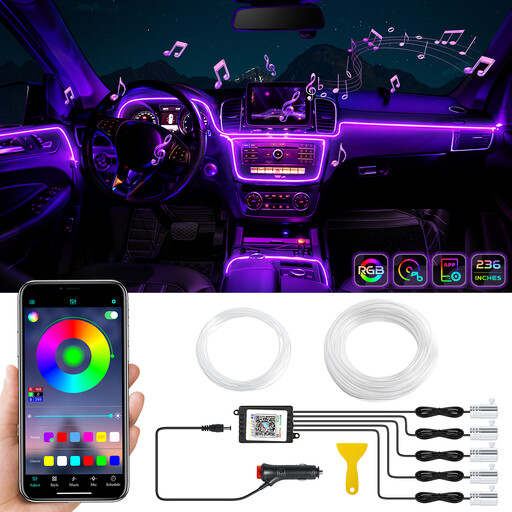
Why This Fits Their Persona: Ideal for someone new to car modification in the UK. This kit provides a very long (236-inch) fibre optic tube that can be cut to size, offering great flexibility for a first project in a smaller car like a Ford Fiesta or Vauxhall Corsa without a large initial investment.
While it uses traditional fibre optics, the instructions suggest a workaround for the "hotspot" issue by connecting an LED to both ends of a strip if you feel the light is weak. The simple 12V plug-in design avoids complex wiring traps.
Features app control with music sync and includes a pry tool. The generous length of the fibre optic tube makes it a versatile starting point for custom layouts.
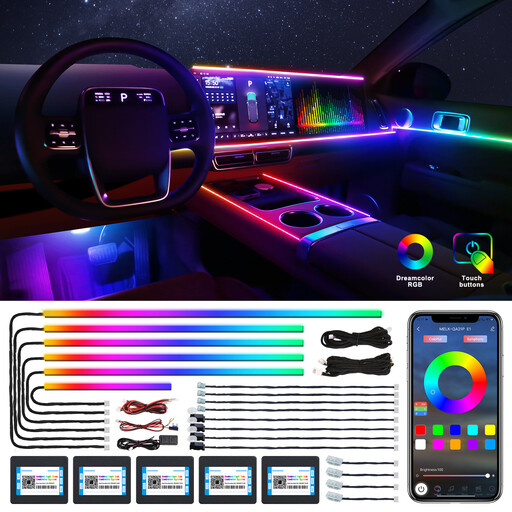
Why This Fits Their Persona: This user wants advanced features and a high-impact result for their VW Golf or BMW 3 Series. The 18-in-1 kit offers comprehensive coverage for the dash, all four doors, handles, storage bins and footwells, with dynamic "Dreamcolor" chasing effects that stand out.
It uses modern acrylic strips with embedded LEDs, completely avoiding the "hotspot" pitfall by providing bright, uniform light. It also features dual control (app and hidden touch buttons), preventing you from being locked out by a faulty app.
Features an RGB Smart IC for dynamic "Dreamcolor" effects (chasing, bouncing lights). The system allows for dual-zone control, so you can set the footwells to a different colour from the dashboard strips.
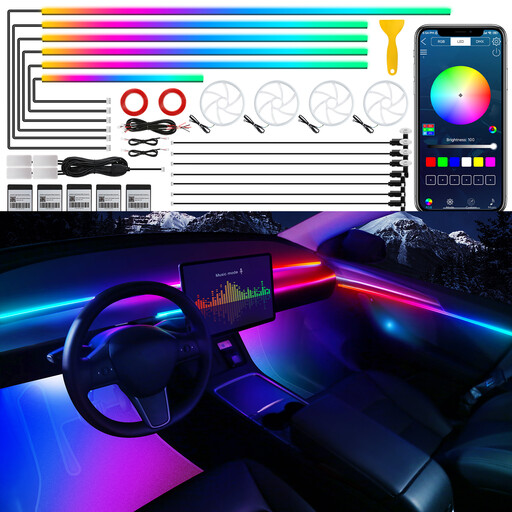
Why This Fits Their Persona: For the owner of an SUV or larger saloon who wants the most complete and immersive lighting setup possible. This 22-in-1 kit leaves no stone unturned, adding dedicated lights for door horn speakers on top of all the standard locations for a truly bespoke feel.
This is a complete, all-in-one solution that prevents the trap of needing to buy extra components. Its modular system with a main controller and four sub-controllers ensures all lights work in sync without complex, messy wiring.
The most comprehensive coverage in a single kit. The inclusion of door horn lights is a unique feature that provides a fully integrated lighting experience not found in smaller kits. It also features dual-zone control and dynamic Dreamcolor effects.
We have compiled a complete, real-time list of products that fully satisfy these strict selection criteria and UK safety regulations.
Most quality RGB car lights use LEDs rated for 30,000 to 50,000 hours of operation. For the average driver, this means the lights will likely last longer than the car itself. The most common points of failure are not the LEDs but the wiring connections or the control box, so a secure installation is key to longevity.
The difficulty varies. Simple car footwell lights that plug into a USB port or 12V socket can be fitted in minutes. More comprehensive kits with acrylic or fibre optic strips that tuck into trim panels are more involved and may take a couple of hours. However, most kits are designed for DIY installation and come with a plastic pry tool to avoid damaging your car's interior. Always test the full kit before you begin the final installation.
When the car is running, the power draw from LED lights is minimal and will not affect your electrical system. The main concern is battery drain when the car is off. To prevent this, ensure your kit is powered correctly. A kit that plugs into the 12V cigarette lighter socket will typically turn off with the ignition. If you choose to hardwire the system, it must be connected to an ACC (accessory) fuse. This type of fuse only supplies power when the key is in the 'on' or 'accessory' position, preventing any drain on the battery when the car is parked.