
24/7 Customer Support

Free returns

Same-day & Next-day Delivery

Quality Guaranteed

Unlock Your Welcome Offers: FREE Delivery | Up to 80% OFF | Free 30-day JoyPlus trial
Download the APP
Adding a custom glow to your car's cabin is a popular way to personalise your ride, but the market for car interior ambient lighting kits is filled with options that can lead to disappointment. Many drivers in the UK end up with kits that look cheap, fail after a few months or are a nightmare to install. As the Joybuy Product Recommendation Officer, my role is to help you navigate the options and find a kit that delivers a premium look without the common headaches.
Before you buy, it's crucial to understand the pitfalls. Many enthusiasts are lured in by flashy marketing, only to face one of these common issues:
To avoid these issues, focus on the core specifications. Getting these right is the difference between a sleek, factory-finish look and a modification you'll regret.
The most significant factor in light quality is the strip technology itself.
How you interact with your lights is just as important as how they look. A quality kit should offer robust control options.
A "universal" kit isn't truly universal if it doesn't include the right parts for a clean installation. A comprehensive package should provide:
We've filtered through the options to find kits that address the common pitfalls and match different user needs.
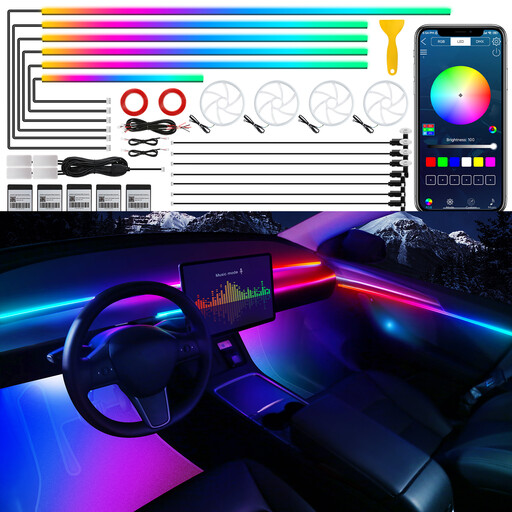
Why This Fits Their Persona: For the UK driver who wants to go all-out, this 22-in-1 kit provides everything needed to illuminate the dash, all four doors, footwells, handles, storage boxes and even speaker horns for a complete, cohesive look.
The acrylic strips with embedded LEDs deliver perfectly even light, eliminating hotspots. Its main and sub-controller system drastically simplifies wiring for such a comprehensive kit.
Unmatched coverage with 22 separate lighting elements. The modular design makes a complex installation manageable for a DIY enthusiast.
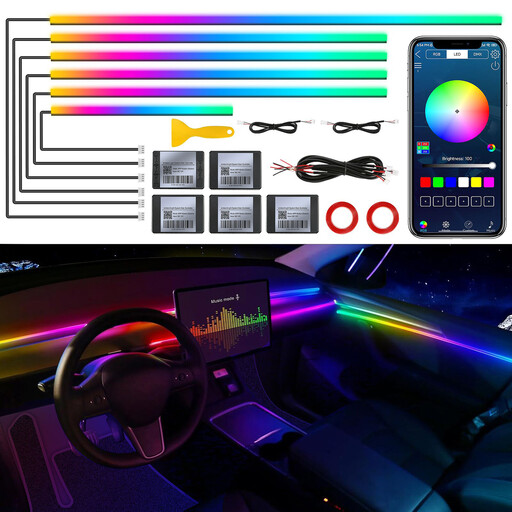
Why This Fits Their Persona: Ideal for the driver who wants a clean, high-impact effect without the complexity of a massive kit. This 6-in-1 set focuses on the essential dashboard and door lines, delivering a modern look with advanced app control.
It provides the same high-quality acrylic strips for a uniform glow but in a simplified package. It also includes a hidden touch button, offering a reliable physical backup to the app control.
Streamlined installation focusing on the most visible areas. Features advanced "Dreamcolor" dynamic effects for a modern, flowing light show.
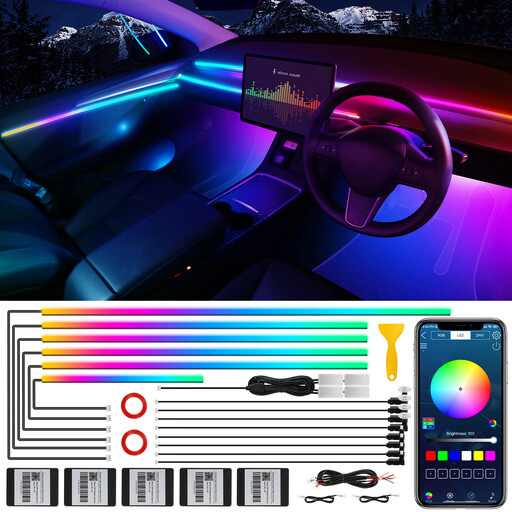
Why This Fits Their Persona: This kit strikes a great balance. It covers the dash, doors and footwells, but its standout feature is dual-zone control. This allows the driver to set different colours and modes for the main strips and the footwell lights simultaneously.
By offering dual-zone control, it overcomes the creative limitations of single-zone systems. The 10-in-1 configuration provides comprehensive coverage without being overwhelming.
Dual-zone functionality allows for greater customisation (e.g., blue dash with white footwells). It's a powerful feature usually found in much more expensive setups.
We have compiled a complete, real-time list of products that fully satisfy these strict selection criteria and UK safety regulations.
Most modern kits are designed for DIY installation. They typically include a plastic pry tool to help you gently tuck the thin edge of the light strip into the gaps between your car's interior panels. For power, the simplest method is plugging into your car's 12V socket (cigarette lighter). For a more integrated look, the system can be hardwired to the fuse box, which is a more involved but still manageable task for a confident DIYer.
LEDs are extremely energy-efficient. When your car is running, the power draw is negligible. If you hardwire the kit, it's essential to connect it to an "accessory" (ACC) fuse. This ensures the lights only receive power when the ignition is on, preventing any battery drain when the car is parked. Kits powered by the 12V socket will also turn off with the car.
Neither is definitively "better," as they serve different preferences. Fibre optic car interior lighting is highly flexible and can be easier to route around tight curves, but may have less consistent brightness. Acrylic car interior led strip lights provide a brighter, perfectly uniform glow that often looks more like a premium, factory-fitted option, though they are less flexible. The choice depends on whether you prioritise flexibility or uniform brightness.