
24/7 Customer Support

Free returns

Same-day & Next-day Delivery

Quality Guaranteed

Unlock Your Welcome Offers: FREE Delivery | Up to 80% OFF | Free 30-day JoyPlus trial
Download the APP
Adding a splash of colour to your car's interior can transform your driving experience, turning a mundane commute into something more personal and atmospheric. However, the market for car interior ambient lighting is flooded with options, and it's easy to make a purchase you'll later regret. Many drivers find their exciting new upgrade quickly becomes a source of frustration.
As the Joybuy Product Recommendation Officer, my role is to help you navigate the options and identify the key features that separate a quality kit from a disappointing one. Before you buy, be aware of these common pitfalls:
To avoid these issues, focus on a few core parameters that determine the quality and usability of your lighting system.
The technology used to diffuse the light is critical for achieving a clean, uniform glow.
How you interact with your lights is just as important as how they look.
Consider how the kit will be powered and how much work you are willing to put in.
Based on these criteria, we've matched a few standout options to different types of users.
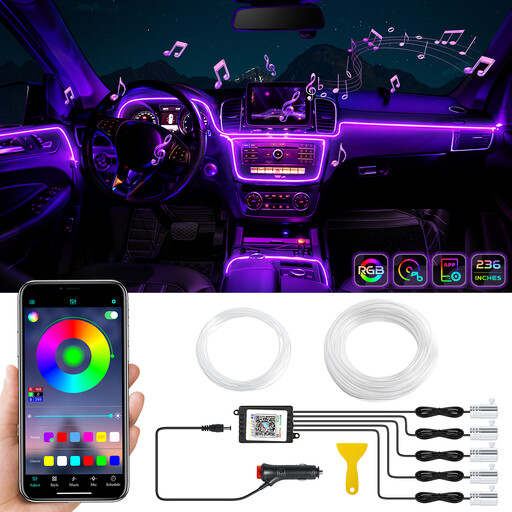
Why This Fits Their Persona: This kit is ideal for someone new to car modifications who wants a straightforward, low-commitment entry into ambient lighting. The 5-in-1 design provides enough fibre optic cable for the main dashboard and centre console, powered simply by the car charger.
It avoids the complex installation trap by using a simple 12V car charger plug. While it uses traditional fibre optics, the instructions suggest connecting an LED at both ends of a strip if the light appears weak, offering a practical way to mitigate the "hotspot" issue.
Plug-and-Play: No need for wiring to the fuse box. Generous Length: The 6-metre fibre optic line is long enough for most saloons and can be cut to size.
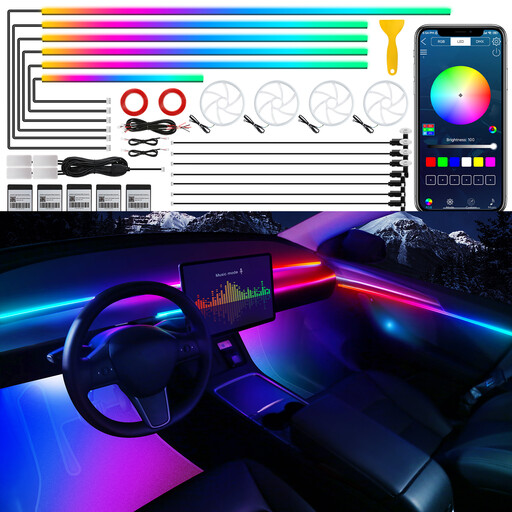
Why This Fits Their Persona: For the driver who wants total control and full cabin immersion. This comprehensive 22-in-1 kit includes acrylic strips for the dash and doors, plus separate lights for footwells, door handles, storage boxes and even speaker horns. It's a complete overhaul.
It directly solves the "hotspot" problem by using acrylic light strips with embedded LEDs for a uniform glow. The multi-controller system (1 main, 4 sub-controllers) ensures stable power and data distribution, preventing the connectivity issues that plague simpler kits.
Dual-Zone Control: Set different colours and modes for the main strips and the accent lights. Comprehensive Coverage: Illuminates nearly every part of the car's interior for a complete custom look.
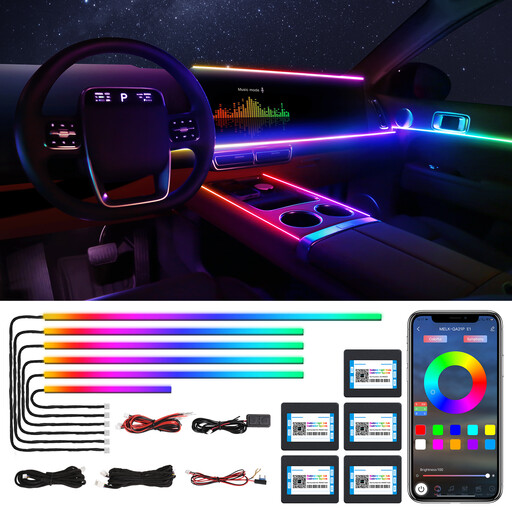
Why This Fits Their Persona: This is for the driver who appreciates a subtle, integrated enhancement that looks like it could have come from the factory. The 6-in-1 kit focuses solely on the main acrylic strips for the dashboard and four doors, providing a clean and elegant line of light without extra distractions.
By focusing on just the six core acrylic strips, it avoids the installation complexity of more comprehensive kits. The ultra-thin design is made to be tucked into existing trim gaps, preventing the "stuck-on" look of bulkier **car interior neon lights**.
Clean & Minimalist: Provides a high-end, uniform glow without cluttering the cabin. Advanced Control: Features the same RGB Smart IC and app control as larger kits, including music sync and dynamic modes.
We have compiled a complete, real-time list of products that fully satisfy these strict selection criteria and UK safety regulations.
For interior lighting, the rules are generally relaxed as long as the lights do not distract the driver or other road users. The key points from the UK Highway Code are to ensure that lights do not cause glare, are not mistaken for emergency vehicle lights (blue/red flashing) and do not shine directly out of the front or rear windscreens. It's always wise to use them considerately and ensure they do not breach MOT test requirements for driver's view and distraction.
Modern LED strip lights for car are highly energy-efficient and draw a very small amount of power. When connected correctly (either to a switched 12V source or hardwired to the ACC fuse), they will only operate when the car is on or in accessory mode. The power draw is minimal and will not drain a healthy car battery during normal operation.
Installation difficulty varies. A simple plug-in kit can be fitted in under an hour with basic tools. You use a provided pry tool to gently open a gap in your dashboard or door trim, insert the plastic tube and then feed the fibre optic through it. More complex, hardwired kits like the 22-in-1 system will take longer and require more care when routing wires and hiding the control boxes. Always test the lights before fully installing them.