
24/7 Customer Support

Free returns

Same-day & Next-day Delivery

Quality Guaranteed

Unlock Your Welcome Offers: FREE Delivery | Up to 80% OFF | Free 30-day JoyPlus trial
Download the APP
Adding custom lighting to your car's interior can completely transform the driving experience, creating a unique atmosphere that reflects your personal style. However, the market for car interior ambient lighting is filled with options that can be disappointing. Many drivers in the UK end up with kits that look cheap, fail quickly or are a nightmare to install.
As the Joybuy Product Recommendation Officer, my role is to help you navigate these choices. This guide will highlight the common traps to avoid and break down the essential features to look for, ensuring you choose a kit that delivers a premium finish without the frustration.
Before you buy, be aware of these frequent issues that can turn an exciting upgrade into a waste of money.
To ensure you get a high-quality result, focus on these three non-negotiable specifications.
The technology used to diffuse the light is critical. While traditional fibre optic car lighting can work, superior systems now use acrylic strips with LEDs embedded directly within them.
For a seamless, high-end aesthetic, look for kits that specify acrylic construction with a high density of LEDs.
A responsive control system is what brings your lighting to life. While a simple remote can be a backup, a well-designed app offers far more creative freedom. Key features to look for in car lighting with app control include:
A truly universal car lighting kit should be designed for a clean, integrated installation. Look for kits that include separate light strips and controllers for different zones of the car, such as the dashboard, centre console and all four doors. This modular approach allows for a much tidier setup. The strips themselves should be thin and flexible, designed to be wedged into the natural gaps in your car's interior panels for a factory-fitted appearance.
Based on these criteria, here are some recommended options that match different user needs and avoid the common pitfalls.
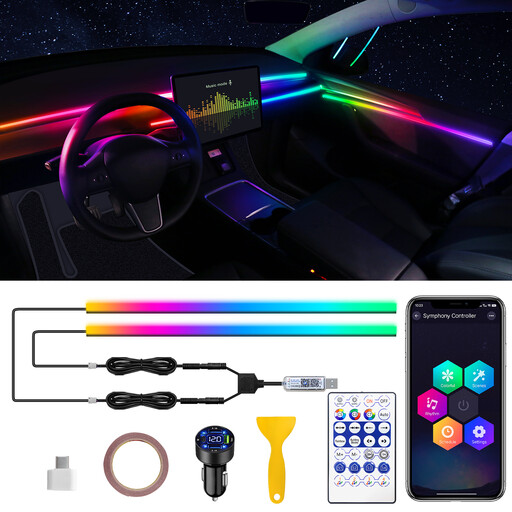
Why This Fits Their Persona: This user is a tech-savvy car enthusiast who wants full control over their lighting effects from their phone. They enjoy creating complex, dynamic scenes and syncing the lights perfectly with their music playlists during evening drives.
It uses an acrylic light strip with 600 LEDs, providing bright, uniform colour without hotspots. The system is managed via the "LED LAMP" app, offering deep customisation with RGB Smart IC "dreamcolor" chasing modes, avoiding the limitations of basic remotes.
The high density of LEDs ensures superior brightness and evenness. The kit is comprehensive, with a main controller and four sub-controllers for a clean, organised installation across the dash and doors.
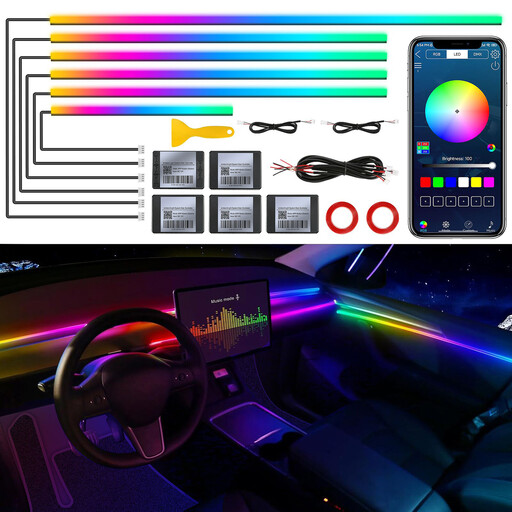
Why This Fits Their Persona: This driver wants the flexibility of app control but also values having a physical, integrated way to quickly change modes or turn the system off without reaching for their phone. They appreciate thoughtful design features that make daily use more convenient.
This kit avoids over-reliance on a single control method. While it has a full-featured app ("LotusLamp X"), it also includes a hidden touch button for quick, tactile control, preventing frustration if the app is not immediately accessible.
The dual-control system (app and touch button) is a significant practical benefit. It also features dual-zone control, allowing you to set different colours or modes for the main acrylic strips and the footwell/door handle lights simultaneously.
We have compiled a complete, real-time list of products that fully satisfy these strict selection criteria and UK safety regulations.
Yes, it is generally legal to install and use ambient lighting inside your car. However, there are important rules to follow. The light must not be so bright that it distracts you or other drivers. It is illegal for the lights to show colours like flashing blue, red or green on the exterior of the vehicle, as this can mimic emergency services. As long as the lighting is contained within the cabin and is not a distraction, it is permitted.
LED lighting is very energy-efficient. Most car led strip lights run on the car's 12V system and draw a very small amount of power. When your car is running, the alternator will easily power them with no noticeable effect. When the engine is off, they will draw from the battery, but the consumption is so low that it is unlikely to drain a healthy battery unless left on for many days. Many kits also include an auto-off or low-power standby mode.
Most modern kits are designed with DIY installation in mind. The thin acrylic strips are made to be pushed into the gaps between your dashboard and door panels, often without needing any adhesive. The main challenge is connecting the system to a 12V power source. This is typically done by wiring it to the fuse box. If you are not comfortable with basic car electrics, it may be wise to have it professionally installed, but for many enthusiasts, it is a manageable weekend project.