
24/7 Customer Support

Free returns

Same-day & Next-day Delivery

Quality Guaranteed

Unlock Your Welcome Offers: FREE Delivery | Up to 80% OFF | Free 30-day JoyPlus trial
Download the APP
As a Joybuy Product Recommendation Officer, I see many car enthusiasts in the UK looking to add a personal touch to their vehicle's cabin. The appeal of car interior ambient lighting, once a feature reserved for high-end luxury models, is now accessible to everyone. However, the market is flooded with options and it's easy to make a purchase you'll later regret.
This guide is designed to help you navigate the choices and avoid the common pitfalls that lead to wasted money and a disappointing result. We'll focus on the practical details that separate a quality installation from a short-lived gimmick.
Before you add anything to your basket, be aware of these frequent issues with aftermarket lighting kits:
To ensure you get a system that looks great and lasts, focus on these three core parameters.
The technology used to create and spread the light is the most important factor for achieving a premium look.
Consider how much of your interior you want to illuminate. A simple footwell lighting kit can add a subtle accent, while a comprehensive kit can transform the entire cabin.
A good universal car atmosphere light system should be modular. This means it uses a main controller connected to several smaller sub-controllers. This design ensures that every part of the system—from the long dashboard strip to the small door handle lights—receives adequate power and stays perfectly synchronised with the rest of the lights.
A reliable control system is non-negotiable. Look for kits that use a dedicated, well-reviewed app with a stable Bluetooth connection. Features like a car interior lights with music sync mode, which pulses the lights to the beat of your music, are a popular feature.
It's also wise to choose a kit that offers a physical backup control method, such as a small, hidden button, in case of any issues with your phone or the app. For power, most DIY car interior lighting kits can be plugged directly into a 12V socket (cigarette lighter), but for a cleaner, more permanent installation, they can be hardwired to the car's fuse box.
We've selected a few options from our catalogue, matching them to different user needs and project ambitions.
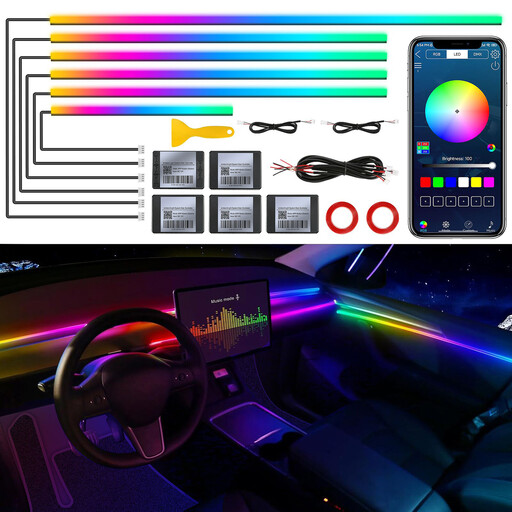
Why This Fits Their Persona: Ideal for someone new to car modifications who wants a significant visual upgrade without being overwhelmed. This kit provides the core lighting for the dashboard and all four doors, making it a manageable first project.
The use of acrylic light strips ensures a much more uniform and even glow compared to basic fibre optics, preventing the common "hotspot" issue and delivering a cleaner look.
Features Dreamcolor RGB Smart IC technology for dynamic chasing and flowing effects. Includes a physical touch button for backup control alongside the app.
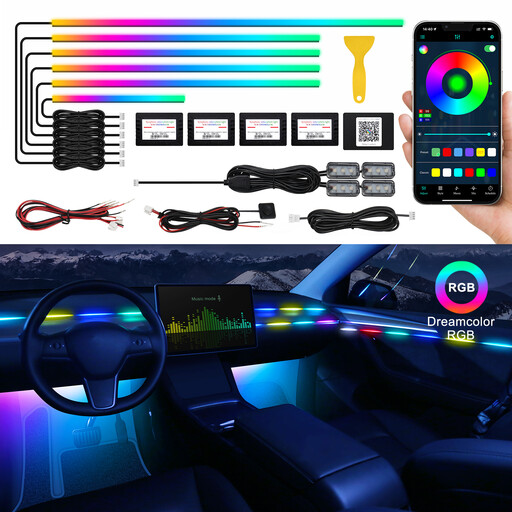
Why This Fits Their Persona: For the driver who wants a complete, immersive atmosphere. This kit expands on the basics by adding a dedicated footwell lighting kit, bathing the entire cabin in synchronised colour.
The modular system with main and sub-controllers ensures the additional footwell lights are perfectly synchronised with the dash and door strips, avoiding the mismatched colours or delays seen in piecemeal setups.
Provides comprehensive coverage for a full-cabin effect. The kit includes all necessary components, including four footwell lamps, for a complete and cohesive installation.
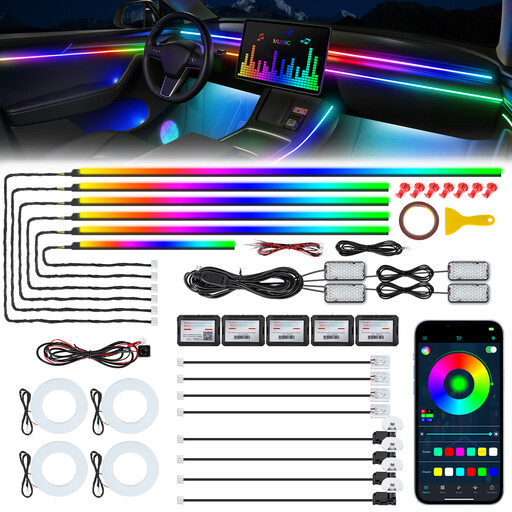
Why This Fits Their Persona: For the detail-oriented owner who wants to illuminate every possible accent line. This extensive kit includes dedicated lights for door handles, storage pockets and even speaker surrounds for the ultimate custom look.
A comprehensive multi-controller architecture is essential for a kit this large. It ensures stable power and perfect data synchronisation across all 22 pieces, preventing the flickering or colour errors that plague overloaded systems.
Offers an exceptional level of customisation with components for nearly every interior surface. It allows for a detailed, integrated lighting scheme that rivals factory systems in top-tier vehicles.
For most people, it's a manageable weekend project. The majority of the work involves carefully tucking the thin acrylic or fibre optic strips into the gaps between your car's interior panels. Most kits include a plastic pry tool to help with this. Powering the kit is usually as simple as plugging it into the 12V cigarette lighter socket. For a hidden installation, you can choose to hardwire it to the fuse box, which may require a bit more confidence with car electrics.
Modern LED lighting kits are incredibly efficient and draw very little power. When wired correctly to an "accessory" circuit (like the cigarette lighter or a specific fuse), the lights will only receive power when the car's ignition is on. This means there is no risk of them draining your battery while the car is parked.
They serve different purposes and achieve different looks. Simple adhesive LED strips can be very bright but often create visible dots of light ("hotspotting") and can look like an obvious add-on. Fibre optic car lighting, especially the newer acrylic-style guides, are designed to be hidden in panel gaps. They produce a more subtle, seamless and uniform line of light that closely mimics the sophisticated look of factory-installed ambient lighting systems. The choice depends on whether you want a bold, bright statement or a sleek, integrated glow.