
24/7 Customer Support

Free returns

Same-day & Next-day Delivery

Quality Guaranteed

Unlock Your Welcome Offers: FREE Delivery | Up to 80% OFF | Free 30-day JoyPlus trial
Download the APP
The standard interior of a car, while functional, often lacks personality. For many UK drivers, the cabin is a space where a lot of time is spent, and creating an environment that reflects your style can significantly enhance the driving experience. A car interior ambient lighting kit is a popular and effective way to modernise your vehicle, adding a touch of sophistication and customisation that was once reserved for high-end luxury models.
However, the market is filled with options, from simple plug-in strips to complex, multi-zone systems. This guide is designed to help you understand the key features to look for, so you can select a kit that matches your vehicle, your technical skills and your desired aesthetic. We will explore different lighting technologies, kit sizes and control features to help you make an informed choice.
Navigating the specifications of a DIY car lighting kit can seem daunting. Here are a few key points to focus on to ensure you get the right product for your project.
The technology used to deliver the light is crucial to the final look. While basic LED strips are common, many modern kits now use acrylic or fibre optic car lighting for a more refined finish.
Many of the latest kits combine these technologies, using bright acrylic strips for the main lines and smaller, dedicated LEDs for areas like footwells and door handles.
The "X-in-1" number on a product listing refers to the total number of individually controlled light pieces or zones in the kit. Understanding this helps you match the kit to your ambitions.
The way you interact with your lights is just as important as the lights themselves. Modern kits have moved beyond simple remotes.
Here are a few options that showcase the different features and configurations available, helping you find a suitable match for your vehicle upgrade project.

Why It Stands Out: This is one of the most comprehensive kits available, designed for the enthusiast who wants to leave no part of the interior untouched. The 22-in-1 configuration includes lighting for the centre console, doors, footwells, storage boxes and even speaker horns, creating a truly immersive environment. Its dual-zone control is a standout feature, allowing you to set different colours and modes for the main acrylic strips and the accent lights simultaneously.
Pros:
Who is it for? The dedicated car modifier aiming for a complete, professional-grade lighting installation with maximum coverage and customisation options.
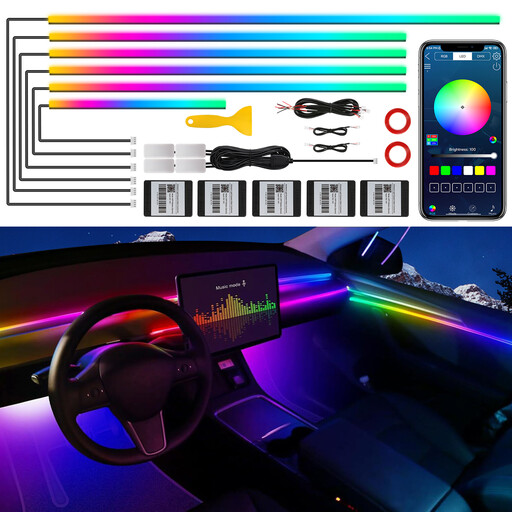
Why It Stands Out: This 14-in-1 kit offers a fantastic balance between extensive coverage and manageable installation. It provides the most impactful lighting elements—dashboard and door strips, footwell lamps and door handle lights—without the extra wiring required for storage bins and speaker grilles. It still delivers the high-end look and feel with bright acrylic strips and full app control.
Pros:
Who is it for? The car enthusiast who wants a significant upgrade that goes beyond the basics, covering the doors and footwells for a premium feel, but doesn't require the complexity of the 22-in-1 kit.

Why It Stands Out: This 6-in-1 kit is an excellent entry point into the world of high-quality ambient lighting. It focuses on the core components: six acrylic strips for the dashboard and doors. What makes it unique is its dual-control system. You get full customisation via the "LotusLamp X" app, plus a discreetly hidden touch button for quick colour changes or turning the system on and off without reaching for your phone.
Pros:
Who is it for? Drivers new to car lighting or those who want to achieve the modern, dynamic Dreamcolor effect on their dashboard and doors with a simpler, more focused installation.
The kits highlighted here represent some of the most popular configurations, but the world of custom car lighting is vast. If you're looking for different features or kits with a particular focus, such as powerful music sync LED lights, you can explore a wider collection to find the perfect fit for your project.
1. Are car interior ambient lighting kits difficult to install? Most modern kits are designed as a DIY car lighting kit. They typically come with a plastic pry tool to help you tuck the thin acrylic or fibre optic strips into the gaps between interior panels for a clean, wire-free look. Power is usually drawn from the car's 12V socket (cigarette lighter) or can be hardwired to the fuse box for a more permanent setup. While a basic 6-in-1 kit can be installed relatively quickly, more comprehensive kits will naturally require more time and care.
2. Can LED interior lights drain my car battery? LEDs are extremely energy-efficient and consume very little power. The kits are designed to operate off a 12V DC supply and draw a minimal current. Most systems only receive power when the ignition is on. Even those with a memory function to save your last setting draw a negligible amount of power when the car is off, so they should not drain a healthy car battery.
3. Are RGB car interior lights legal in the UK? Generally, interior ambient lighting is legal in the UK, provided it does not distract the driver or create confusion for other road users. The key is that the light should not be directly visible from the outside of the vehicle, nor should it flash in colours like red or blue, which could be mistaken for an emergency vehicle. It is always a good practice to check the latest DVLA guidelines to ensure full compliance.