
24/7 Customer Support

Free returns

Same-day & Next-day Delivery

Quality Guaranteed

Unlock Your Welcome Offers: FREE Delivery | Up to 80% OFF | Free 30-day JoyPlus trial
Download the APP
Adding a custom glow to your car's interior can completely transform the driving experience, turning a standard cabin into a personalised space. However, the market for car interior ambient lighting kits is flooded with options, and it's easy to make a purchase you'll later regret. As the Joybuy Product Recommendation Officer, my role is to help you navigate the choices and find a kit that delivers on its promises without the common pitfalls.
Before you add anything to your basket, let's look at the frequent issues that UK drivers encounter. Understanding these will help you sidestep disappointment and wasted money.
To ensure you get a high-quality, long-lasting lighting system, focus on these key technical specifications.
The biggest factor in light quality is the strip itself. While older kits used simple fibre optics, modern systems have moved towards a superior technology:
How you interact with your lights is crucial. Most kits offer a combination of control methods:
These numbers refer to the total number of lighting components in the box. A basic kit might only cover the dashboard and centre console, while a more comprehensive one can illuminate the entire cabin.
Based on these criteria, here are a few options tailored to different types of car enthusiasts.
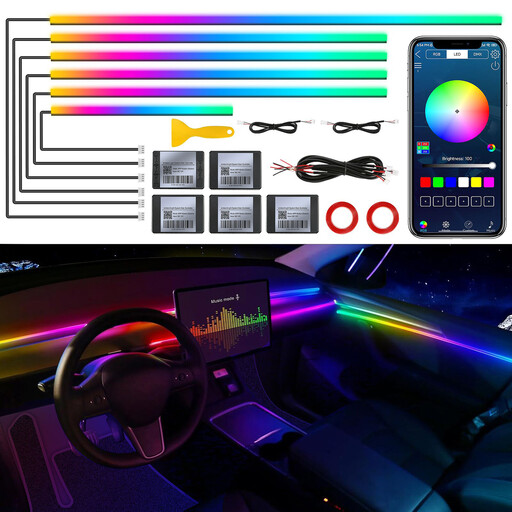
Why This Fits Their Persona: This kit is an excellent entry point for someone new to car lighting modification. It provides coverage for the main visual areas (dashboard and doors) without the complexity of a larger kit, making for a straightforward weekend project.
It uses modern acrylic strips with embedded LEDs, ensuring you get a bright, uniform glow across the entire length and avoiding the "fading light" flaw of basic fibre optics.
Features RGB-IC "Dreamcolor" technology for dynamic chasing effects, usually found in more expensive kits. It also includes both app and physical button controls for convenience.
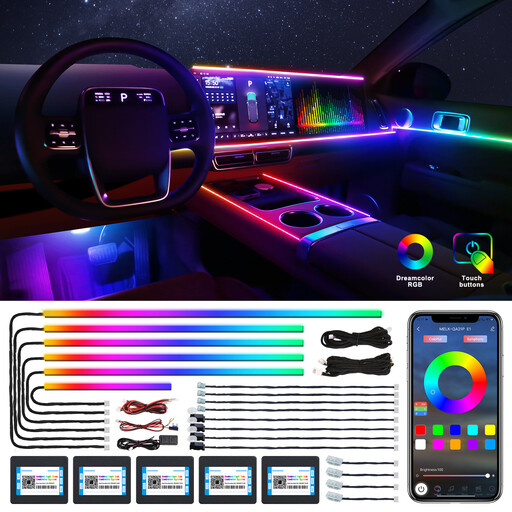
Why This Fits Their Persona: For the driver who wants a complete, immersive lighting experience. This 18-in-1 kit provides total cabin coverage, including dashboard strips, door strips, footwell lights, door handle lights and even lights for the door storage boxes.
Despite its complexity, this kit uses a modular system with a main controller and four sub-controllers. This simplifies wiring, preventing the "tangled mess" and allowing for a much cleaner installation.
Offers dual-zone control via the app, allowing you to set different colours and modes for the main strips versus the accent lights (footwells, handles), enabling highly creative and personalised lighting schemes.
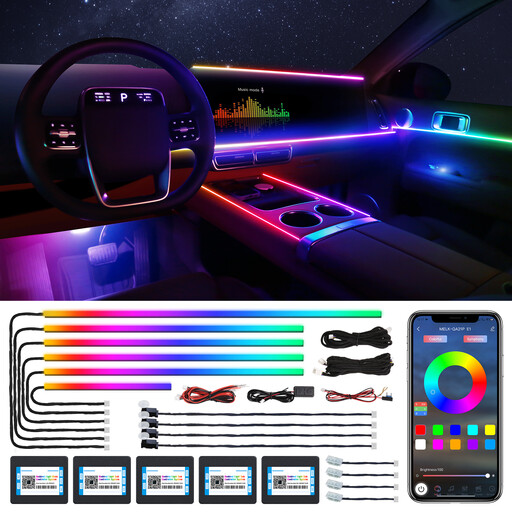
Why This Fits Their Persona: This user prioritises advanced features and smooth performance. The 14-in-1 kit offers a great balance of coverage and technology, with a focus on responsive music sync and customisable animations controlled through the "LotusLamp X" app.
It addresses the "unreliable app" pitfall by using a well-established control app and providing multiple control methods, including discreet touch buttons, ensuring you're never locked out of basic functions if your phone isn't to hand.
The built-in high-sensitivity microphone for the sound-active function provides accurate music synchronisation. The dual-zone control also allows for sophisticated, multi-layered lighting effects that react to your music.
We have compiled a complete, real-time list of products that fully satisfy these strict selection criteria and UK safety regulations.
Yes, the vast majority of modern kits are designed for DIY installation. They typically include a plastic pry tool to help you tuck the thin edge of the acrylic strips into the gaps between your car's interior panels. For power, many kits offer a simple 12V plug that goes into your car's cigarette lighter socket, requiring no wiring knowledge.
This is a common concern, but it's generally not an issue. These kits use low-power LEDs that draw a minimal amount of current. Furthermore, they are designed to be connected to an ACC (accessory) power source. This means they only turn on when the key is in the ignition and turned to the accessory position or when the engine is running. They will not draw power when the car is completely switched off.
The lifespan of an LED is typically very long, often rated for tens of thousands of hours. The more likely point of failure in a low-quality kit is the controller box or the power connections. By choosing a kit with features like short-circuit protection and a low-heat design, you can expect it to last for many years.