
24/7 Customer Support

Free returns

Same-day & Next-day Delivery

Quality Guaranteed

Unlock Your Welcome Offers: FREE Delivery | Up to 80% OFF | Free 30-day JoyPlus trial
Download the APP
Upgrading your car's interior with custom lighting can transform your driving experience, adding a touch of modern sophistication that was once reserved for premium vehicles. However, the market for aftermarket car interior ambient lighting is flooded with options, and it's easy to make a purchase you'll later regret. Many kits promise a high-end look but deliver a lack of brightness, frustrating installation and unreliable performance.
As the Joybuy Product Recommendation Officer, my role is to help you navigate these choices. Before you add anything to your basket, let's look at the common pitfalls that UK drivers encounter and how to avoid them.
To ensure you get a high-quality, reliable system, focus on these three core parameters. They are the difference between a dazzling upgrade and a disappointing DIY project.
The most significant factor in light quality is the strip itself. Instead of basic fibre optic tubes, look for kits that use acrylic car LED strip lights. These strips have multiple LEDs embedded directly within them, encased in an acrylic diffuser. This design produces a far brighter, more consistent and softer glow that looks integrated and professional.
For the most dynamic effects, seek out kits with RGBIC (Red, Green, Blue, Independent Control) technology. Unlike standard RGB strips that can only show one colour at a time, RGBIC allows for multiple colours to be displayed on a single strip simultaneously. This is the technology that enables the popular "Dreamcolor" or chasing effects, where light appears to flow and dance along the strip.
A truly universal kit should be comprehensive. Before buying, check the contents list to ensure it meets your needs. A good fibre optic car lighting kit for a full-cabin installation should include:
The control system is your interface for the entire lighting setup. A reliable Bluetooth connection is non-negotiable. The companion app should offer a wide range of customisation, including:
Based on these criteria, we've matched a few standout options from our catalogue to different types of users.
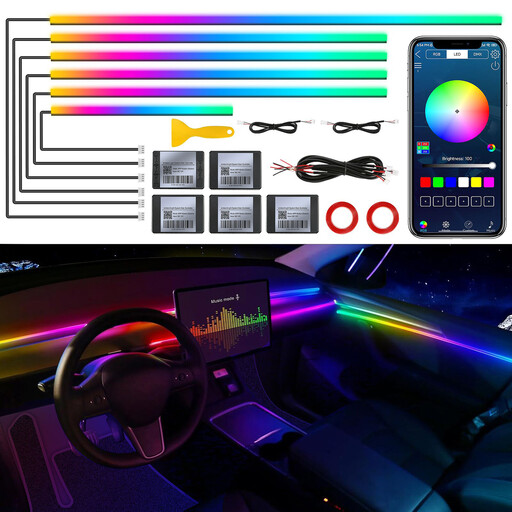
Why This Fits Their Persona: This is an ideal starting point for those new to car lighting modification. The 6-in-1 kit provides enough acrylic strips to cover the main dashboard and all four doors, offering a high-impact upgrade without the complexity of a 20-piece system. It's a manageable weekend project for a car enthusiast in the UK.
It uses modern acrylic strips with embedded LEDs, ensuring bright, uniform light across the dash and doors, steering clear of the dim, patchy look of basic fibre optics.
Includes RGBIC 'Dreamcolor' technology for dynamic chasing effects, a feature typically found in more expensive and complex kits. It offers a premium look on a budget.
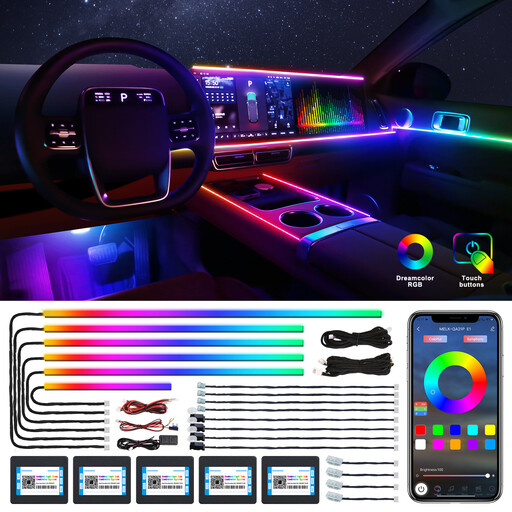
Why This Fits Their Persona: For the enthusiast who wants granular control and maximum impact. The 18-in-1 kit provides extensive coverage, including footwells and door storage bins, while the dual-zone function allows for creative, two-tone lighting schemes (e.g., blue dash, red footwells) controlled via the feature-rich app.
This kit avoids the "one-size-fits-none" problem by providing a comprehensive set of 18 components and modular controllers, ensuring a complete and tidy installation for almost any vehicle.
The standout feature is Dual-Zone Control. This allows separate customisation of different cabin areas simultaneously, offering a level of personalisation that single-zone kits cannot match.
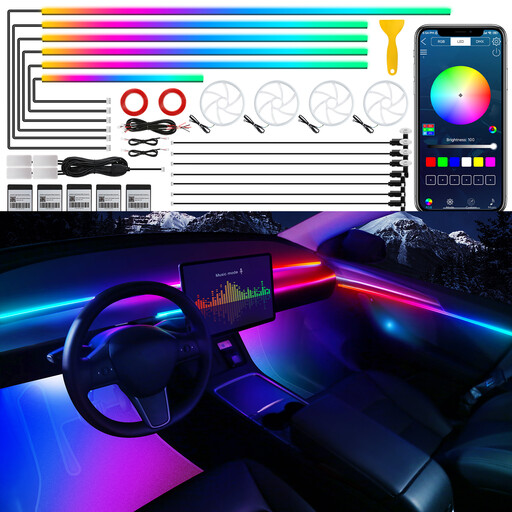
Why This Fits Their Persona: For the modifier who wants to illuminate every possible detail. This 22-in-1 kit is one of the most comprehensive available, including lights for the dashboard, doors, footwells, door handles, storage bins and even the door speaker grilles. It's designed for a complete, show-car-level transformation.
This kit completely eliminates the risk of an incomplete project. Its sheer number of components ensures you have a dedicated light for every part of the interior, providing a cohesive and fully integrated look.
Unmatched coverage. The inclusion of small, detailed lighting modules like those for door handles and speaker horns allows for a level of customisation that mimics high-end factory ambient lighting systems.
We have compiled a complete, real-time list of products that fully satisfy these strict selection criteria and UK safety regulations.
For most DIY-savvy individuals, installation is straightforward but requires patience. Most kits are designed to be tucked into the gaps between your car's interior panels using a provided pry tool. The most time-consuming part is often hiding the wires for a clean finish. Power can usually be sourced from the 12V cigarette lighter for a simple plug-and-play setup, or hardwired to the fuse box for a more permanent installation. Always test the lights before fully installing them.
High-quality LED lights have a very long lifespan, often rated for 30,000 to 50,000 hours of use. For the average driver, this means the lights will likely outlast the car itself. The lifespan is more often determined by the durability of the wiring and control modules rather than the LEDs themselves. Choosing a kit with good build quality is key.
When the car is running, the alternator provides more than enough power, so there is no risk of draining the battery. When the car is off, the power draw is a valid concern. Most modern kits have a very low standby power draw. For kits wired to the cigarette lighter, power is typically cut when the ignition is off. If you hardwire the kit, connecting it to a fuse that is only active when the car is on (an ACC-switched fuse) will prevent any battery drain.