
24/7 Customer Support

Free returns

Same-day & Next-day Delivery

Quality Guaranteed

Unlock Your Welcome Offers: FREE Delivery | Up to 80% OFF | Free 30-day JoyPlus trial
Download the APP
Adding custom lighting is one of the most popular ways to personalise a vehicle's interior, transforming a standard cabin into a space that reflects your style. However, the market for car interior ambient lighting is flooded with options, and it's easy to make a purchase you'll later regret. Many kits promise a high-end look but deliver a frustrating experience.
As the Joybuy Product Recommendation Officer, my role is to help you navigate the options and identify the key features that matter. Before you buy, be aware of these common pitfalls that can lead to wasted money and a disappointing result.
To ensure you get a lighting system that looks great and functions correctly, focus on these core parameters.
The technology used to diffuse the light is crucial for the final look.
How you interact with your lights determines their day-to-day usability.
Consider how the kit will be installed and powered in your vehicle. Most kits offer two options:
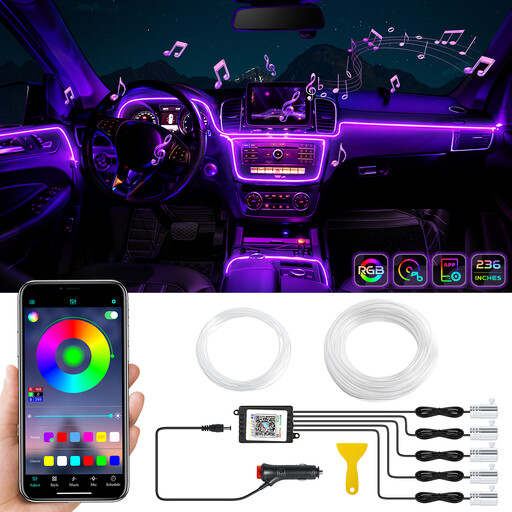
Why This Fits Their Persona: This is an ideal entry point for someone new to car modification. The 5-in-1 design is less complex than larger kits, and the single, long fibre optic tube offers flexibility for a simple dash and console installation without needing to manage multiple strips.
It avoids the "tangled wire trap" by using a simple 12V car charger for power and a single fibre optic line, minimising wiring complexity. The product description also gives a tip to add an LED at both ends if the light seems weak, acknowledging and offering a solution to the potential "hotspot" issue.
The generous 236-inch (6-metre) fibre optic line can be cut to size, providing great versatility for different car interiors. It offers modern features like app control and music sync in a straightforward package.
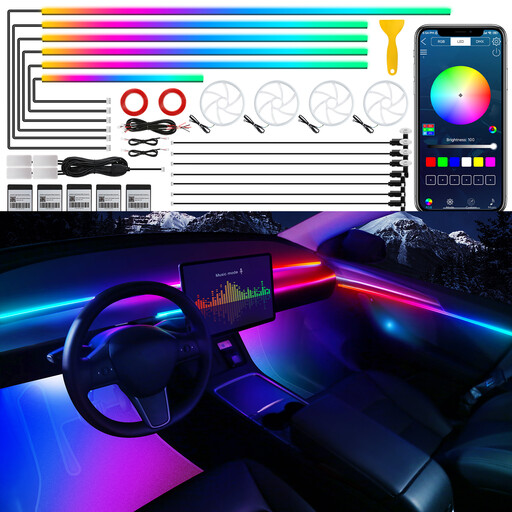
Why This Fits Their Persona: For the enthusiast who wants total cabin immersion, this 22-in-1 kit is the solution. It provides lighting for the dash, all four doors, footwells, door handles, storage bins and even speaker horns, creating a comprehensive and cohesive lighting theme.
This kit uses modern acrylic light strips, which provide a bright, uniform glow and directly solve the "hotspot" problem common in basic fibre optics. Its modular system with a main controller and four sub-controllers is designed for an organised, comprehensive installation, avoiding a chaotic mess of wires.
Its main advantage is the sheer completeness of the kit. The inclusion of dual-zone control via the app allows for sophisticated lighting schemes, such as setting the dash to a different colour from the footwells, offering a high degree of customisation.
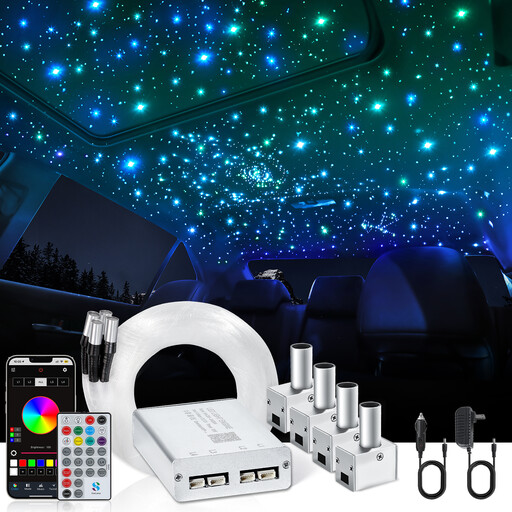
Why This Fits Their Persona: This is for the car owner looking beyond simple trim lighting to create a truly high-end, "show car" atmosphere. A starlight headliner kit replicates the starry sky effect found in ultra-luxury vehicles, making a bold and impressive statement.
This is a specialised kit for a specific, advanced project, not a simple strip light. The 4-port light engine is designed to provide even illumination for up to 1000 fibre points, preventing the dim, sparse look of underpowered starlight kits. It's an involved installation, and the product is transparent about this.
It delivers a genuine starry sky effect with a huge number of individual light points. The powerful app control offers dynamic modes like twinkle and fade, plus sound activation, providing a level of customisation far beyond standard rgb car interior lights.
We have compiled a complete, real-time list of products that fully satisfy these strict selection criteria and UK safety regulations.
Most modern car atmosphere lights are designed to be highly energy-efficient. When connected to the ACC circuit, they only draw power when the car's ignition is on. If connected to a 12V socket that is always live, it's advisable to unplug the kit or ensure it's switched off when leaving the car for extended periods to prevent any minor battery drain. All kits operate on a low-heat 12V system, which is standard for vehicle accessories.
Installation difficulty varies. A simple kit using a 12V plug can be fitted in under an hour, typically involving tucking the light strips or fibres into the gaps between interior panels with the provided tool. More comprehensive kits, especially a starlight headliner kit, are significantly more involved. This requires removing the headliner, drilling hundreds of small holes and carefully routing the fibres, making it a project for a confident DIY enthusiast. Always test the lights before final installation.
Neither is definitively "better"; they suit different goals.