
24/7 Customer Support

Free returns

Same-day & Next-day Delivery

Quality Guaranteed

Unlock Your Welcome Offers: FREE Delivery | Up to 80% OFF | Free 30-day JoyPlus trial
Download the APP
A car interior ambient lighting kit can transform a plain cabin with colourful trim lighting, footwell illumination and music-responsive effects. However, product listings often make similar kits look interchangeable. The practical differences usually appear during installation, app setup and everyday use.
Before buying, UK drivers should look beyond claims such as “16 million colours” or “universal fit”. Check the power requirement, light-strip construction, included components and whether the installation suits your vehicle’s trim.
A 5- or 6-metre fibre optic cable may sound generous, but it may need to be divided between several sections. Some kits use one LED at each end of a fibre, while others use several LED emitters or independent acrylic strips.
This affects brightness and layout. If you want lighting across the dashboard, four doors and the footwells, compare the actual number of strips and light zones, not just the total cable length. A kit designed for footwell and door-handle lights will normally offer more structured coverage than a single loose RGB car LED strip light.
Cars, SUVs, vans and trucks have different trim gaps, consoles and door-panel layouts. A strip that tucks neatly into one dashboard may be too thick for another. Some acrylic car interior LED lights are approximately 11.7 mm wide, while fibre optic tubing may require a suitable channel or gap.
Also check the power source. Most car atmosphere lights are designed for 12V interior car lights or a 12V accessory socket. A vehicle with a 24V electrical system should not be connected directly without an appropriate converter. Test the kit before hiding wires or pressing trim back into place.
Sound-activated car lights respond to audio captured by a microphone. They can change colour with music or voice, but they are decorative effects rather than a substitute for road lighting. Fast flashing or highly distracting animations may be unsuitable when driving on public roads.
Keep illumination away from the windscreen, mirrors, instrument readings and any area where reflections could affect visibility. Follow the vehicle manufacturer’s guidance and applicable UK lighting and road-safety requirements.
Look for the stated operating voltage and connector type. The reference kits here specify 12V DC, with some listings giving a 10–16V operating range. Do not assume a USB-powered household strip is suitable for a vehicle unless the product specifically supports it.
For a cleaner installation, some kits can be connected through an accessory circuit, but hardwiring should only be undertaken if you understand automotive electrical connections. A plug-and-play cigarette-lighter setup is easier to remove and reduces modification to the vehicle.
Fibre optic car ambient lighting generally channels light from LED units through a transparent fibre or tube. It can be cut and tucked into dashboard or door-trim gaps, but excessive bending or folding can reduce light transmission or damage the material.
Acrylic strips use a light bar or acrylic lens to distribute illumination along the strip. Product listings describe this format as providing a more even visual line, while modular sections can be positioned around the cabin. Check the minimum bend radius, thickness and approved cut points before installation.
Wireless app-controlled car lights may use Bluetooth and an app such as Lotus Lantern, LotusLamp X or another named application. Confirm that the app supports your phone’s operating system and that the controller can be paired before installation.
Useful control features include:
A single controller is usually simpler. Multi-controller systems offer broader coverage and independent zones, but they also involve more cables, connection points and installation decisions.
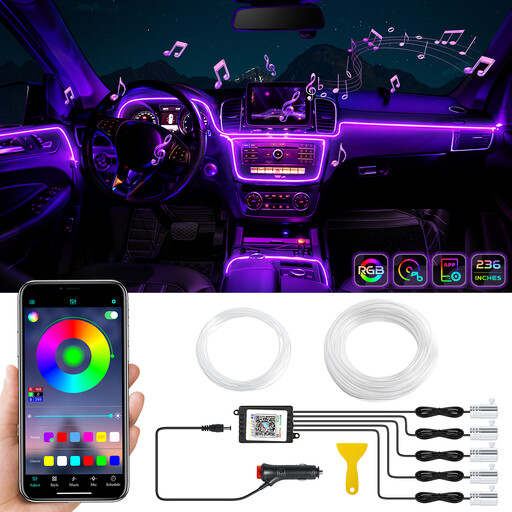
Why This Fits Their Persona: A straightforward option for drivers who want app-controlled RGB lighting without a large multi-zone installation. The 236-inch fibre line can be divided for dashboard or trim-gap placement.
The listing identifies the fibre length, five LED lights, 12V use, included pry tool and app connection process, making the installation scope clearer than a generic light string.
Bluetooth app control, sound-sensitive mode, 29 preset modes and a cuttable optical-fibre layout.
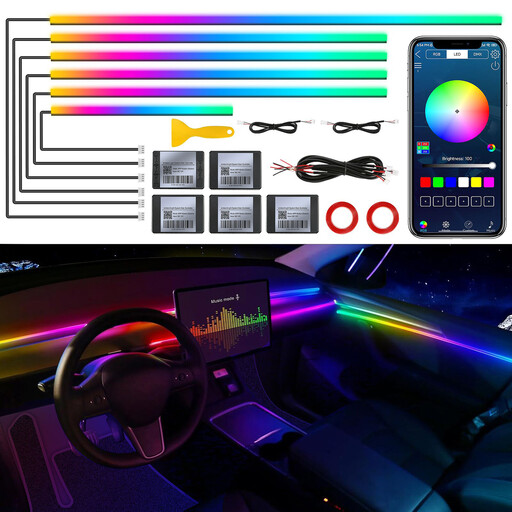
Why This Fits Their Persona: Suitable for enthusiasts seeking a more structured acrylic installation across the dashboard and four doors, with colour effects managed from a phone.
Its stated configuration lists six acrylic sections, a main controller and four sub-controllers. This helps buyers plan zones instead of estimating coverage from LED count alone.
RGB Smart IC effects, Bluetooth app control, touch-button control and separate area settings.
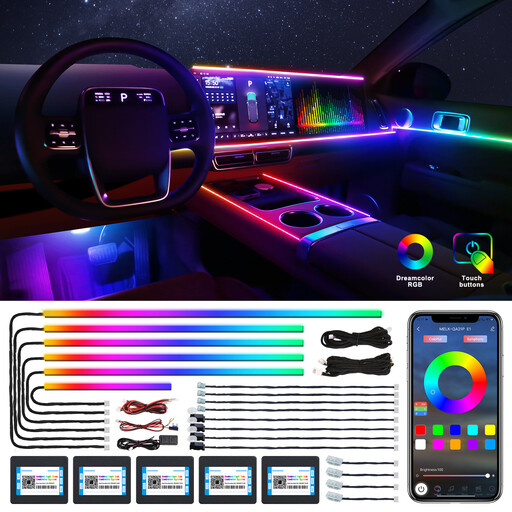
Why This Fits Their Persona: A broader cabin layout for owners of larger cars, SUVs, vans or trucks who want dashboard, door, footwell and storage-compartment lighting.
The package specifies four footwell lamps, four door-handle lights and four storage-box lights, so the included coverage is easier to match to a larger interior.
Six acrylic strips, multiple controllers, sound-active effects and separate control for different lighting areas.
For extra flexibility, browse the wider strip lighting range, but compare each product’s power input and intended environment before choosing a non-automotive strip.
We have compiled a complete, real-time list of products that fully satisfy these strict selection criteria and UK safety regulations.
Plug-and-play kits are generally more approachable for DIY installation because they use an accessory socket and supplied tools. The time required depends on how much trim must be loosened and whether you are fitting only dashboard lighting or adding door, storage-box and footwell zones. Always follow the supplied instructions and avoid interfering with airbags or vehicle wiring.
Consumption varies by LED count, brightness, strip length and animation mode. The product listing should provide electrical specifications; where wattage is not stated, ask the seller before estimating running costs. Using a lower brightness and switching the kit off when the engine is not running can reduce unnecessary battery drain.
Lifespan depends on heat, vibration, moisture, cable handling and installation quality. Avoid folding or sharply bending fibre, secure loose wiring and keep controllers away from spills. Inspect connectors periodically, particularly in doors and footwells, where movement and damp conditions can place greater strain on components.