
24/7 Customer Support

Free returns

Same-day & Next-day Delivery

Quality Guaranteed

Unlock Your Welcome Offers: FREE Delivery | Up to 80% OFF | Free 30-day JoyPlus trial
Download the APP
A car interior ambient lighting kit can transform a plain cabin with coloured dashboard lines, subtle footwell illumination and music-responsive effects. However, product listings often use similar phrases for very different systems. A low-cost strip may be suitable for a quick decorative project, while a multi-zone acrylic kit can require careful routing, several controllers and a suitable 12V power connection.
For UK drivers, the purchase decision should involve more than colour selection. Check the installation method, power requirements, app compatibility and whether the lighting can be positioned without distracting you while driving.
A listing may highlight hundreds of LEDs, but that number does not automatically indicate how much of your car will be illuminated. Some systems use a central light source with fibre optic cable, while others distribute LEDs along an acrylic strip. The result can differ in brightness and uniformity.
Before buying, check the actual strip lengths and included components. A kit described as 175 inches may include several shorter sections rather than one continuous strip.
Wireless app-controlled car lights generally refer to Bluetooth control, not wireless power. The controller and light sections still need a connection to a 12V supply, such as the accessory socket or an ACC fuse installation. Multi-controller kits may also require extension leads between the dashboard, doors and footwells.
If you want a tidy factory-style finish, allow time to hide wiring behind trim. For a simpler project, choose a system that can remain powered through the 12V socket.
RGB car LED strip lights may support iOS and Android, but app names and pairing procedures vary. Some use Bluetooth rather than home Wi-Fi, so control distance is limited inside or close to the vehicle. Sound-reactive functions also rely on a microphone and may respond to surrounding noise rather than only the car stereo.
Cutting is another common source of disappointment. Acrylic and fibre optic strips should only be cut where the product instructions permit. Cutting through a resistor or bending an optical strip too sharply can result in dim sections or unsynchronised colours.
Most car systems in this category are designed for 12V DC. Confirm that your vehicle provides a compatible supply. A 24V commercial vehicle should not be connected directly unless a suitable step-down converter is used.
Check whether the kit uses:
A hardwired installation can look cleaner, but it may be better handled by a qualified automotive installer. Test the lights before fitting them permanently, as recommended in the supplied product information.
Dreamcolor acrylic LED strip systems are designed to sit in narrow trim gaps and can produce a continuous illuminated line. Fibre optic car interior lights usually transmit light from LED sources through a cable, which can be flexible but may need careful positioning for consistent brightness.
Measure your trim gaps before ordering. The product information for some acrylic systems describes an ultra-thin profile, but the exact fit can still vary between saloons, SUVs, coupés, pick-ups and vans. Do not force a strip into a gap that is too narrow, and avoid folding or sharply creasing fibre optic material.
Look beyond the phrase “16 million colours”. Useful questions include:
For everyday driving, a dim static setting is generally less distracting than rapid flashing or high-brightness effects. Position car footwell lights, car door handle lights and LED car neon lights so they do not obstruct instruments, mirrors, controls or your view of the road. Interior modifications should also be secured so cables cannot interfere with pedals or seat movement.
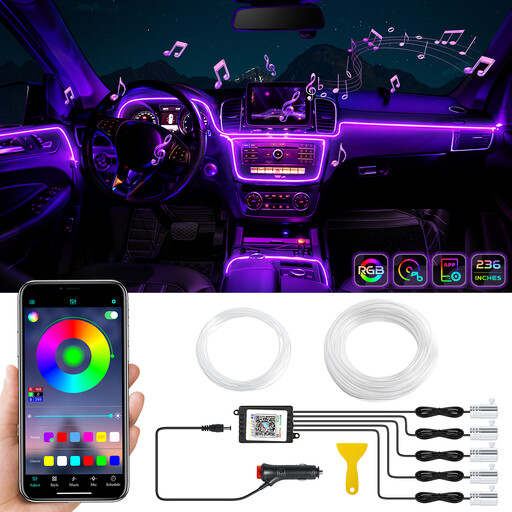
Why This Fits Their Persona: A practical starting point for UK vehicle owners wanting multicolour car interior lights without immediately committing to a larger door-and-footwell package. The 6-metre fibre optic line can be divided into several sections.
The stated 10–16V operating range and 12V car charger specification make the power requirement clear. The listing also explains how the fibre can be arranged into three to five strips.
Bluetooth app control, 29 preset modes, brightness and timing adjustment, plus a built-in sound sensor.
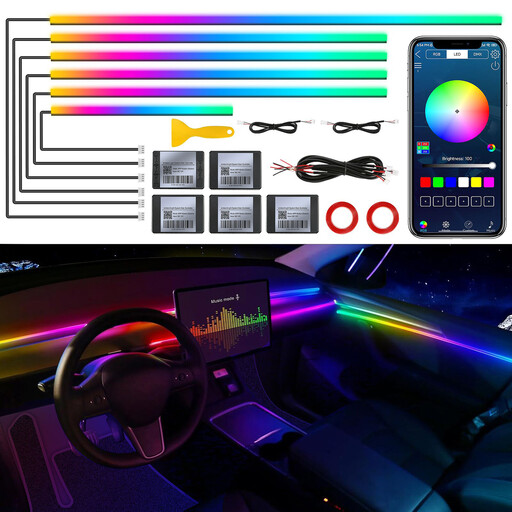
Why This Fits Their Persona: Suits customisation fans seeking a more structured dashboard and door installation, with separate controllers for different areas of the cabin.
Its specification lists six acrylic sections, 593 LEDs, one main controller and four sub-controllers, rather than presenting only a headline length.
RGB Smart IC chase effects, static colours, app and touch control, music sensing, voice control and timed activation are listed features.
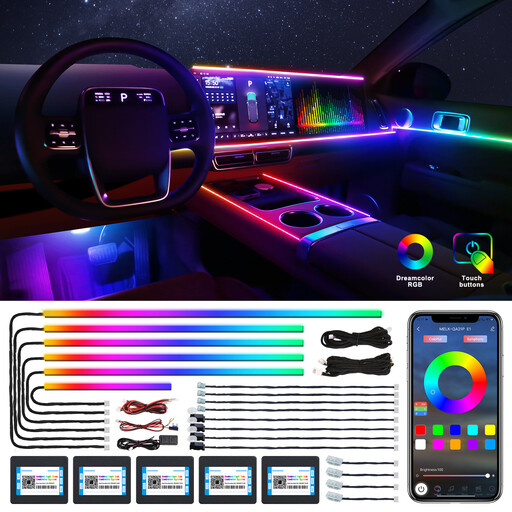
Why This Fits Their Persona: Designed for drivers who want coordinated dashboard, footwell, door-handle and storage-box illumination across a larger cabin such as an SUV, van or family vehicle.
The package contents identify four footwell, four door-handle and four storage-box lights, helping buyers assess coverage before ordering.
The listed 175-inch system supports dual-zone control, 593 LEDs, five extension cords and multiple installation areas.
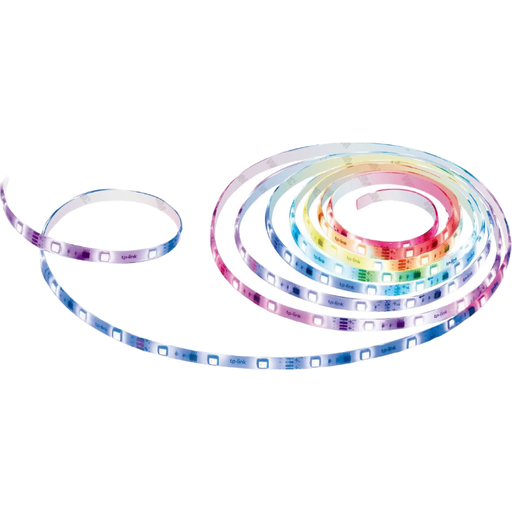
Why This Fits Their Persona: A home-focused option for desks, TVs, bedrooms and gaming rooms rather than vehicle trim. It is suitable when Wi-Fi, scheduling and voice control matter more than 12V car installation.
The product uses a mains adapter and home Wi-Fi, so it is not presented as a car kit requiring an unsuitable vehicle power connection.
The listed features include 50 colour zones, app control, presets, timers, voice control and cut-to-length installation at marked points.
We have compiled a complete, real-time list of products that fully satisfy these strict selection criteria and UK safety regulations.
Interior decorative lighting is not automatically prohibited, but it must not distract you, obstruct your view or create a hazard. Avoid positioning lights where they interfere with dashboard readings or controls, and use restrained settings while driving. Check the specific requirements for your vehicle and installation.
Lifespan depends on operating temperature, power stability, moisture exposure, adhesive quality and how often the lights are used. A secure installation, the specified voltage and sensible ventilation can help avoid premature failure. Keep spare connectors and protect wiring from repeated movement.
A small LED system generally draws less power than many conventional vehicle accessories, but the exact consumption varies by LED count, brightness and the number of active zones. Use the supplied controller and power source, and avoid leaving the kit running when the engine is off for extended periods to reduce battery drain.