
24/7 Customer Support

Free returns

Same-day & Next-day Delivery

Quality Guaranteed

Unlock Your Welcome Offers: FREE Delivery | Up to 80% OFF | Free 30-day JoyPlus trial
Download the APP
A car interior ambient lighting kit can transform a plain cabin with colour-changing dashboard strips, footwell lights and door accents. However, product listings often emphasise LED counts and colour modes while leaving out details that affect installation, compatibility and long-term usability.
Before buying, check the power requirements, strip construction, controller layout and cutting instructions. The right kit should suit your vehicle’s interior gaps and your preferred installation method, rather than simply offering the longest product description.
A high number of LEDs does not automatically mean an even light line. Some fibre optic systems place light sources at intervals, which can produce dimmer areas along longer sections. Acrylic car LED strip lights use an acrylic lens to spread light along the strip, while traditional fibre optic car ambient lighting normally transfers light from one or more LED sources through a separate fibre.
For a consistent dashboard or door-trim effect, look for details such as:
A kit may be described as suitable for cars, SUVs, vans and trucks, but the interior gaps can vary considerably. Check whether the strip can fit behind your dashboard trim and door panels. Some acrylic strips are thicker than ordinary flexible tape, so measure narrow gaps before ordering.
Also confirm the vehicle’s power supply. Most products in this category are 12V car interior lighting, designed for a cigarette-lighter socket or a suitable accessory circuit. A 24V commercial vehicle may require an appropriate step-down converter. Do not connect a lighting kit to a higher voltage than specified.
Wireless app-controlled car lights are convenient, but app compatibility and controller design matter. Some kits use “LED LAMP”, “Lotus Lantern”, “LotusLamp X” or similar applications, depending on the product version. Check the listing and instructions before installation, then confirm that your phone supports the required iOS or Android version and Bluetooth connection.
A built-in microphone can enable music-sync car lights, but the sensor responds to sound captured near the controller. It may react differently depending on cabin noise, audio volume and controller placement. Treat sound activation as an additional effect rather than a guaranteed synchronised connection to the vehicle’s audio system.
Acrylic strips can provide a visible, continuous light line when correctly tucked into trim gaps. They are bendable, but product instructions commonly warn against folding them sharply or bending them in half. Plan the route before cutting, particularly around corners, air vents and door hinges.
Many Dreamcolor car LED lights include six main sections measuring approximately 4 × 29.5 inches, 1 × 43.3 inches and 1 × 14 inches. This arrangement can cover a dashboard and door areas, but the layout will depend on your cabin size.
Look for a clearly stated DC 12V working voltage and a controller with features such as short-circuit protection and memory function. These features describe the product design; they do not replace correct installation or vehicle-specific electrical advice.
For a simple setup, a cigarette-lighter connection may be suitable if the kit supports it. A concealed ACC-fuse connection can create a cleaner appearance, but hardwiring should be carried out only if you understand automotive electrical systems or use a qualified installer. Keep cables away from pedals, seat rails, steering components and airbags.
A basic RGB strip may change the entire length to one selected colour. RGB Smart IC or Dreamcolor systems can offer chasing, bouncing, flashing and other segment-based effects. Some multi-controller kits also support separate zones for the main strip, footwell lights, door handle lights and storage compartments.
Count the included components rather than relying on “in 1” wording. A larger kit may include:
Before cutting, test every strip. Follow the marked cutting points and leave the required allowance around resistors or end components, as an incorrect cut can cause part of the strip to become dim or lose colour synchronisation.
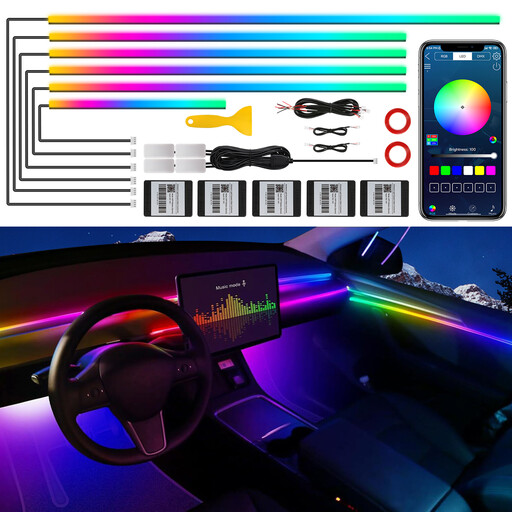
Why This Fits Their Persona: A practical entry point for drivers wanting app control, RGB colour selection and sound-reactive effects without choosing a larger multi-zone package.
It specifies six acrylic strips, a main controller and four sub-controllers, rather than presenting LED quantity alone as the deciding feature.
12V operation, Bluetooth app control, music sensor, memory function and cuttable acrylic strip design.
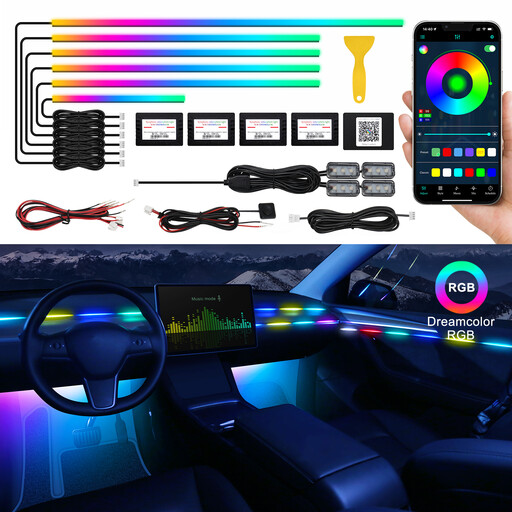
Why This Fits Their Persona: Suits modifiers who want a more complete cabin layout with coordinated dashboard, footwell and door-handle illumination.
The listing identifies separate footwell sections and a multi-controller arrangement, helping buyers plan a cleaner installation across the cabin.
593 LEDs, RGB Smart IC effects, static colour mode, 16 million colour options and dual-zone control.
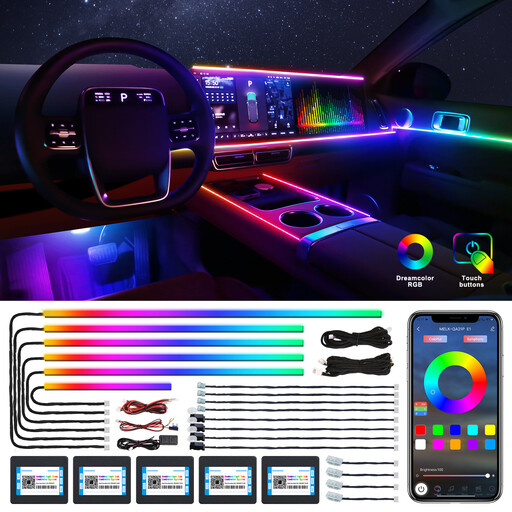
Why This Fits Their Persona: Designed for owners of larger cars, SUVs, vans or trucks who want lighting beyond the dashboard and footwells.
The package includes footwell, door-handle and door-storage lighting, reducing the need to combine unrelated kits and controllers.
593 LEDs, four footwell lamps, four door-handle lights, Bluetooth control and sound-active modes.
We have compiled a complete, real-time list of products that fully satisfy these strict selection criteria and UK safety regulations.
Test the kit before hiding the controller or inserting strips into trim. Clean and dry the installation surface, route cables securely and avoid obstructing airbags or vehicle controls. Acrylic components should not be sharply folded, and adhesive may not hold reliably on dusty, textured or damp surfaces.
Ambient lighting should support cabin decoration without distracting the driver. Select a brightness level that does not create glare or interfere with visibility, and check any relevant requirements for your vehicle and intended road use. Do not operate a phone app while driving; set the colour and mode before moving.
Most kits operate from a 12V accessory supply and use relatively little power compared with major vehicle systems. Actual consumption varies by LED count, brightness and effect. Avoid leaving the lights connected when the engine is off for long periods, as any accessory lighting can contribute to battery drain.
Many listed kits are cuttable, but only at the specified end or marked points. Leave the recommended allowance around resistors and test the strip first. Cutting in the wrong place may create a dim section or prevent colours from synchronising.
Usually, the built-in microphone detects nearby sound rather than receiving a direct audio signal from the stereo. Performance can vary with volume, road noise and controller placement. For reliable operation, position the controller where it can detect cabin audio while keeping it safely concealed.