
24/7 Customer Support

Free returns

Same-day & Next-day Delivery

Quality Guaranteed

Unlock Your Welcome Offers: FREE Delivery | Up to 80% OFF | Free 30-day JoyPlus trial
Download the APP
A car interior ambient lighting kit can add colour around the dashboard, doors and footwells without replacing factory trim. However, product listings often focus on LED counts and colour modes while overlooking installation limits, power requirements and the difference between acrylic light guides and conventional fibre optic cable.
For UK motorists, the right choice should suit the vehicle’s interior layout, offer manageable wiring and remain unobtrusive while driving. Here is what to check before buying RGB car interior lights, wireless app-controlled car lights or car LED strip lights.
A high LED figure does not automatically mean better illumination. Light distribution, lens material and the position of the light source also affect the visible result. A strip with an acrylic lens can spread light along its length, while some fibre optic systems rely on LEDs at one or both ends.
Check whether the listing describes:
Many kits are described as suitable for cars and lorries, but dashboard and door trim gaps vary considerably. A strip may be too thick for a narrow seam, or the supplied cables may not reach rear footwells without extensions.
Measure the intended installation route first. Also check whether the product uses a cigarette-lighter connection, USB adapter or hardwired 12V feed. A kit intended for a standard 12V vehicle should not be connected directly to a 24V system without suitable conversion equipment.
Music-sync car lights normally use a built-in microphone rather than taking a direct audio signal from the vehicle. This means the response can vary with cabin volume and microphone placement. Bluetooth pairing may also require a specific app, such as LotusLamp X, Lotus Lantern or LED LAMP.
Cutting requires care too. Some acrylic LED strips can be trimmed only at designated points. Cutting through a resistor or the wrong end can leave part of the strip unlit or out of sync.
Most options in this category are 12V car interior lights, designed for passenger cars, SUVs, vans and pick-ups with a suitable accessory power supply. Confirm the voltage range in the product listing before installation.
For a tidier finish, an experienced vehicle electrician can connect the kit to an ACC-controlled supply. For a simpler DIY installation, a 12V socket may be more practical. Keep wiring away from pedals, steering components, seat rails and airbags. Interior decorative lighting should not create glare or distract the driver, and local road-use requirements should always take priority.
An acrylic LED strip light for car interiors can create a continuous illuminated line when tucked into dashboard or door trim gaps. The listed acrylic profile must fit the available space; do not force it into a seam that is narrower than the strip.
Traditional fibre optic car ambient lighting can be more flexible in some layouts, but it may require careful routing, transparent tubing and concealed LED sources. Avoid folding optical fibre sharply, as this can interrupt light transmission.
Compare the actual contents rather than relying only on “6-in-1”, “14-in-1” or “22-in-1” wording. Useful details include:
A larger kit may offer fuller coverage, but it also involves more wiring and more installation time.
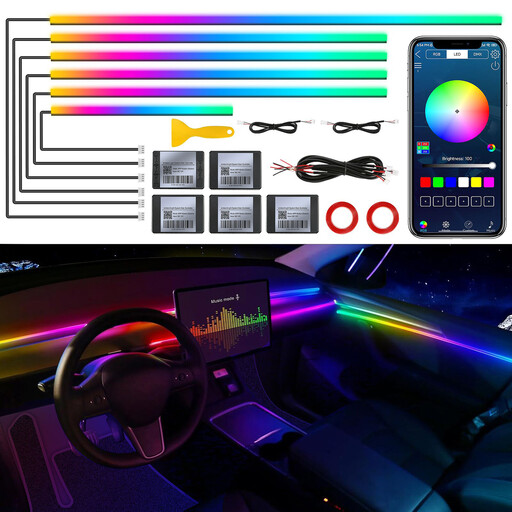
Why This Fits Their Persona: A straightforward option for first-time DIY motorists who want dashboard and door lighting without a large selection of extra modules.
The package lists six acrylic strips, a main controller and four sub-controllers, so the buyer can assess coverage before ordering.
12V operation, Bluetooth app control, music sensor and cuttable acrylic strips.
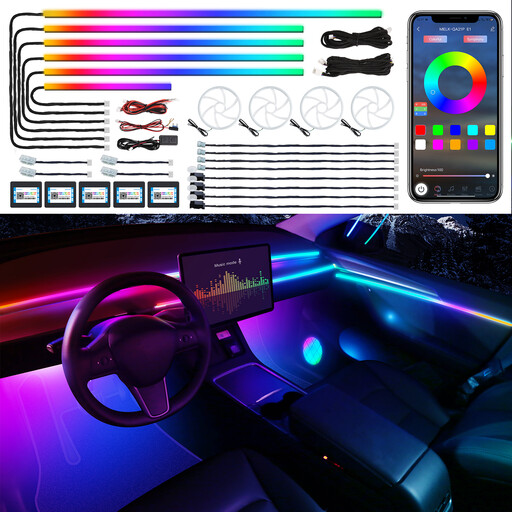
Why This Fits Their Persona: Suits owners styling a larger cabin who want coordinated dashboard, footwell, door-handle, storage-box and door-horn lighting.
The listed package specifies the additional door and footwell modules, reducing uncertainty about what the “22-in-1” description includes.
593 LEDs, dual-zone control, 16 million colour selection and Bluetooth control for iOS and Android.
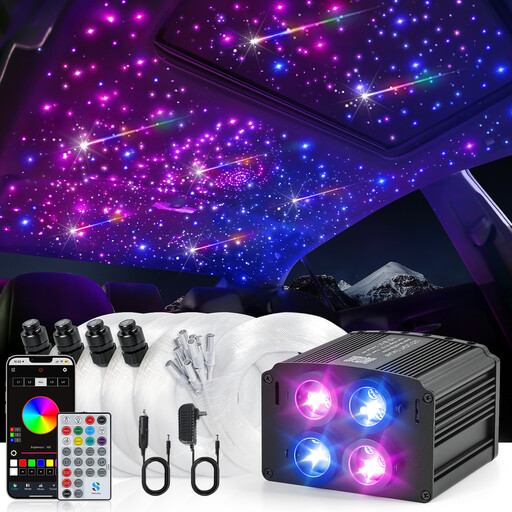
Why This Fits Their Persona: Designed for motorists seeking a roof-focused decorative installation rather than simple footwell lights or dashboard strips.
The listing explains that installation involves removing the headliner, drilling fibre openings and placing the light engine in a ventilated area.
Includes 1,000 fibre strands, 240 meteor strands, four-colour control, app operation and an RF remote.
We have compiled a complete, real-time list of products that fully satisfy these strict selection criteria and UK safety regulations.
Before fitting, test every strip and controller outside the trim. Then:
Dashboard and footwell kits can suit careful DIY installation, particularly when they use a 12V socket and supplied pry tool. Door panels, headliners and hardwired ACC connections require more preparation. If trim removal or vehicle electrics are unfamiliar, professional installation may reduce the risk of damaged clips or wiring.
Most RGB LED kits are designed for low-voltage 12V operation, but consumption varies by LED count, brightness and the number of active modules. Switching the kit off when the vehicle is parked helps avoid unnecessary battery drain, especially where the power connection is not ignition-controlled.
Lifespan depends on heat, moisture, vibration, installation quality and how often the kit operates at maximum brightness. Avoid sharply bending acrylic or fibre optic sections, protect connectors and follow the specified voltage. These steps can help maintain consistent colour and illumination over time.