
24/7 Customer Support

Free returns

Same-day & Next-day Delivery

Quality Guaranteed

Unlock Your Welcome Offers: FREE Delivery | Up to 80% OFF | Free 30-day JoyPlus trial
Download the APP
A car interior ambient lighting kit can add colour to the dashboard, doors and footwells without major modification. However, attractive product listings often hide practical differences. A strip described as “universal” may not suit narrow trim gaps, while a music-sync feature may respond to cabin noise rather than your vehicle’s audio system.
Before buying, focus on the installation method, power requirements and included lighting zones—not just the number of colours or advertised modes.
A higher LED figure does not automatically mean a more even finish. Some fibre optic kits use separate LED sources connected to sections of optical fibre, while acrylic car interior lights use illuminated acrylic strips. The result can differ in brightness, glow distribution and how discreetly the strip sits in the trim.
Check the actual strip lengths and included components. A kit with six strips measuring 4 × 29.5 inches, 1 × 43.3 inches and 1 × 14 inches may be more useful than a longer single cable if you want separate dashboard and door sections.
Wireless app control normally refers to Bluetooth communication between your phone and the controller. The lighting still needs a power connection, commonly a 12V car supply, cigarette lighter socket or an ACC fuse connection.
Multi-controller kits can also involve extension cables and separate power connections. Plan where the main controller, sub-controllers and wiring will sit before removing trim panels.
Acrylic and fibre optic strips should not be folded sharply. Excessive bending can interrupt light transmission or damage the strip. Some cuttable designs also require you to cut only at suitable points and leave additional length near a resistor.
Measure the trim gaps first. A strip that is too thick may not sit securely, while a loose installation can create visible edges, rattles or exposed wiring.
Acrylic car interior lights generally use an acrylic lens or strip to distribute light from LEDs along the visible section. They are suited to dashboard lines, door trim and centre consoles where you want a defined illuminated edge.
Traditional fibre optic car ambient lighting can be more flexible for custom layouts, but the visible brightness depends on how the fibre is connected to its LED source. Some kits include a transparent tube, separate emitters and a longer fibre line that you cut into sections.
For a cleaner DIY installation, check whether the product includes a pry tool, adhesive tape, extension leads and enough LED sources for the planned zones.
Wireless app-controlled car lights commonly use Bluetooth and support iOS and Android. Features may include static colours, brightness adjustment, chasing patterns, timers and scene modes. Some kits also include a hidden touch button for basic on/off or colour changes.
A built-in microphone enables music-sync car lights, but it usually detects sound near the controller. Test the sensitivity before final installation, especially in a noisy cabin. Music synchronisation should be treated as an optional effect rather than a precise connection to the vehicle’s audio system.
Most products in this selection specify 12V DC operation. Confirm this matches your vehicle’s supply before connecting. A 24V truck, bus or specialist vehicle may require an appropriate step-down converter, and any hardwiring should be completed safely with suitable fusing.
Look for practical details such as a stated operating temperature range, short-circuit protection and low-heat operation. Ambient lighting should not obstruct instruments, warning lights, pedals, windows or the driver’s view. Avoid intense or distracting settings while driving and follow your vehicle manufacturer’s guidance.
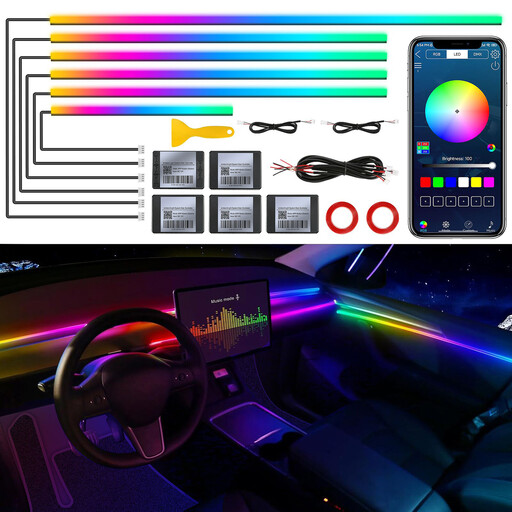
Why This Fits Their Persona: A straightforward starting point for drivers who want dashboard or door ambience without a large multi-zone package. It specifies six acrylic strips, Bluetooth app control and 12V operation.
The stated strip configuration makes coverage easier to plan than relying on a single long fibre cable. Test the sections before fitting and avoid sharp folds.
Six acrylic strips; app and hidden touch-button control; static and dynamic colour modes.
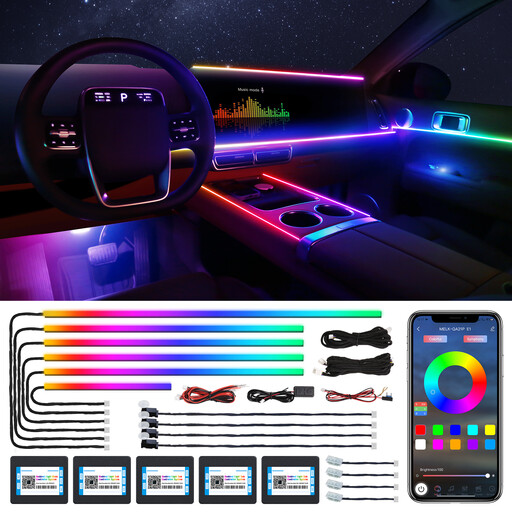
Why This Fits Their Persona: Suitable for owners seeking a coordinated cabin finish across dashboard, footwell and door-handle areas, with separate controllers for a more organised installation.
The package lists four footwell lights and four door-handle lights, helping prevent the surprise of needing extra accessories for those zones.
175-inch kit; dual-zone control; Bluetooth app; sound-active mode; stated 12V working voltage.
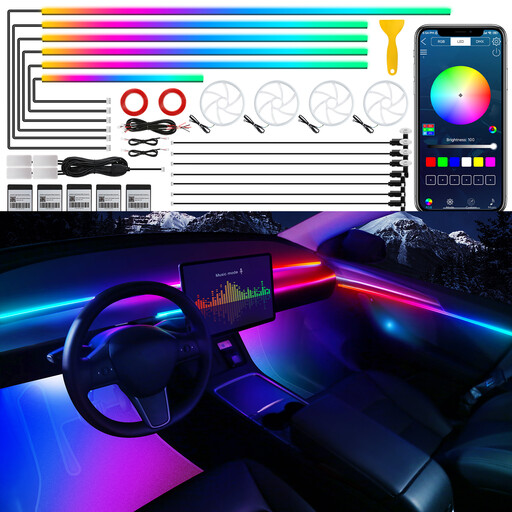
Why This Fits Their Persona: A substantial option for larger cabins, SUVs, vans and vehicle modifiers wanting footwell, door-handle, storage-box and door-speaker zones.
The included zone count is clearly stated, reducing the risk of buying a basic strip and later adding separate car footwell lights or door lights.
Six main acrylic strips; four footwell, four door-handle, four storage-box and four door-horn lights; dual-zone effects.
We have compiled a complete, real-time list of products that fully satisfy these strict selection criteria and UK safety regulations.
Interior lighting is generally subject to safe installation and responsible use. Do not allow lights to obstruct the driver’s view, instruments or controls, and avoid settings that create distraction or excessive glare. Check relevant vehicle requirements if you hardwire the kit or make wider electrical modifications.
The exact draw depends on the number of active LEDs and brightness setting. These kits are designed for a 12V supply, but the product’s electrical specification should be checked before connection. If the vehicle battery is older or the lighting is used for long periods while parked, monitor battery condition.
Several listed kits are designed to be cut to length, but cutting must follow the product instructions. Avoid cutting through resistors or unsuitable sections, and leave the recommended extra length. Test the strip after cutting before completing the installation.