
24/7 Customer Support

Free returns

Same-day & Next-day Delivery

Quality Guaranteed

Unlock Your Welcome Offers: FREE Delivery | Up to 80% OFF | Free 30-day JoyPlus trial
Download the APP
A car interior ambient lighting kit can add colour to a dashboard, centre console, doors and footwells without a permanent modification. However, product listings often use similar phrases for very different systems. A low price may conceal limited coverage, difficult wiring or an app that does not work as expected.
Before buying RGB car LED strip lights for a car, SUV, truck or RV, check the installation design, power requirements and control system rather than relying on phrases such as “neon”, “Dreamcolor” or “16 million colours”.
A listing may advertise 175 or 236 inches of fibre optic cable, but the kit may divide this between several shorter strips, connectors and light sources. Check the individual lengths and included accessories. A kit with separate sections for the dashboard, doors and footwells may be more practical than one long strip that is difficult to route neatly.
Wireless app control normally refers to Bluetooth communication between your phone and the controller. The lights still require a power connection, commonly through a 12V car power socket, USB adapter or a professionally installed ACC connection. Multi-controller kits can also require extension cables between the main controller and sub-controllers.
Acrylic fibre optic strips are flexible, but they should not be folded sharply or bent in half. Some cuttable products must only be shortened at suitable points, with additional length left to avoid damaging a resistor or affecting colour synchronisation. Test every section before hiding it behind trim.
For most universal car interior LED ambient lights, a 12V DC input is a key specification. Confirm that the kit is compatible with your vehicle’s accessory socket or intended power adapter. Do not connect a product to a higher voltage source. If you plan to hardwire it to an ACC fuse, installation should be completed according to the vehicle and product instructions.
Look for practical protections such as short-circuit protection, a memory function and clear operating-temperature information. A listing that mentions low heat or water resistance does not mean the controller or every connection can be exposed to moisture.
Wireless app-controlled car lights are useful when you want to change colour, brightness, timing or animation from the driver’s seat while parked. Check whether the product uses Bluetooth, which mobile operating systems it supports and the recommended connection distance.
Some kits also include a hidden touch button, allowing basic colour or power changes without opening the app. This can be helpful if Bluetooth pairing is inconvenient.
Compare the number of lighting sections, not only the LED count. A kit may include:
Dual-zone control lets the main strip and auxiliary areas display different colours or modes. Music sync car lights and sound-activated car lights respond to sound captured by a microphone, so their reaction can vary with cabin volume and road noise.
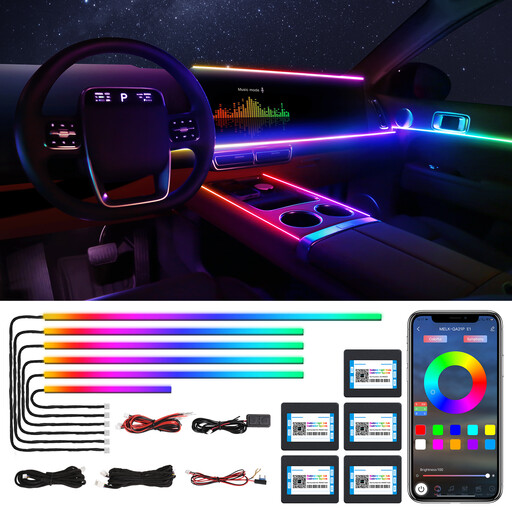
Why This Fits Their Persona: A straightforward starting point for UK drivers who want dashboard or door accents without a larger multi-light package. It includes six acrylic strips, Bluetooth app control and a 12V specification.
The product information states the strip layout, 12V input and Bluetooth pairing steps, making the expected setup clearer than a generic single-strip listing.
App colour and mode control; sound-active function; included pry tool and adhesive tape.
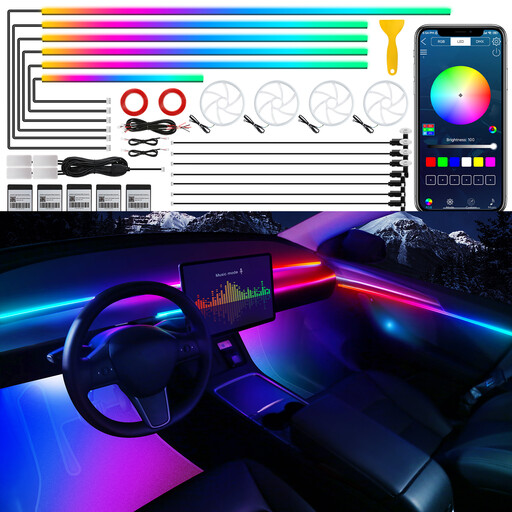
Why This Fits Their Persona: Suitable for customisers seeking broader cabin coverage across the dashboard, footwells, door handles, storage compartments and door speaker areas.
The package lists separate light areas, one main controller, four sub-controllers and extension cords, helping buyers plan a multi-zone installation.
RGB Smart IC chase modes; dual-zone colour control; footwell, door-handle, storage-box and door-horn lights.
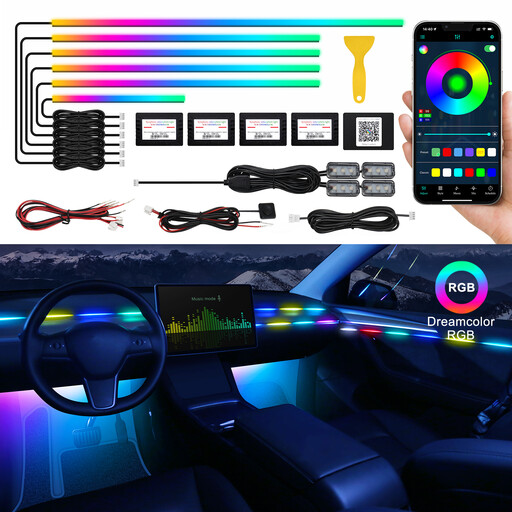
Why This Fits Their Persona: A practical match for SUV, truck and RV owners wanting dashboard coverage plus four footwell lamps and a modular controller arrangement.
Its listed sections and 12V design make it easier to compare against a larger cabin before purchase. The product notes also explain that the acrylic strip should not be sharply folded.
Four footwell lamps; app and touch-button control; sound-responsive and chasing modes.
We have compiled a complete, real-time list of products that fully satisfy these strict selection criteria and UK safety regulations.
Test the kit before attaching strips behind trim. Clean and dry the installation surface, use the supplied pry tool carefully and keep wires away from pedals, airbags, hinges and moving seat mechanisms. For a factory-style finish, hide the controller and route cables behind removable panels rather than leaving loose wiring around the centre console.
A 12V LED kit generally uses less energy than conventional interior bulbs, but actual running cost depends on power draw, brightness, the number of sections active and how long the vehicle is switched on. Avoid leaving lights powered when the engine is off, particularly if the vehicle battery is older.
Interior accent lighting is generally used for decoration, but it must not obstruct the driver’s view, distract the driver or interfere with vehicle controls. Avoid bright settings while driving and follow the product instructions. Check the packaging for applicable UK conformity information rather than assuming that a listing’s “safe” wording confirms compliance.
Many 12V car interior lighting kits are designed for DIY installation using an accessory socket, adhesive and a trim tool. App-controlled modular kits can still involve several cables and controllers. If you plan to use an ACC fuse or alter factory wiring, seek suitable automotive installation support.
Lifespan depends on heat, vibration, moisture, connection quality and how often the kit is used. Avoid sharply bending acrylic fibre optic strips, keep connectors dry and do not exceed the specified voltage. Testing the system before final installation can also prevent hidden faults from being difficult to access later.